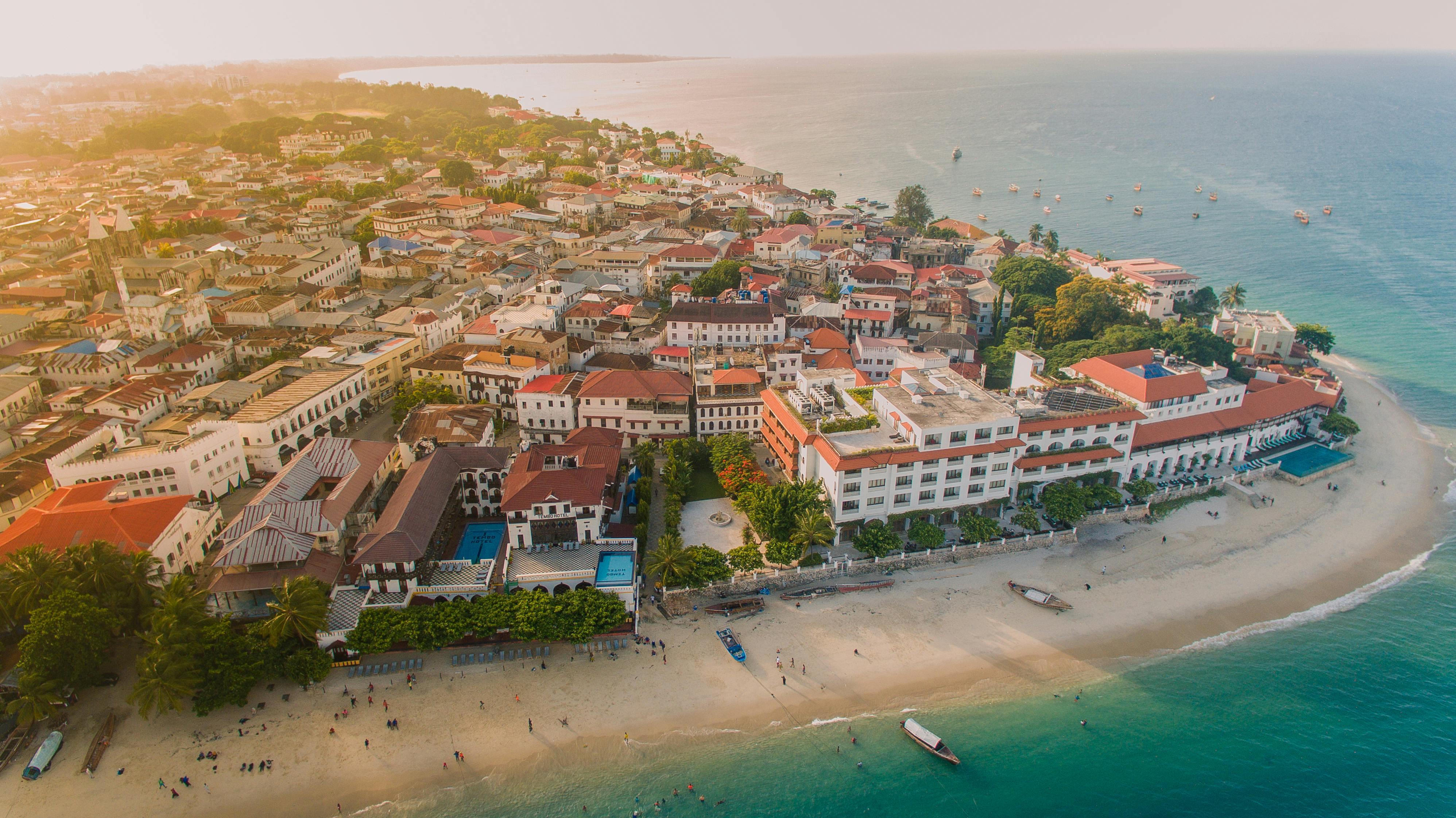
Stone Town · Jozani · Paje · Jambiani · Matemwe · Nungwi · Kendwa · 13 min read
Zanzibar 7 Day Itinerary: Stone Town, Paje and Nungwi
7 days · 3 cities
Duration
7 days
Estimated budget
800 to 1,300 dollars per person, no flights
Best time to go
June to October and December to February
Visa
Tanzania visa, 50 dollars, on arrival
This 7 day Zanzibar itinerary splits the island into three bases: Stone Town, Paje on the east coast and Nungwi in the north. Moving twice is the decision that shapes the week, because the tide decides which beach you can swim from, and when.
In short: two days of city, spices and Jozani on the way east, Jambiani and The Rock, then Mnemba and sunsets in the north. Visa, insurance, timing and food are at the end.
Day 1: arriving in Stone Town, the fort and the night market
The Old Fort: the 17th century Omani stronghold

Free to enter the courtyard, 1 hour, 15 minutes by car from the airport. Start here after checking in: the lanes of Stone Town have no street signs, and the fort is the landmark everything runs from.
The Omanis raised these coral rag walls between 1698 and 1701, right after driving out the Portuguese, who had held the island for two centuries. The courtyard now holds an amphitheatre, craft stalls and cafes, and is where the city's festivals happen.
House of Wonders: the palace under scaffolding next door

Quick stop, 20 minutes, 100 metres from the fort. The building has been closed and wrapped in scaffolding since part of the facade and the tower collapsed in December 2020, and restoration continues with support from the Aga Khan Trust for Culture.
It is worth pausing for the scale of it: when Sultan Barghash built it in 1883 it was the first building in East Africa with electric light and a lift, and the largest on the Swahili coast.
Forodhani Gardens: the food market that opens at sunset

Free to enter, 1h30, right next to the fort. Stalls go up around 6pm as the sun drops and stay until 9pm or 10pm. It is the cheapest and liveliest dinner in town.
Order the Zanzibar pizza, which is not a pizza: thin dough stuffed with minced meat, egg and cheese, folded and fried on a griddle. The rule that saves your stomach: eat what comes hot off the griddle, from the stall with a queue of locals, and be wary of seafood platters that have been sitting out for hours.
Day 2: the history of Stone Town and Changuu Island
Christ Church Cathedral: the slave market that became a church

About 1h15, guide included in the ticket, open from early morning. The Anglican cathedral was built from 1873 directly on top of East Africa's largest slave market, closed that same year under British pressure on Sultan Barghash.
The altar stands where the whipping post was, used to test how much pain people up for sale could take. In the basement of a building next door, two chambers remain where dozens were held before auction, with ceilings too low to stand under. It is the hardest and most necessary visit on the island.
Darajani Market: fish, fruit and spices

Quick stop, 30 minutes, 200 metres from the cathedral. Open since 1904, this is where the city shops: mounds of mango and rambutan, sacks of clove and cinnamon, and the fish hall at the back, which smells exactly as you are imagining.
Go in the morning, when the catch has just landed, and agree a price before accepting anything put in your hand.
Changuu Island: giant tortoises and the prison that never was

About 4 hours including the boat, which leaves from the beach in front of Forodhani; island entry around 4 dollars plus the shared boat. Head out after lunch and be back for sunset.
The 1893 building was designed as a prison but never held prisoners: it became a quarantine station for ships carrying yellow fever. The real draw is the Aldabra giant tortoises, a gift from the British governor of the Seychelles in 1919, some more than a century old with their birth year painted on the shell.
Boats usually stop at the Nakupenda sandbank on the way, which disappears completely at high tide. Confirm with the boatman that the stop is included before you pay.
Day 3: Stone Town to Paje, through the spice farms and Jozani
Kizimbani spice farm: why they call it the spice island

About 2 hours with a guide, 15 to 20 dollars per person, 25 minutes north of Stone Town. Leave at 9am with your bags in the car: the day ends on the east coast.
The guide scrapes bark off the trunk and holds it out to smell: cinnamon, nutmeg, cardamom, pepper, vanilla, annatto. Zanzibar was once the world's largest clove producer, planted with slave labour from the 1820s, and that monoculture shaped the island's economy until tourism arrived. Packaged spices sold at the end are good and cheap, but skip the soaps and oils at airport prices.
Jozani Forest: the monkey that lives nowhere else

Entry around 10 to 12 dollars with the compulsory guide, 1h30, 30 minutes from Kizimbani and 20 from Paje. It is the only national park on Unguja, the main island.
The Zanzibar red colobus exists nowhere else in the world, and only a few thousand remain. They sit metres from the trail in troops, and guides ask for three metres of distance, both to protect you and to keep human disease away from them. The second half of the visit is a boardwalk over the mangrove, across the road.
Day 4: Jambiani, The Rock and the tide at Paje
Jambiani: the seaweed farms and village life

Free, 2 hours, 15 minutes south of Paje. Go at low tide, when the women of the village wade into the lagoon to tend the stakes where red seaweed grows, sold to the cosmetics and food industries.
Seaweed farming is now one of the main sources of income for women on the east coast, and a community centre in Paje turns part of the harvest into soap. Walking through the village, between coral houses and beached boats, shows the Zanzibar that exists outside the resorts. Ten minutes away is Kuza Cave, a limestone cavern with turquoise fresh water and a Swahili cultural centre, which charges a couple of dollars and rarely makes it into itineraries.
The Rock: the restaurant on a rock in the sea

Lunch around 30 to 50 dollars per person, 1h30, 30 minutes north of Paje at Michamvi Pingwe. Book days ahead and ask about the tide when you do: at low tide you walk across the sand, at high tide a small boat covers the 20 metres.
A dozen tables sit on a coral outcrop and the kitchen is essentially fish and seafood. You are paying for the setting rather than the cooking, and it is still worth one meal. If the price stings, eat on Bwejuu beach and come to look at the rock from the shore.
Paje beach: kitesurfing and the tide that redraws the shore

Free, the rest of the afternoon. Paje is the island's kitesurfing capital: the reef holds back the waves, the wind blows steadily from June to September and from December to March, and schools charge around 70 to 90 dollars for a private lesson.
If you are not sailing, understand the tide before complaining about the sea: at low tide the water pulls back hundreds of metres and the beach becomes a sand flat of pools and starfish; at high tide the turquoise pool returns. The two hours either side of high tide are the swimming window.
Day 5: Paje to Nungwi, stopping at Matemwe
Matemwe beach: the northeast coast facing Mnemba

Free, 1 hour, an hour by car from Paje and 40 minutes from Nungwi. It is the natural stop on the transfer day, and the beach the Mnemba boats leave from.
Matemwe is a long fishing village with scattered hotels and no nightlife at all. The tide pulls back here too, but the view of Mnemba atoll on the horizon is the best on the island.
Nungwi dhow yard: boats built by hand on the sand
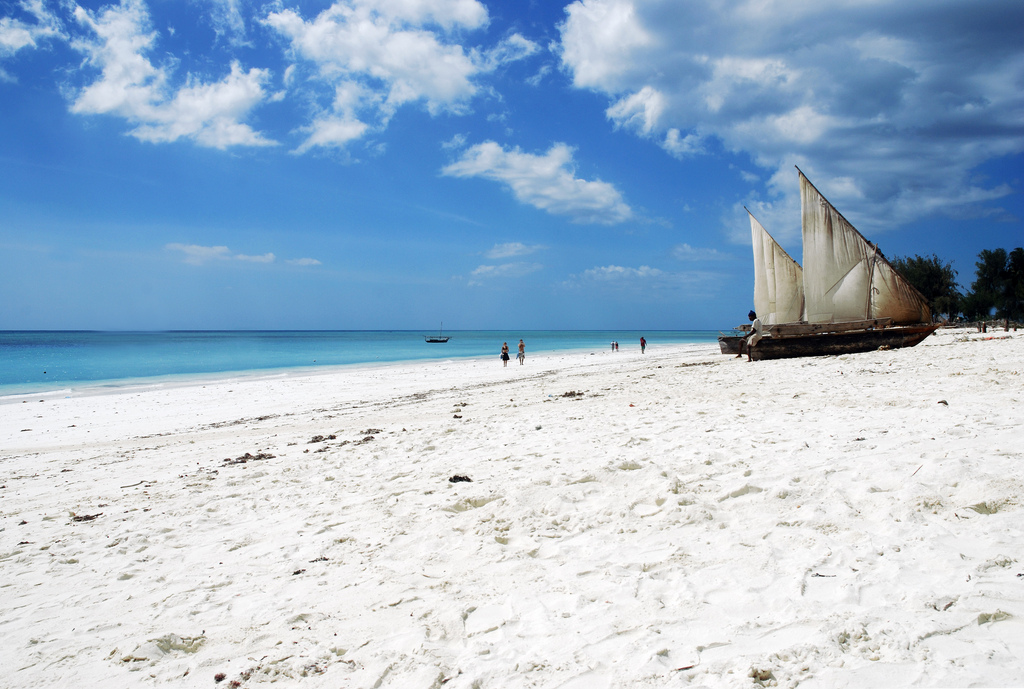
Free, 1 hour, on the northern tip. Dhows, the Arab sailing boats that have worked this coast for centuries, are still built here on the sand, without plans or factory nails, from mango wood and simple tools.
Ask before photographing anyone at work; a small tip is welcome. Next door are the late afternoon fish market and the boats that head out for sunset.
Nungwi beach: the one beach the tide does not spoil

Free, late afternoon. The northern tip is the only part of the island where the tide barely moves the waterline: you can swim at any hour, which explains the concentration of hotels.
The other reason is the sunset, which here drops into the sea. Be on the sand between 6pm and 6.30pm, when the dhows sail out with the sun behind them and the photo takes itself.
Day 6: snorkelling at Mnemba atoll and sunset at Kendwa
Mnemba atoll: the best snorkelling on the island

About 4 hours, 35 to 60 dollars per person on a shared boat, plus the marine reserve fee. Leave at 8.30am from Nungwi or Matemwe, because the sea is flattest early and midday boats meet the wind.
The island inside the atoll is private, owned by a luxury lodge, and nobody lands: the trip is the reef around it, with butterflyfish, green turtles and, with luck, dolphins on the way. Bring sunscreen without oxybenzone and refuse operators who offer to chase dolphins for you to swim with, a practice Tanzania discourages and that stresses the animals.
Kendwa beach: deep sand and the northern sunset

Free, the whole afternoon, 10 minutes by car from Nungwi or a 40 minute walk along the beach at low tide. Kendwa is wider, deeper and calmer than Nungwi, and the sea has no rocks at the entry.
It is also where the island's full moon party happens, once a month, filling the beach. If you want quiet, check the date before booking; if you want the opposite, book around it.
Day 7: Mangapwani and Maruhubi on the way to the airport
Mangapwani slave chamber: the hiding place after abolition

About 1 hour including the nearby cave, a couple of dollars to enter, 45 minutes south of Nungwi on the airport road. Leave Nungwi at 9am with your bags.
The chamber was cut into the coral and roofed over, and was used to hide enslaved people after the trade was banned in 1873: ships kept arriving at night, far from the policed harbour of Stone Town. Going down the steps and seeing the size of the hole explains more than any text. A few minutes away is the natural Mangapwani cave, with fresh water the community still uses.
Maruhubi Palace ruins: the columns of the burnt palace

A couple of dollars to enter, 45 minutes, 4 km north of Stone Town and essentially on the airport road. Sultan Barghash had the palace built in 1882 for his household, with its own aqueduct and Persian style baths.
A fire destroyed it in 1899 and what remains are the stone columns, the reservoir and part of the baths, taken over by vegetation. It is a short stop, and the last of the route: the airport is 20 minutes from the gate.
Do you need a visa for Zanzibar?
Yes, because Zanzibar is part of Tanzania. The tourist visa costs 50 dollars and can be obtained online on the official immigration site or on arrival at Zanzibar airport. The e-visa avoids the queue and takes a few working days, so apply at least two weeks ahead. Your passport must be valid for six months.
Two requirements catch people out. The first is the international yellow fever vaccination certificate, compulsory for anyone arriving from a country where the disease is endemic, including Brazil, with the dose given at least ten days before. The second is Zanzibar's mandatory travel insurance: since October 2024 every visitor must buy the Zanzibar Insurance Corporation policy, 44 dollars per adult, covering 90 days, on the government portal before flying. Your own travel insurance does not replace it, and the proof is checked on arrival.
When is the best time to visit Zanzibar?
June to October, the dry season, with sunny days around 28 degrees and cooler nights, and December to February, hotter and more humid but with the clearest water, which is when snorkelling at Mnemba is at its best. December and January are also peak season, with hotel prices roughly doubled.
Avoid mid March to May, the long rains, when it pours daily and part of the hotels and restaurants close. November brings short rains that get in the way very little, and much lower prices.
How to get to Zanzibar and how to get around the island
Most travellers connect through Doha, Dubai, Addis Ababa or Istanbul. Since June 2026 Airlink has linked Johannesburg to Zanzibar, and the same airline starts flying from Cape Town in October 2026. Another option is flying to Dar es Salaam and crossing by ferry, 2 hours by catamaran and far cheaper than the 20 minute domestic flight.
There is no public transport worth using on the island: dala-dalas, converted pick-ups, are slow and packed. The norm is private transfers, around 15 dollars from the airport to Stone Town, 50 from Stone Town to Paje and 60 to 70 from Paje to Nungwi. Renting a car requires a local permit, sold on the spot by the rental company, and driving is on the left.
Where to eat in Zanzibar: classic dishes and where to find them
Zanzibari cooking mixes the Swahili coast, India and the Arabian peninsula, and coconut and spices go into almost everything. The dishes to try are pweza wa nazi, octopus stewed in coconut milk; urojo, the yellow soup of potato, chickpea flour and green mango that locals call Zanzibar mix; pilau and biryani, the Indian inheritance; and mishkaki, marinated beef skewers grilled on the street.

The dinner you should not miss is at Forodhani Gardens in Stone Town: stalls go up at sunset and serve skewers, Zanzibar pizza and sugarcane juice with lime and ginger for a few dollars. Pick the stall with the queue of islanders and order what is cooked in front of you.

By day, the Swahili canteens on Mkunazini street in Stone Town serve the dish of the day for a few dollars, with a queue at lunchtime. Street bakeries turn out mkate wa kumimina, a fermented rice bread, and the chapatis that come with almost everything.

For a special night, the rooftops of restored merchant houses in Stone Town serve set menus with live taarab music and a view over the roofs, booking required and prices well above the island average.

What to avoid: the trays of pre-grilled seafood on the tourist stalls at Forodhani, which sit off the heat for hours, and tap water, including ice from beach shacks. Zanzibar is majority Muslim: alcohol is served in hotels and tourist restaurants only, and during Ramadan many local kitchens close during the day.
Are 7 days enough for Zanzibar?
For Unguja, the main island, yes: seven days give you two in Stone Town, two on the east coast and two in the north, with one transfer day in between and no rush. What is left out is Pemba, the neighbouring island with the best diving in the archipelago and almost no tourists, and the southwest, with Safari Blue in Menai Bay.
The usual combination is a safari before or after: the Serengeti is a two hour flight away, and the same island plus savannah idea runs through our Kenya itinerary. If the Arab half of this history interests you, the other end of it is in our Oman itinerary, whose sultanate ruled Zanzibar and even moved its capital here. To adjust dates and hotels, save this itinerary on Galmund.
Estimated budget per person
Prices checked on 21 September 2026. Check current prices at Tanzania Immigration, electronic visa · Zanzibar Insurance Corporation, mandatory inbound insurance.
Frequently asked questions
Do I need a visa for Zanzibar?+
Yes. Zanzibar is part of Tanzania and the tourist visa costs 50 dollars, obtained online on the official immigration site or on arrival at the airport. A yellow fever certificate is also required from anyone arriving from a country where the disease is endemic, along with the Zanzibar travel insurance policy, 44 dollars per adult, bought on the government portal before you fly.
How much does a 7 day trip to Zanzibar cost?+
Between 800 and 1,300 dollars per person without flights, covering a mid range double room, food, transfers, boat trips and entry fees. Add 50 dollars for the visa and 44 for the compulsory insurance. The biggest variable costs are the Mnemba snorkelling trip, 35 to 60 dollars, and the transfers between the three bases, which add up to about 130 dollars per car.
Is the Zanzibar travel insurance really compulsory?+
It is. Since 1 October 2024 every foreign visitor must buy the Zanzibar Insurance Corporation policy on the government portal, 44 dollars per adult, valid for 90 days. Children aged 3 to 17 pay half and under 2s are free. Proof is checked at immigration, and your own travel insurance does not replace this policy.
Does the tide affect swimming in Zanzibar?+
On the east coast, yes. At Paje, Jambiani and Bwejuu the water pulls back hundreds of metres at low tide and returns at high tide, so swimming happens in the two hours either side of high water; the rest of the time the beach is a sand flat that is good for walking. In the north, at Nungwi and Kendwa, the range is small and you can swim all day, which is why this itinerary ends there.
Should you stay in Stone Town or only on the beach?+
Both. Stone Town holds everything historical about the island, from the slave market to Swahili and Omani architecture, and two nights are enough to see it slowly and have dinner at Forodhani. But the city has no swimming beach, so the rest of the week needs a beach base, and this route uses two, one on each coast, because tide and wind behave differently on them.
Ready to go?
Save this itinerary to your Galmund and take the schedule, map and budget with you. Edit, share and track it all on the globe.
Save this itinerary to my GalmundBeen there already?
Pin this trip on your globe and keep your photos where they were taken.
Pin it on my globe