Nairobi · Naivasha · Hell’s Gate · Masai Mara · 14 min read
Kenya 7 Day Itinerary: Nairobi, Naivasha and a Masai Mara Safari
7 days · 3 cities
Duration
7 days
Estimated budget
US$ 1,800 to US$ 3,000 plus flights, 7 days
Best time to go
July to October, the Great Migration
Visa
eTA online, US$ 30, apply a week ahead
This 7 day Kenya itinerary follows a single circuit, Nairobi, Lake Naivasha and the Masai Mara, by road with a driver guide on the way out and by light aircraft on the way back, so you do not repeat 6 hours of road.
In short: giraffes and orphaned elephants in Nairobi, cycling in Hell’s Gate, two and a half days in the Mara and a farewell in the capital. Visa, timing and where to eat are in the practical sections.
Day 1: arrival in Nairobi, the giraffes and Karen Blixen’s house
Giraffe Centre: giraffes at eye level

About 15 dollars, 1 hour, open until 5pm. It is the first plan after check-in: it is in Langata, in the southwest of the city near the Karen hotels, and needs no booking.
The centre was founded in 1979 to save the Rothschild giraffe, which was down to little more than a hundred animals in western Kenya. From the raised platform you hand feed pellets with the giraffe’s head level with yours, and its long, dark blue tongue is the part nobody forgets.
Karen Blixen Museum: the farm from Out of Africa

About 18 dollars, paid through the government platform, 75 minutes, open until 6pm. It is 10 minutes by car from the Giraffe Centre, and the whole district, Karen, is named after her.
The Danish writer lived here from 1917 to 1931, trying to grow coffee at an altitude too high for coffee. The book she later wrote, Out of Africa, became the 1985 film. The house keeps her furniture and props from the shoot, and the farm machinery still stands in the garden.
Day 2: safari in Nairobi National Park and the orphaned elephants
Nairobi National Park: the safari with skyscrapers behind

80 dollars per adult plus the platform fee; 4 hours by car with a driver. Go in at 6am when it opens: that is when the lions are still active and the city traffic has not started.
It is the only national park in the world on the edge of a capital, and the photo everyone wants is this one: a zebra or giraffe in front and Nairobi’s skyscrapers on the horizon. But it is a real safari, with lions, buffalo and one of the country’s best protected black rhino populations. It is a rehearsal for the Masai Mara on Day 4.
Sheldrick: the orphaned elephants from 11am to noon

Just one hour, from 11am to noon, every day, and only with advance booking on the official website. It is on the western edge of the park, so it fits straight after the morning safari.
Founded in 1977 by Daphne Sheldrick, the nursery rescues calves whose mothers died from poaching or drought and raises them until they can return to the wild, years later, in Tsavo. During the visit the keepers bring the calves out for their bottles and mud bath and tell each one’s story by name.
Kazuri Beads: the handmade ceramic beads of Karen

Free tour, 45 minutes, 3 kilometres from the Karen Blixen Museum. It is a calm late afternoon after a day that started at 6am.
The workshop started in 1975 with two women and now employs hundreds, almost all single mothers. The tour goes through every stage: clay shaped by hand, the kiln and the painting of each bead. The shop at the end sells the pieces straight from their makers, and it is the best spent souvenir money of the trip.
Day 3: the Rift Valley and Hell’s Gate by bike
Fisher's Tower: the lava tower at the Hell's Gate entrance

20 minutes, 2 kilometres from Elsa Gate, the park’s main entrance. From Nairobi it is about 2 hours by road down the Rift Valley escarpment, with a viewpoint on the way.
It is what remains of a volcano’s vent, 25 metres of hardened lava that held out when everything around it eroded. The name honours the German explorer Gustav Fischer, who passed through in 1883. Rock hyraxes, small animals that look like marmots, sunbathe on the stones.
Hell's Gate: cycling among zebras to the gorge

50 dollars per adult, 3 hours. Rent a bike at Elsa Gate and ride the 7 kilometres of dirt road to the gorge. It is one of the few parks in Kenya where you move outside a vehicle, because there are almost no predators.
Along the way zebras, giraffes, buffalo and gazelles pass a few metres from the bike. At the end, the descent into the Lower Gorge, a narrow canyon of volcanic rock with hot water seeping from the walls, is only done with a park guide: the water rises fast when it rains in the hills.
Next to the park is the Olkaria geothermal spa, with pools heated by the neighbouring power plant, good for ending the day if there is time left.
Day 4: Crescent Island in the morning and arrival in the Masai Mara
Crescent Island: the walking safari on Lake Naivasha

2 hours including the boat, with the boat and the walk paid separately at the jetty. Go at 7:30am: the hippos are still out of the water and you need to leave at 9:30 for the Masai Mara.
The boat crosses the lake past pods of hippos and fish eagles and lands on a crescent shaped peninsula. With no predators there, you walk with a guide a few metres from giraffes, zebras, wildebeest and waterbuck. Part of Out of Africa was filmed here.
Masai Mara: the first game drive at dusk

200 dollars per adult per 24 hours from July to December, 100 dollars from January to June. From Naivasha it is about 5 hours by road via Narok to Sekenani Gate: arrive for lunch at camp and head out on the first game drive at 4pm.
The Mara is the Kenyan half of the Serengeti ecosystem, and its density of lions, leopards and cheetahs is among the highest in Africa. The low late afternoon light is the best time for the cats, which start moving once the heat eases. Camps sit inside or on the edge of the reserve, and the safari is always with a driver guide in an open roof vehicle.
Day 5: balloon at dawn and the Mara River
Balloon over the Masai Mara at sunrise

450 to 500 dollars per person, 1 hour in the air plus breakfast in the bush. It is the biggest optional expense of the trip, and the only one that has to be booked weeks ahead in high season. A vehicle picks you up at camp around 5:30am.
The balloons launch from the Musiara area in the north of the reserve, near the Mara River, and rise with the sun. From above, the herds of wildebeest and zebra become patterns on the ground, and you can watch elephants and giraffes crossing the plain. The landing ends with a champagne breakfast in the middle of the savanna, and the drive back counts as a game drive.
Mara River: where the Great Migration crosses

A full day of safari, with a picnic lunch packed at camp. In migration season, July to October, the driver heads straight for the crossing points and you wait: the herd can take hours to decide whether to jump, or not.
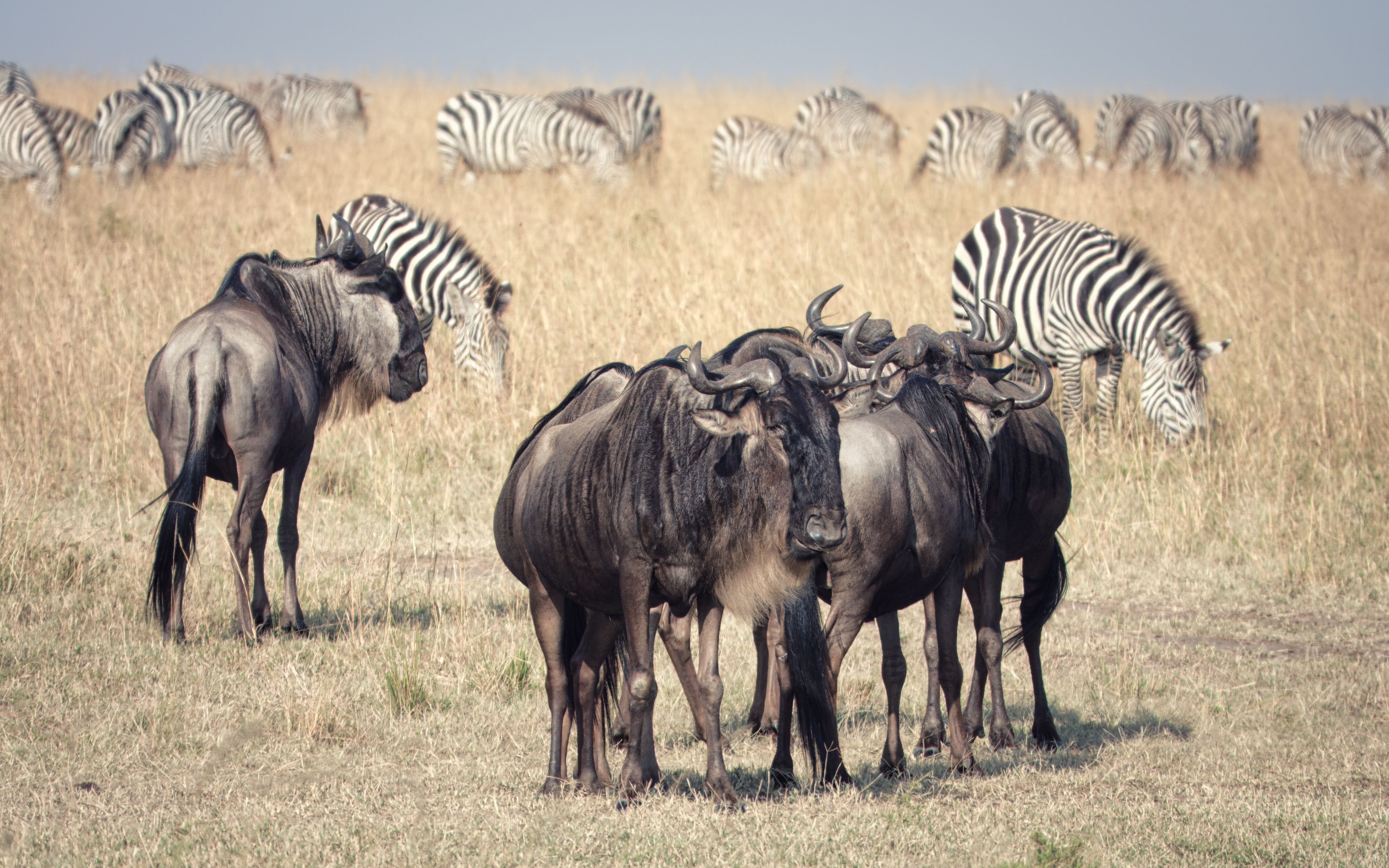
When it does, it is the spectacle that put the Mara on the map: thousands of wildebeest and zebras plunging down the bank and crossing the current among crocodiles. Out of season, the river is still worth it for the number of hippos and crocodiles, and the day is completed with the cats on the plains.
Day 6: flight back to Nairobi, the National Museum and Karura
Nairobi National Museum: human origins and Kenya

Paid entry, 90 minutes. The flight from the Mara lands at Wilson Airport around 11am, and the museum is 20 minutes away, on the way to the north of the city.
The human origins hall is the reason to visit: Kenya is one of the cradles of our species, and the fossil casts from the Lake Turkana basin tell that story without needing a guide. The bird and mammal halls help put names to what you saw on safari, and the Snake Park is next door on the same ticket.
Karura Forest: the forest Wangari Maathai saved

Entry fee paid at the gate, 2 hours, 15 minutes by car from the museum. After days inside a safari vehicle, it is the walk your body is asking for.
It is about a thousand hectares of forest inside the city, with trails, a waterfall and the caves where Mau Mau fighters hid during the struggle against British rule. The forest only exists because, in 1998, Wangari Maathai led the protests against it being carved up for development; she won the Nobel Peace Prize in 2004.
Day 7: downtown Nairobi and home
Railway Museum: the line that founded Nairobi

Paid entry, 75 minutes, open from 8am, next to the central station. It is the last morning’s plan, close to downtown and on the way to the airport.
Nairobi was born in 1899 as a depot on the Uganda Railway, the line the British built from Mombasa to Lake Victoria and that the press of the time nicknamed the Lunatic Express, for its cost and its deaths. The museum has steam locomotives in the yard and the carriage from which a Tsavo lion dragged off a superintendent in 1900.
KICC: the view of Nairobi from the helipad

Paid entry at the front desk, 45 minutes, 600 metres from the Railway Museum. It is the farewell to Nairobi before the airport, 40 minutes away.
Opened in 1973, the 28 storey tower was East Africa’s tallest building for years, and the amphitheatre beside it imitates a traditional hut. From the helipad on top you see the whole city and, on a clear day, Nairobi National Park, where the trip began.
Do you need a visa for Kenya?
Kenya no longer issues tourist visas: almost every visitor, including those from the United States, the United Kingdom, Europe and Brazil, instead needs an electronic travel authorisation, the eTA, applied for only on the official government website ending in go.ke. It costs 30 dollars and is issued within three working days; apply at least a week ahead.
Travellers arriving from countries with yellow fever risk, such as Brazil, must show the international vaccination certificate. For the Mara and Naivasha, talk to a doctor about malaria prevention; in Nairobi, thanks to the altitude, the risk is low.
When is the best time for a safari in Kenya?
July to October, in the dry season, when the Great Migration moves through the Masai Mara and the Mara River crossings happen. It is also the most expensive time: the reserve fee doubles to 200 dollars a day and camps fill up, so book months ahead.
January and February are the second best window: a short dry season, animals gathered near water and lower prices. April and May bring the long rains, with difficult dirt roads and some camps closed. Nairobi sits at 1,700 metres, so mornings are cool all year: bring a jacket for game drives that leave before sunrise.
How to get to Kenya and get around on safari
Jomo Kenyatta International Airport in Nairobi is the gateway, with direct flights from London, Amsterdam, Paris, Doha, Dubai and Istanbul, and one stop connections from the Americas. From the airport to the Karen hotels is 40 minutes to an hour, depending on traffic.
The safari is done with a driver guide and an open roof 4x4, hired for Days 2 to 4. On the way back, the light aircraft from the Mara to Wilson Airport in Nairobi takes about 45 minutes and saves you 6 hours on dirt roads. In Nairobi, use Uber or Bolt and avoid walking downtown after dark.
Where to eat in Kenya: local dishes and what to avoid
Meals at the Mara camps are included on a full board basis, so you taste the country’s real food in Nairobi and on the road.
The national dish is nyama choma, goat or beef slow roasted over charcoal and served on a board, carved to order, with salt, chilli and kachumbari, a raw tomato and onion salad. It is weekend food, for groups and cold Tusker beer.

The side dish for almost everything is ugali, a firm maize flour dough eaten with your hands, alongside sukuma wiki, greens sautéed with onion and tomato. In Naivasha, order fried tilapia from the lake with ugali on the side.

The capital’s classic address is Carnivore, in Langata near Wilson Airport: meats roast on Maasai swords over a charcoal pit and waiters carve at the table until you lower the little flag. Game meat has been banned in Kenya since 2004; what is served is farmed crocodile and ostrich.

What to avoid: tap water and ice outside good hotels and restaurants, and raw salad from street stalls in the first few days.
How much does a 7 day trip to Kenya cost?
Excluding the international flight, which depends on where you fly from, between 1,800 and 3,000 dollars per person travelling as a couple, with prices checked in September 2026 and without the balloon. The safari is the expensive part: the vehicle and driver, park fees and Mara camps add up to more than the flight.
The breakdown: accommodation costs 90 to 150 dollars a night in Nairobi and Naivasha and 250 to 450 dollars in the Mara, with all meals; the vehicle with driver guide for three days plus the flight from the Mara to Nairobi, split between two, comes to 600 to 850 dollars per person. From Brazil, a return flight with one connection adds 1,200 to 1,800 dollars, bringing the total to 3,000 to 4,800.
Park fees and tickets add up to 520 to 850 dollars: the Mara reserve costs 200 dollars a day from July to December and 100 the rest of the year, Nairobi National Park 80, Hell’s Gate 50, and the Giraffe Centre, Sheldrick and the Karen Blixen Museum 15 to 18 each. The optional balloon adds 450 to 500 dollars.
The table above links to the official sites so you can check current prices before you travel.
Is 7 days enough for a safari in Kenya?
For a first safari, yes. Seven days give you two and a half days in the Masai Mara, which is the minimum for a good chance of seeing the big cats and, in season, a river crossing, plus Nairobi and Lake Naivasha without rushing.
For the whole country, no. Amboseli, with its elephants in front of Kilimanjaro, Samburu in the dry north and the beaches of Diani on the Indian Ocean are each an extension of two to four days. With 10 days, add Amboseli before Naivasha; with 12, finish with three beach days in Diani, flying from Nairobi.
What is not worth doing is shortening the Mara to fit in more places: a safari is about waiting, and the best scenes usually happen on the second and third game drives.
Estimated budget per person
Prices checked on 18 September 2026. Check current prices at Kenya eTA, official government site · Kenya Wildlife Service, national park fees · Sheldrick Wildlife Trust, nursery visits · Giraffe Centre, official site · National Museums of Kenya (National Museum and Karen Blixen).
Frequently asked questions
Do I need a visa to travel to Kenya?+
No visa, but almost every visitor needs the electronic travel authorisation, the eTA, applied for on the official Kenyan government website. It costs 30 dollars and is issued within three working days. Travellers from countries with yellow fever risk also need the vaccination certificate.
How much does a 7 day trip to Kenya cost?+
Between 1,800 and 3,000 dollars per person travelling as a couple, excluding the international flight, covering accommodation, a vehicle with driver guide, the flight from the Mara to Nairobi and park fees, with prices checked in September 2026. The optional Mara balloon flight costs 450 to 500 dollars more.
When is the best time for a safari in the Masai Mara?+
July to October, when the Great Migration passes through the Mara and the river crossings happen. It is the busiest and most expensive season; January and February are the second best window, with lower prices. April and May are the long rains.
Is the Masai Mara balloon flight worth it?+
It is if your budget allows: an hour over the savanna at sunrise with breakfast in the bush, for 450 to 500 dollars per person. Book weeks ahead in high season, because places run out.
Is a safari in Kenya safe?+
The parks and reserves on this itinerary are safe and heavily visited, always with a licensed driver guide. In Nairobi, the precautions are those of any big city: use Uber or Bolt, do not walk downtown at night and keep your phone out of sight.
Ready to go?
Save this itinerary to your Galmund and take the schedule, map and budget with you. Edit, share and track it all on the globe.
Save this itinerary to my GalmundBeen there already?
Pin this trip on your globe and keep your photos where they were taken.
Pin it on my globe