Bucharest · Sinaia · Brasov · Bran · Viscri · Sighisoara · Biertan · Sibiu · 14 min read
Romania 7 Day Itinerary: Transylvania, Brasov, Sighisoara and Sibiu
7 days · 5 cities
Duration
7 days
Estimated budget
1,200 to 2,000 euros per person, 7 days
Best time to go
May to October, or December for snow
Visa
No visa, up to 90 days in Schengen
This Romania 7 day itinerary drives across Transylvania with four bases: Bucharest, Brasov, Sighisoara and Sibiu. Renting a car is the decision that shapes the trip, because the Saxon villages and the castles sit off the rail network.
In short: Bucharest, Sinaia and Peles, Brasov on foot, Bran and the bears, Viscri and Sighisoara, Biertan and Sibiu. Visas, season and food are at the end.
Day 1: arriving in Bucharest, the Palace of the Parliament and the Old Town
Palace of the Parliament: the heaviest building in the world

About 60 lei for the standard tour, 1h30, entry from Strada Izvor and only with a passport. Buy the ticket at the desk on the day, or book by phone 24 hours ahead: the visit is always guided and in a group.
Ceausescu raised more than 3,000 rooms here in the 1980s, demolishing a whole district to open the avenue you see from the balcony. The tour covers a fraction of the building and still runs 2 kilometres of corridor.
Carturesti Carusel: the white bookshop on Lipscani

Free, 20 minutes, 1.2 kilometres from the Parliament. Six white floors wrap a central void inside a 1903 building that was once a bank and then a warehouse. The top floor cafe opens onto Lipscani street, in the middle of the Old Town.
Romanian Athenaeum: the 1888 concert hall

40 minutes, 900 metres from the bookshop. The walk-in visit is short and cheap, and the round hall carries a 75 metre painted frieze that tells the history of Romania in a single loop.
The acoustics are why this is home to the George Enescu Philharmonic. If there is a concert on your night, go to the concert: it often costs less than a guided tour elsewhere, and visits close during rehearsals.
Day 2: Sinaia, Peles Castle and arriving in Brasov
Sinaia Monastery: the stop before climbing to Peles

Free, 30 minutes, 2 hours from Bucharest on the DN1. Founded in 1695, it gave the town its name and sits at the car park where the 15 minute walk up to the castle starts.
Peles Castle: the summer palace of King Carol I

50 lei for the basic tour and 120 lei for the Grand Tour, plus 35 lei to take photos, 1h45 with the queue. Closed Monday and Tuesday, and in 2026 it also closes from 2 November to 1 December for conservation: check the date before planning the day.
It is an 1883 neo-Renaissance palace, the first in Europe with its own electricity, and the carved wood interior is what justifies the trip. The Grand Tour adds the second floor and only pays off if you like interiors.
Sinaia to Brasov is 45 minutes on the DN1, with the whole Prahova Valley through the window.
Council Square: the first coffee in Brasov

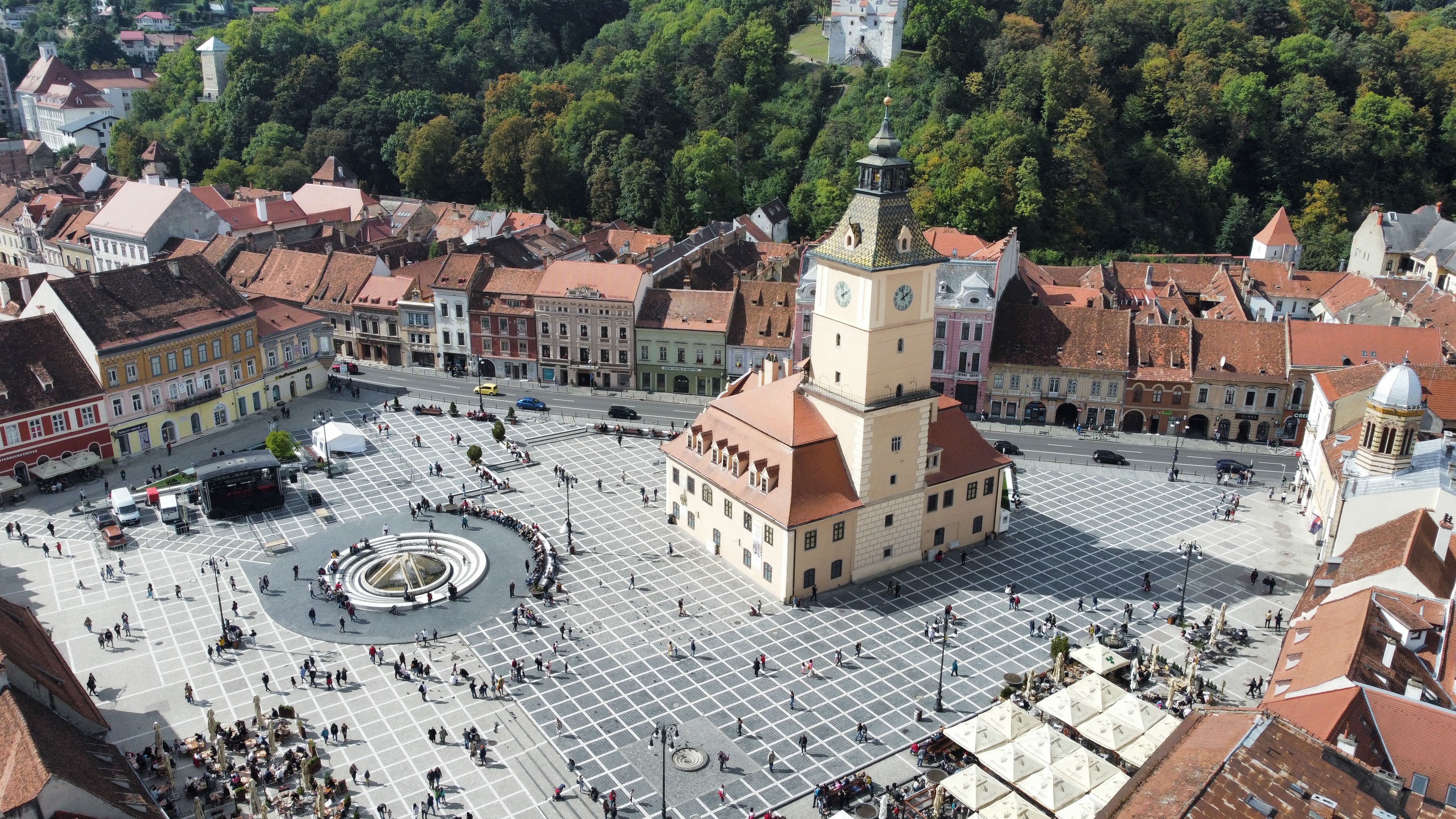
Open square, 1 hour, right after check-in. The old town hall in the middle dates from 1420 and now holds the city museum; around it are the painted facades and the terraces where Brasov has dinner.
Everything on the next day starts here: the Black Church is 200 metres away and Rope Street 300.
Day 3: Brasov on foot, from the Black Church to the top of Tampa
Black Church: the largest organ in Romania

15 lei, 1 hour, open Tuesday to Saturday. The name comes from the 1689 fire that blackened the walls of the largest Gothic church between Vienna and Istanbul.
Two things to look for inside: the 1839 Buchholz organ, with almost 4,000 pipes, and the collection of Anatolian rugs hanging in the galleries, brought back by Saxon merchants. In summer there are organ recitals in the late afternoon.
Rope Street: the alley 1.3 metres wide

Free, 15 minutes, 250 metres from the church. It is one of the narrowest streets in Europe, opened in the 17th century as a firefighters passage. Two photos and it is over, but it sits exactly on the way to the bastion.
Weavers Bastion: the wall that survived

10 lei, 45 minutes, 300 metres from Rope Street. It is the best preserved medieval bastion in Brasov, built in 1450, with wooden galleries on four levels.
Inside there is a model of the fortified city in 1600, which makes sense of everything you walked in the morning. The acoustics are so good that the courtyard hosts opera in summer.
Tampa cable car: the view over Brasov

30 lei one way and 50 lei return, 2 hours with the walk at the top, 500 metres from the bastion. The cabin climbs to 950 metres in 3 minutes, and the white city sign stands up there.
If you would rather walk, the zigzag trail takes about an hour up and you ride down. It runs daily, with a technical break on Monday mornings.
Day 4: the bears of Zarnesti, Bran Castle and Rasnov
Libearty Bear Sanctuary: the visit you have to book

50 lei, 1h30 including the 2 kilometre walk, 30 minutes by car from Brasov. It opens Tuesday to Sunday and only takes visitors in the morning, at fixed times, so the animals are not disturbed: tickets go on sale 10 days ahead online and sell out fast in summer.
More than a hundred brown bears rescued from restaurant and circus cages live here across 69 hectares of oak forest. Children under 5 are not allowed in.
Bran Castle: the castle that became Draculas

100 lei for adults, 1h30, 25 minutes from Zarnesti. Open every day, from 9am Tuesday to Sunday and only from noon on Monday, and anyone arriving after 11am queues.
Vlad Tepes probably never lived here: the Dracula link is 20th century marketing, and Bram Stoker never set foot in Romania. What the castle really has is Queen Maries 1920s restoration, with furniture, narrow passages and an inner courtyard worth the visit. The souvenir market at the entrance is expensive and skippable.
Rasnov Citadel: the free viewpoint with the works going on

Garden open and free, 45 minutes, 15 minutes from Bran. The citadel has been closed for restoration since 2022 and reopening, in stages, is planned for 2028: for now you can only walk the garden and the outside. It is still worth the stop, because the view from the hill reaches the Bucegi massif and the whole Brasov valley.
Day 5: Viscri and the citadel of Sighisoara
Viscri fortified church: King Charles Saxon village

15 lei, 1h30, 1h40 from Brasov, with the last 8 kilometres on a broken road. The white church dates from the 12th century, joined the Unesco list in 1999, and the ticket covers the tower, the museum and the exhibition.
The village has a single street, painted Saxon houses and horse carts still in use. King Charles bought and restored a house here, which put Viscri on the map: arrive early, because the tour buses unload after 11am.
Viscri to Sighisoara is another 50 minutes.
Clock Tower: the museum and the citadel viewpoint

50 lei with the history museum, 1 hour, right after check-in. The tower dates from 1360, stands 64 metres tall and keeps the 1648 mechanism with the wooden figures that turn at midnight.
The balcony at the top is the best view of the citadel, the only inhabited one in Europe and a World Heritage site since 1999. The house where Vlad Tepes was born is on the square next door and is now a tourist restaurant: read the plaque and move on.
Covered Staircase: 175 wooden steps

Free, 15 minutes, 200 metres from the tower. The wooden tunnel was built in 1642 so children could reach the school on top of the hill even in snow. There are 175 steps and the climb takes 5 minutes.
Church on the Hill: the 15th century frescoes

About 15 lei, 45 minutes, at the top of the staircase. It is a Gothic church from 1345, with frescoes rediscovered under the whitewash and a crypt, the only one in a Transylvanian church.
Next to it lies the Saxon cemetery, whose German headstones tell on their own the story of the community that left the country after 1990. It closes early outside summer.
Day 6: Biertan and arriving in Sibiu
Biertan fortified church: the door with 19 locks

1h15 for the visit, 1 hour of mountain road from Sighisoara. It was the Saxon bishops seat for 300 years and is the largest of the Unesco fortified churches, with three rings of wall and towers linked by covered stairs.
The famous piece is the sacristy door from 1515, with a system of 19 locks worked by a single key. The other is the marital tower, where couples who wanted a divorce were locked in together for two weeks, with one plate and one bed.
Biertan to Sibiu is another hour.
Council Tower: climb it to understand Sibiu

A token ticket of a few lei, 40 minutes, right after check-in. The 1588 tower stands between the Large Square and the Small Square, and the top floor shows both squares and the roofs with their oval dormers, the eyes of Sibiu.
The stairs are narrow and there is no lift. The Large Square below hosts the Christmas market and the theatre festival in June.
Liars Bridge: the first iron bridge in Romania

Free, 15 minutes, 100 metres from the tower. Built in 1859, it was the first cast iron bridge in the country and links the Small Square to the lower town. Legend says it creaks when somebody lies while standing on it.
Day 7: the two cathedrals of Sibiu and the ASTRA Museum
Lutheran Cathedral: the 73 metre tower

A cheap ticket for the church plus an extra for the tower, 1 hour, 150 metres from the Large Square. The Gothic church dates from 1520 and holds the tomb of Mihnea cel Rau, son of Vlad Tepes, murdered at its door in 1510.
The tower climb is on wooden stairs and ends at the highest viewpoint in the centre. Look for the 1445 Crucifixion fresco behind the organ as well.
Orthodox Cathedral: a miniature Hagia Sophia

Free, 30 minutes, 300 metres from the Gothic cathedral. It was built between 1902 and 1906 after the Hagia Sophia in Istanbul, and the interior is covered in frescoes on a blue and gold ground. Cover your shoulders to go in.
ASTRA Museum: 400 wooden buildings in the open air

50 lei, 2h30, 10 minutes by car from the centre and on the way to the airport. It is the largest open air museum in Europe: 400 houses, mills, churches and workshops brought from all over Romania and rebuilt across 96 hectares of woodland.
Rent a bicycle at the gate, because the paths add up to kilometres. Leave the last hours of the day for it: Sibiu airport is 8 minutes away, with daily flights to Munich on Lufthansa and to Vienna on Austrian.
Do you need a visa to visit Romania?
Most visitors do not. Romania joined the Schengen area in full on 1 January 2025, and citizens of Brazil, the United States, Canada, the United Kingdom, Australia and the European Union enter with a passport alone for up to 90 days in any 180 day period. That allowance is shared with every other Schengen country in the same window.
The ETIAS travel authorisation, at 20 euros, is not in force yet: the European Union now points to 2027 after several delays. Until then, nothing changes at the airport.
When is the best time to visit Transylvania?
May to October. May and June catch the countryside green and the Saxon villages without crowds. July and August are hot in Bucharest and busy in Bran and on Council Square, but that is when the Transfagarasan is open. September and October give the best balance of weather and price, with yellow slopes around Tampa.
November to March is cold and grey, with reliable snow above 1,000 metres. December brings the Christmas markets of Sibiu and Brasov, the best reason to face the winter. Watch out for Peles, closed for conservation from 2 November to 1 December 2026.
How to get to Romania and how to travel between the cities
Bucharest Henri Coanda airport, 17 kilometres from the centre, is the main gateway, with direct flights from most of Europe and from Istanbul and Doha. From Brazil there is no direct flight and the trip runs 15 to 18 hours with one connection. This itinerary leaves from Sibiu, which has daily flights to Munich and Vienna. If you would rather close the loop, Sibiu to Bucharest is 4h30 on the A1.
Between the cities, drive. Trains link Bucharest, Brasov, Sighisoara and Sibiu, but Viscri, Biertan, Zarnesti and Bran are off the network, and they are what gives this route its character. A compact car runs 25 to 45 euros a day, dropping it in a different city carries a one way fee, and the rovinieta, the compulsory electronic road toll on national roads, is almost always included in the rental: confirm it in writing, because the fine falls on the driver.
The currency is the Romanian leu, not the euro. Cards work almost everywhere, including the cable car ticket, but carry some cash for village churches and for parking in Viscri.
Where to eat in Romania: typical dishes and the best restaurants
Romanian cooking is winter food and farm food, with pork, cabbage and sour cream in nearly everything. Three dishes carry the trip.

Sarmale are cabbage or vine leaves rolled around pork and rice, slow cooked for hours and served with mamaliga, the cornmeal polenta, and a spoon of smantana. It is the Sunday and Christmas dish, and it is on every menu.

Mici, also called mititei, are skinless rolls of minced meat seasoned with garlic, grilled over charcoal and eaten with mustard and bread. They cost a few lei on the street and are the market and festival snack.

Papanasi close the bill: fried fresh cheese doughnuts under sour cream and red berry jam. One portion feeds two people, and almost nobody warns you first.

In Bucharest, Caru cu Bere on Strada Stavropoleos has been serving since 1879 in a neo-Gothic hall with stained glass, and it is the place to eat sarmale without paying tourist trap prices: book, because the queue at the door is real. In Brasov and Sibiu, walk two streets away from the terraces on the main square with menus in five languages: the same dish can cost 40 per cent less.
Are 7 days enough to see Romania?
For Transylvania, yes. Seven days cover Bucharest, Sinaia, Brasov, Bran, Viscri, Sighisoara, Biertan and Sibiu with road legs of at most 2 hours, which is the limit before a trip turns into commuting.
Left out are Maramures, with its wooden churches and the merry cemetery of Sapanta, and the Danube Delta, each of which needs 3 days of its own. The Transfagarasan, the mountain road between Sibiu and Wallachia, opened on 12 June in 2026 and closes in October, with traffic allowed from 7am to 9pm on the alpine stretch: if your trip falls inside that window, it replaces the A1 on the way back and becomes a full day. For another European destination with the same cost profile, see the Albania 7 day itinerary.
Estimated budget per person
Prices checked on 20 September 2026. Check current prices at Muzeul National Peles · Castelul Bran · Rezervatia Libearty, Zarnesti · Muzeul ASTRA, Sibiu · Biserica Neagra, Brasov.
Frequently asked questions
Do you need a visa to visit Romania?+
Most visitors do not. Romania has been a full Schengen member since 1 January 2025, and citizens of Brazil, the United States, Canada, the United Kingdom, Australia and the European Union enter on a passport alone for up to 90 days in any 180 day period, shared with the other Schengen countries. The ETIAS authorisation, at 20 euros, is expected in 2027 and is not required yet.
How much does a 7 day trip to Romania cost?+
Between 1,200 and 2,000 euros per person, counting the long haul flight, mid range hotels, a rental car split by two, food and tickets. Romania is one of the cheapest destinations in the European Union: a full dinner off the main square runs 15 to 25 euros.
When is the best time to visit Transylvania?+
May to October, with May and June for green countryside and no crowds, and September and October for the best balance of weather and price. July and August are high season and the only guaranteed window for the Transfagarasan. December is worth it for the Christmas markets of Sibiu and Brasov.
Can you do Transylvania without a car?+
You can, but with a different route. Trains link Bucharest, Brasov, Sighisoara and Sibiu comfortably enough, and Bran has hourly buses from Brasov. Viscri, Biertan and the bear sanctuary at Zarnesti sit off public transport and need a paid tour or a hired taxi.
Is Bran Castle really Draculas castle?+
No. Vlad Tepes, the prince behind Bram Stokers character, probably never lived at Bran, and Stoker never visited Romania. The association was invented by tourism in the 20th century. The castle is worth it for Queen Maries 1920s restoration and its position in the pass, not for the legend.
Ready to go?
Save this itinerary to your Galmund and take the schedule, map and budget with you. Edit, share and track it all on the globe.
Save this itinerary to my GalmundBeen there already?
Pin this trip on your globe and keep your photos where they were taken.
Pin it on my globe