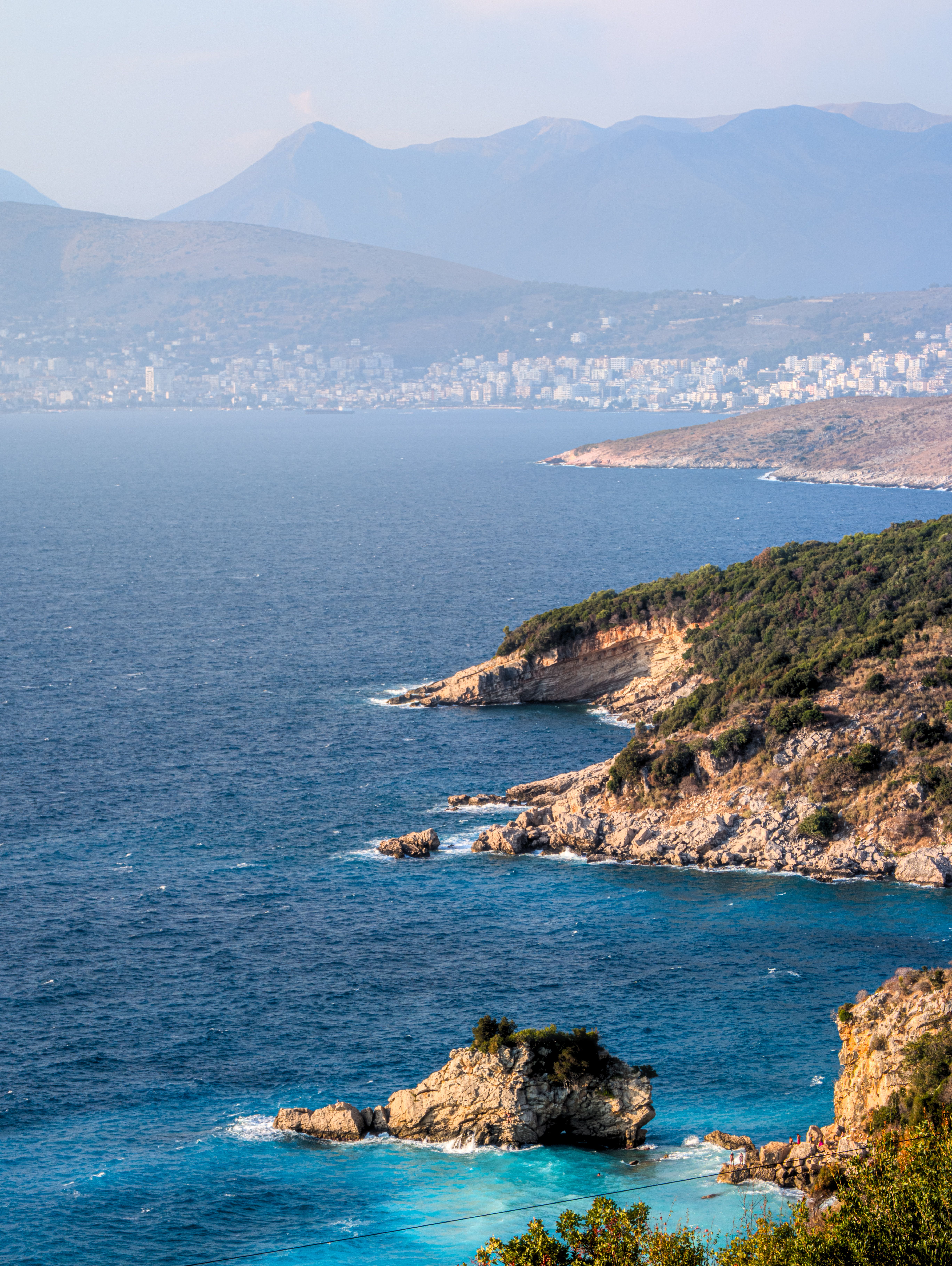
Tirana · Berat · Gjirokastër · Sarandë · Ksamil · Albanian Riviera · 15 min read
Albania 7 Day Itinerary: Tirana, Berat, Gjirokastër and the Riviera
7 days · 5 cities
Duration
7 days
Estimated budget
US$ 1,700 to US$ 2,600 per person, 7 days
Best time to go
May to October, June and September best
Visa
No visa for Brazilians, up to 90 days
This Albania 7 day itinerary covers the south of the country by rental car, with four fixed bases and no repeated nights: Tirana, Berat, Gjirokastër and Sarandë.
In short: two days in the capital, Berat and its Ottoman houses, Gjirokastër and the Vjosa valley, the Blue Eye and Butrint, Ksamil, and the drive back along the Riviera over the Llogara Pass. Visas, seasons and food are in the practical sections.
Day 1: arriving in Tirana and the centre on foot
Skanderbeg Square: where Tirana starts

Allow 45 minutes, it is free, and it is 25 minutes from the airport by taxi. The square was closed to cars in 2017 and became a stone esplanade, with the National History Museum on one side and the equestrian statue of Skanderbeg at the centre.
It is the best place to grasp the scale of the city before walking: everything you see today is less than 15 minutes away on foot.
Et'hem Bey Mosque: the frescoes that outlived state atheism

Free entry, 30 minutes, closed during prayers. Take your shoes off and cover your shoulders.
Built between 1789 and 1823, it is one of the few mosques the Enver Hoxha regime did not demolish when it declared Albania the world's first officially atheist state in 1967. The interior frescoes, showing trees, waterfalls and bridges, are rare in the Islamic world, where figurative imagery is usually avoided.
Tanners' Bridge: fifteen minutes of Ottoman Tirana

A 15 minute stop, no ticket, on the way between the square and the Pyramid. The eighteenth century stone bridge once crossed the Lana river so tanners could drive cattle to market. The river was diverted and the bridge now spans a lawn, which is the most honest image of what Tirana has done with its own past.
Pyramid of Tirana: the mausoleum turned public staircase

Free to climb, no ticket, 45 minutes. Go late in the day: the view from the top catches the sunset over Mount Dajti.
Opened in 1988 as a museum to Enver Hoxha and designed by the dictator's daughter, it spent 30 years derelict and covered in graffiti. In 2023 the Dutch practice MVRDV reopened it with external steps anyone can climb and coloured boxes housing the TUMO technology centre.
Blloku, the district where only the party elite could live until 1991, starts two blocks west and is where the bars open at night.
Day 2: communist Tirana, from the centre to Mount Dajti
House of Leaves: the surveillance museum inside the listening post

Around 700 lek, 75 minutes, closed on Mondays. It is the most powerful museum in Tirana and the least visited.
The villa was built in 1931 as a maternity clinic and became, in 1944, the headquarters of the Sigurimi secret police. The museum kept the equipment in place: wiretaps, microphones hidden inside household objects, wall cameras, and the files recording who informed on whom. The name comes from the ivy covering the facade.
Bunk'Art 2: the bunker under the Interior Ministry

Around 900 lek, 90 minutes, entered through a concrete dome on the pavement beside the Clock Tower. It is a 5 minute walk from the House of Leaves, so both fit into one morning.
Twenty four rooms of the bunker built for the Interior Ministry, devoted to the history of the political police and to the thousands of Albanians executed by the regime. If you only have time for one of the two bunkers, choose this one for the content and the other for the scale.
Bunk'Art 1: five floors of nuclear shelter

Around 900 lek, 2 hours, on the north eastern edge of the city. Take a taxi: it is 25 minutes from the centre.
This is the real bunker: 106 rooms on five levels, dug into the mountain between 1972 and 1978 to shelter Hoxha and the high command from a nuclear attack that never came. Albania ended the communist period with more than 170,000 bunkers across its territory. Some of the rooms now hold contemporary art installations.
Dajti Ekspres Cable Car: fifteen minutes up Tirana's mountain

Around 1,000 lek return, a 15 minute ride, closed on Tuesdays. The lower station is 10 minutes from the previous bunker, which turns the two into a single afternoon.
The cable car climbs 800 metres to Mount Dajti National Park, from where the whole of Tirana is visible. At the top there are short trails and restaurants with terraces, and on a clear day you can see the Adriatic.
Day 3: Tirana to Berat, the city of a thousand windows
Berat Castle: the citadel people still live in

Leave Tirana around 8.30am: it is a 2 hour 30 minute drive to Berat. Tickets cost around 400 lek, and the visit takes 90 minutes.
What sets the Kala apart from any other castle in the Balkans is that it was never emptied: families live inside the thirteenth century walls, there is washing on the lines and cats on the steps. The cobbled climb is steep and gets slippery in rain, so closed shoes help.
Onufri Museum: the red nobody managed to copy

Around 400 lek, 45 minutes, inside the castle, in the Church of the Dormition of St Mary.
Onufri was a sixteenth century icon painter who created a red pigment so intense it came to carry his name and has never been reproduced. The church's gilded iconostasis is what impresses most up close.
Mangalem Quarter: the thousand windows that name Berat

No ticket, 1 hour, walking down from the castle. This is where the classic photograph of Berat is taken.
The white Ottoman houses of the eighteenth century were built stepped up the slope so that none blocks another's window, and seen from the river the effect is a wall of glass. That is where the nickname, the city of a thousand windows, comes from. The quarter has been a UNESCO World Heritage Site since 2008.
Gorica Bridge: crossing to the other side of the Osum

No ticket, 40 minutes including the walk across.
The seven arch stone bridge was raised in 1780 and links Mangalem to Gorica, the Christian quarter, quieter and without shops. The best angle on Mangalem is from here in late afternoon, when the sun hits the windows head on.
Day 4: Berat to Gjirokastër through the Vjosa valley
Vjosa Valley: the stop between Berat and Gjirokastër

A 20 minute stop at one of the roadside viewpoints, about 2 hours from Berat. There is no infrastructure, just the valley.
The Vjosa is the last large undammed river in Europe and became a national park in 2023, the first on the continent created to protect an entire river. On the descent to Tepelenë it spreads into several braids across white gravel, and the road follows the Këlcyra gorge just before.
Gjirokastër Castle: the fortress above the stone city

Around 400 lek, 90 minutes. The castle is the highest point in the city, so start there and walk down for the rest of the day.
The fortress holds an open air artillery gallery and the wreckage of an American aircraft the regime displayed as a spying trophy. From the terrace you can see the whole Drino valley.
Zekate House: the most complete Ottoman tower house in the country

Around 300 lek, 45 minutes, a short steep climb from the bazaar.
Built in 1812 by a treasurer to Ali Pasha, it has three floors, twin towers and a top floor reception hall with a carved ceiling and painted niches. It is the most complete example of the fortified Gjirokastër house, designed to withstand a siege and receive guests at the same time.
Pazari i Vjetër: the old bazaar and the slate streets

No ticket, 1 hour, walking down from the castle. This is where the cafes and the fabric shops are.
The seventeenth century bazaar was rebuilt after a fire in the nineteenth century and keeps its wooden shopfronts along streets that meet at an angle. Gjirokastër is called the stone city because the roofs are laid with grey slate, and from here you see that close up.
Day 5: Gjirokastër to Sarandë, by way of the Blue Eye
Syri i Kaltër: the spring nobody has found the bottom of

Around 50 lek per person plus 200 per car, 1 hour including the walk. Leave Gjirokastër at 9.30am: it is 50 minutes away.
The water rises from a fissure more than 50 metres deep and divers have never reached the end of the conduit. The centre is dark blue and the rim pale green, which gives the eye shape that names the place. The temperature stays at 10 degrees all year: some people get in, most give up.
Lëkurësi Castle: sunset over Sarandë and Corfu

No ticket for the courtyard, 75 minutes, up a narrow road. Arrive 40 minutes before sunset.
The castle was built by Suleiman the Magnificent in 1537 to control the channel between Sarandë and the Greek island of Corfu, 10 kilometres away and visible end to end on the horizon. What remains are the walls and a restaurant in the courtyard, and what you come for is the view over the bay.
Day 6: Butrint and Ksamil, the far south
Butrint National Park: the Greco-Roman city inside the lagoon

Around 1,000 lek, 2 hours 30 minutes, opens at 8am. Go early: after 11am the coach tours arrive from Corfu and the theatre fills up.
Butrint was a Greek colony, a Roman city, a Byzantine bishopric and a Venetian fort, and each layer settled over the previous one without erasing it. The third century BC theatre still carries manumission inscriptions cut into the stone, and the early Christian baptistery has an animal mosaic that stays covered most of the year to keep it from degrading.
The site sits inside a lagoon, so bring insect repellent.
Ksamil and its islands: turquoise water, with one caveat

Public beach with paid loungers, 3 hours, 20 minutes from Butrint on the way back to Sarandë.
The four islets of Ksamil lie a hundred metres offshore and can be reached by swimming or kayak, in shallow, genuinely turquoise water. The caveat is the crowding: in July and August the sand disappears under the loungers, and the same place in June or September is another thing entirely.
Day 7: back to Tirana along the Albanian Riviera
Potami Beach: the first stop on the Albanian Riviera

Leave Sarandë at 9am: it is 1 hour 30 minutes to Himarë on the coast road. Stop for an hour.
Himarë is a village with a Greek Albanian population and pebble beaches of clear water just below the centre. Potami is the most accessible, with parking and bars on the sand, and works as a first stop before the more hidden beaches further north.
Dhërmi: the stone village above the beaches

No ticket, 1 hour, 20 minutes north of Himarë. Park in the upper village, not at the beach.
The Dhërmi that appears in summer photographs is on the coast, but the original village sits 200 metres above it, with stone houses and frescoed Byzantine churches, almost empty outside August. It is worth more for the view down the slope to the sea than for the beach, which you have already seen at Himarë.
Llogara Pass: a thousand metres above the Ionian

No ticket, a 45 minute stop, 30 minutes from Dhërmi. From here it is 3 hours 30 minutes to Tirana, so allow room before your flight.
The road climbs in tight bends to 1,027 metres inside Llogara National Park, between pines bent by the wind, and the viewpoint delivers the whole Riviera below. This is where the Ionian meets the Adriatic, and the change in the colour of the water is visible to the naked eye.
Do you need a visa for Albania?
No. Brazilian and most Western passport holders enter Albania without a visa and may stay up to 90 days within any 180 day period as tourists. You need a passport valid for at least three months from the date of entry and one blank page.
Albania is not part of the Schengen area, so those 90 days are counted separately from the Schengen allowance. In practice you can add Albania to a European trip without consuming the Schengen quota, which is one reason the country has become a standard extension of Balkan itineraries.
Border officers may ask for proof of accommodation and travel insurance. Insurance is not a legal requirement for most visitors, but it is inexpensive and the public health network is limited outside Tirana.
When is the best time to visit Albania?
May to October, and within that window June and September are the best months: the sea is already warm, rates sit well below peak and the southern beaches are free of the August crush.
July and August are the high season, with 33 to 38 degrees in the south, a packed Ksamil and accommodation prices that can double. If those are your dates, book Sarandë months ahead and visit Butrint right at opening.
From November to March it rains heavily on the coast and many Riviera hotels and restaurants simply close. Tirana, Berat and Gjirokastër work all year and look good in winter, but this itinerary, which ends on the coast, loses its point out of season.
How to get to Albania and how to get around
There are no direct flights from Brazil. The shortest connections to Tirana International Airport run via Istanbul with Turkish Airlines, or via Rome, Vienna, Munich and Lisbon with the European carriers. Allow 16 to 22 hours in total including the layover. From Western Europe, low cost carriers fly to Tirana directly.
Inside the country this itinerary assumes a rental car, and the recommendation is firm: intercity minibuses connect the larger towns but do not stop in the Vjosa valley, at the Blue Eye or at the Riviera viewpoints, which are half the point of Days 4, 5 and 7. A small car costs 25 to 45 dollars a day in season.
Driving is straightforward on the main roads and demands attention on mountain routes, which are narrow and lack hard shoulders. The lek is the local currency and cash still matters: outside Tirana many places do not take cards. Euros circulate in Sarandë and Ksamil, almost always at a worse rate.
Where to eat in Albania: local dishes and what to avoid
Albanian cooking is Mediterranean with an Ottoman layer: a lot of yoghurt, lamb, olive oil, fresh cheese and grilled vegetables. Eating well is cheap, and a full dinner with a drink costs 10 to 18 dollars a head away from the tourist strips.
The national dish is tavë kosi, lamb baked under a layer of yoghurt beaten with egg and rice, which comes out of the oven like a savoury souffle. It is heavy, it is served in an individual clay dish, and it is what to order if you eat only one Albanian dish.

Fërgesë is the starter that turns up on every table in Tirana: peppers and tomato cooked down with gjizë, a fresh cheese close to ricotta, served still bubbling in the clay pan to eat with bread. Order one between two, because on its own it already fills you.

For a quick lunch look for byrek, the flaky pastry filled with cheese, spinach or meat sold in bakeries for under a dollar, and qofte, grilled meatballs seasoned with mint and served with onion and bread. To drink, raki made from grapes or plums is offered at the end of the meal and is usually the house's own.

What to avoid: the restaurants with menus in six languages and a photograph of every dish on the pavement along the Sarandë seafront and at Ksamil beach, where the fish is usually frozen and the bill runs two to three times higher. The local rule works well: walk one or two blocks away from the water and the price falls along with the number of tourists. In Berat and Gjirokastër, the small places inside the historic quarters, with four or five dishes on the menu, are the good ones.
How much does a 7 day trip to Albania cost?
Between 1,700 and 2,600 dollars per person, with prices checked in September 2026. Most of that is the flight, because Albania itself is one of the cheapest destinations in Europe.
The breakdown: a connecting flight runs 900 to 1,400 dollars return; mid range accommodation costs 35 to 70 dollars a night, and that is where the season weighs most; food is 20 to 35 dollars a day; the rental car with fuel adds 180 to 320 dollars over the seven days; and the entrance tickets for the whole itinerary, covering Butrint, the two castles, the two bunkers, the House of Leaves, the cable car and the Blue Eye, come to 45 to 70 dollars.
Tickets are charged in lek and mostly in cash at the sites. The budget table above carries the official links for checking current prices before you travel.
Is 7 days enough to see Albania?
For the south of the country, yes, comfortably. Seven days cover Tirana, both Ottoman UNESCO towns, the Vjosa valley, the ruins of Butrint, the far southern beaches and the Riviera drive without a single rushed day, because the distances are short: the longest leg, Sarandë to Tirana, takes about 5 hours with stops.
What does not fit is the north. The Albanian Alps, with the boat crossing of Lake Koman and the hike between Valbona and Theth, need three to four days of their own and a different season, since the trail is only reliably open from June to September. With 10 or 11 days, the natural fit is to start at Shkodër and the north and only then come south for this route.
With less time you can cut the second day in Tirana and drive straight to Berat, turning this into a 6 day trip without losing any of the historic towns. What is not worth cutting is Day 7: the Riviera road over the Llogara Pass is the strongest landscape of the whole itinerary and, done in the morning, still leaves time for an evening flight from Tirana.
Estimated budget per person
Prices checked on 17 September 2026. Check current prices at Butrint National Park, official site · Bunk'Art, official ticketing for both museums · Dajti Ekspres, Mount Dajti cable car · Visit Gjirokastra, official city information · Visit Berat, official city information.
Frequently asked questions
Do Brazilians need a visa for Albania?+
No. Brazilians enter without a visa and may stay up to 90 days in any 180 day period, with a passport valid for at least three months. Because Albania is outside the Schengen area, those days do not consume the European allowance.
How much does a 7 day trip to Albania cost?+
Between 1,700 and 2,600 dollars per person, covering a connecting flight, accommodation, food, a rental car and entrance tickets, with prices checked in September 2026. The flight accounts for most of it, because Albania is one of the cheapest destinations in Europe.
When is the best time to visit Albania?+
May to October, with June and September the best months: warm sea, prices well below peak and southern beaches without the August crush. From November to March much of the Riviera closes.
Do you need to rent a car for this Albania itinerary?+
In practice, yes. Buses link the larger towns but do not stop in the Vjosa valley, at the Blue Eye or at the Riviera viewpoints, which carry the best of Days 4, 5 and 7. A small car costs 25 to 45 dollars a day in season.
Is Albania safe for tourists?+
Yes. Violent crime rates are low by European standards and the tourism boom has come without notable incidents. The usual care with pockets and parked cars applies, and the greater caution goes to mountain roads, which are narrow and lack hard shoulders.
Can the Albanian Alps be added to this 7 day itinerary?+
Not without sacrificing the south. The Lake Koman crossing and the Valbona to Theth hike need three to four days of their own and only work well between June and September. With 10 or 11 days, the natural fit is to start at Shkodër and then head south.
Ready to go?
Save this itinerary to your Galmund and take the schedule, map and budget with you. Edit, share and track it all on the globe.
Save this itinerary to my GalmundBeen there already?
Pin this trip on your globe and keep your photos where they were taken.
Pin it on my globe