Vientiane · Vang Vieng · Luang Prabang · Kuang Si · Pak Ou · 12 min read
Laos 7 Day Itinerary: Vientiane, Vang Vieng and Luang Prabang
7 days · 3 cities
Duration
7 days
Estimated budget
450 to 850 US dollars per person, no flights
Best time to go
November to February, the dry season
Visa
eVisa of about 50 US dollars, or on arrival
This Laos 7 day itinerary runs north from Vientiane to Luang Prabang on the Laos-China Railway, via Vang Vieng, an hour by train per leg. The choice that shapes the week is saving the last three days for Luang Prabang.
In short: two days of temples in the capital, two of mountains and river in Vang Vieng and three in Luang Prabang, with Kuang Si and Pak Ou. Visa and food are at the end.
Day 1: arrival in Vientiane, Patuxai and the Mekong night market
Patuxai: the victory arch and its rooftop view

About 1 hour, with a small fee to climb to the top, open until 5pm. Make it the first stop after check-in: it closes Lane Xang Avenue and gives you the scale of a capital that is low-rise, green and surprisingly quiet.
The arch went up between 1957 and 1968 to honour those who fought for independence, and locals call it the vertical runway, because the cement was donated by the United States to extend the airport. A sign on the monument itself admits, with rare candour, that up close it looks like a monster of concrete.
Chao Anouvong Park night market: sunset over the Mekong

Free, 2 hours, 2 km down the avenue from Patuxai. Stalls open around 5pm on the riverbank and stay until 10pm. Arrive in time to watch the sun drop over the Mekong: the far bank is already Thailand.
The market itself sells clothes and souvenirs and is not much to write home about. The real draw is the promenade beside it, where the whole city comes out to stroll, join open-air aerobics and eat at stalls grilling skewers and salt-crusted fish.
Day 2: Vientiane, from Buddha Park to Wat Si Saket
Buddha Park: the eccentric sculptures of Xieng Khuan

About 1h15, cheap entry, 25 km from the centre near the bridge to Thailand. Go first thing, by tuk-tuk or ride-hailing car, before the heat and the tour groups: it is the furthest point of the day, so work your way back into town afterwards.
A monk who blended Buddhism and Hinduism created the park in 1958, and it holds more than 200 concrete statues, from a huge reclining Buddha to many-armed gods. The most fun piece is a giant three-storey pumpkin whose levels stand for hell, earth and heaven: you enter through a demon's mouth and come out on a terrace overlooking the garden.
Pha That Luang: the golden stupa that symbolises Laos

About 1 hour, a small fee, 4 km northeast of the centre. It is the country's most important monument and appears on the national emblem and on kip banknotes. Cover shoulders and knees to enter.
King Setthathirath rebuilt the 45-metre stupa in the 16th century after moving the capital to Vientiane, and it was restored again in the 20th century after Siamese looting. Walk around the outside of the cloister and visit the two temples in the complex, one with a golden reclining Buddha. In November, at the full moon, the That Luang festival fills the grounds with pilgrims.
COPE Visitor Centre: the war that still maims Laos

Free, donations welcome, 1 hour. It is the most important visit in Vientiane for understanding the country, and the one almost nobody plans.
Between 1964 and 1973 the United States dropped more than 2 million tonnes of bombs on Laos, making it the most heavily bombed country per capita in history. Around a third of the cluster submunitions failed to explode and still lie in the fields. The COPE prosthetics centre shows handmade legs built from bomb scrap, survivor films and the rehabilitation work that continues today.
Haw Phra Kaew: the temple that lost the Emerald Buddha

About 40 minutes, cheap entry, open until 4pm with a lunch break. It stands across the street from Wat Si Saket, 900 metres from COPE.
The temple was built in 1565 to house the Emerald Buddha, which the Siamese carried off in 1779 and which now sits in Bangkok's Grand Palace. Today's building is a 20th-century reconstruction that works as a museum of religious art, with bronze Buddhas on the veranda and carved, gilded wooden doors.
Wat Si Saket: the oldest temple in Vientiane

About 45 minutes, cheap entry, also closes at 4pm. Go straight after Haw Phra Kaew, mid-afternoon.
Built in 1818 by King Anouvong, it is the only temple in the city that survived the Siamese sack of 1828, probably because it followed the Bangkok style. The cloister walls hold thousands of niches with small silver and ceramic Buddha images, some damaged in the invasion, which makes this a quieter visit than its neighbour.
Day 3: by train to Vang Vieng, Tham Chang cave and Nam Xay
Tham Chang cave: the first stop after the train

About 1h15, cheap entry, on the southern edge of town. The train from Vientiane takes about an hour and Vang Vieng station is roughly 15 minutes by car from the centre: drop your bag at the hotel and cross the resort bridge to the cave stairway.
The lit cave, with walkways inside, was used as a hideout against invaders in the 19th century, and its mouth looks over the whole valley. At the base a cold, clear spring lets you swim before heading back for check-in.
Nam Xay viewpoint: sunset over the karst mountains

About 2h30 in total, including a steep 40-minute climb partly on stone and bamboo steps. It is 6 km west of town across the river, reached by tuk-tuk, scooter or bicycle. Bring water, shoes with grip and a torch for the way down.
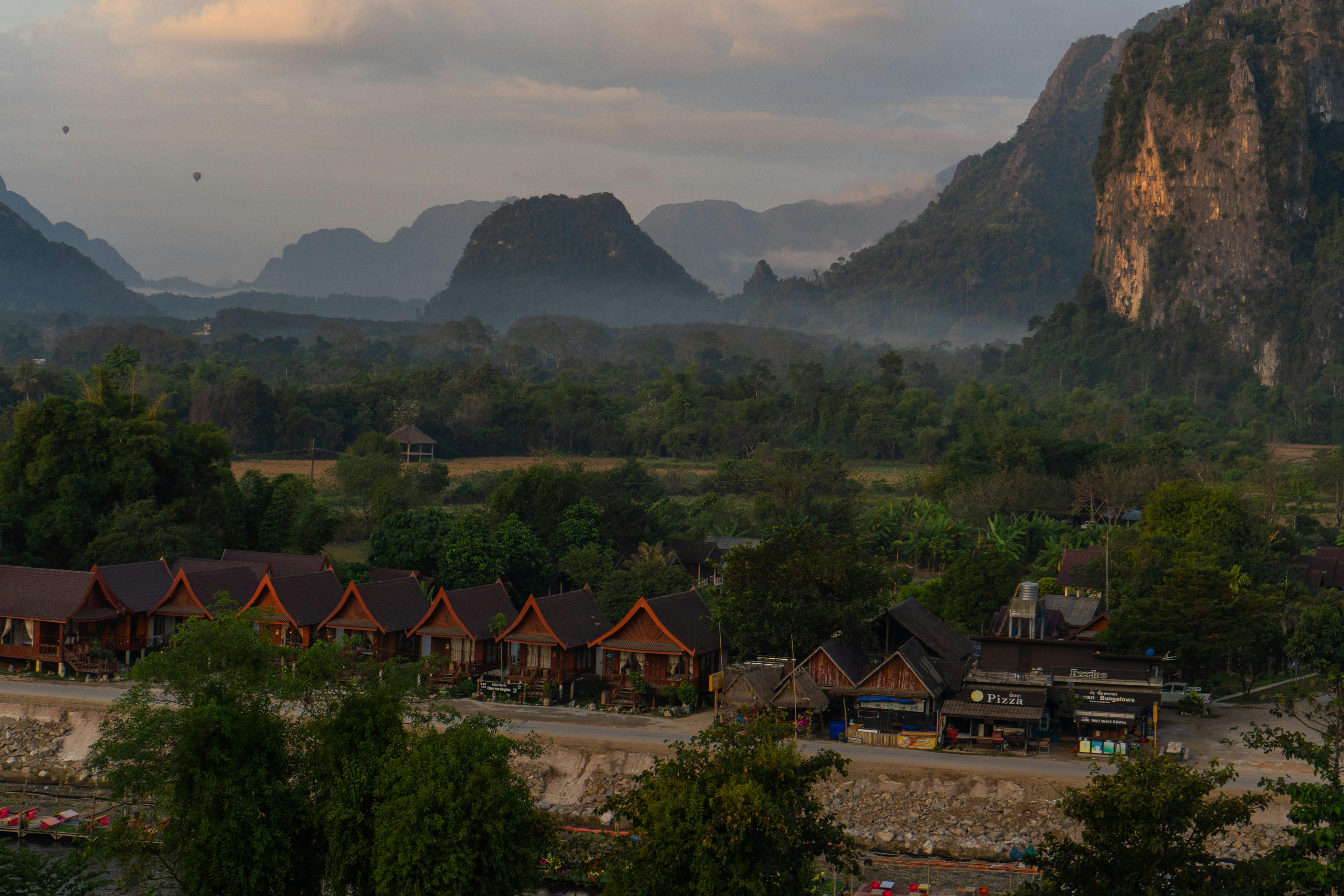
At the top, a wooden platform and an old motorbike left as a photo prop open onto a 360-degree view of rice paddies and limestone peaks. Start climbing at 4pm for the golden light, or go before 6am for sunrise with the valley under mist, the most famous photo in Vang Vieng. If it is crowded, Pha Ngern viewpoint, north of town, has a similar climb and fewer people.
Day 4: Vang Vieng, the Blue Lagoon and the Nam Song river
Blue Lagoon and Tham Phu Kham cave: turquoise water below the cliff

Half a day, cheap entry, 7 km from town on a dirt road. Go early, before 10am, when the buggy groups arrive and the water is still calm. There are several numbered blue lagoons around town; this is the original, number 1, and the prettiest.
Locals jump from the branches of the tree into the pool and swing out on the rope. Above the lagoon, a steep 15-minute path climbs to Tham Phu Kham cave, where a bronze reclining Buddha lies under a shaft of light. Bring a torch: the back of the cave is dark and slippery.
If you want to start the day up high, the sunrise hot air balloon flight leaves town around 6am and costs about 100 US dollars.
Nam Song river: tubing or kayaking back to town

About 3 hours, early afternoon, when the sun is lower. Agencies on the main street drive you 4 km upriver by tuk-tuk and you float back to the centre on an inner tube or paddle a kayak, between limestone cliffs and buffalo on the bank.
Tubing gave Vang Vieng its party reputation until 2012, when the government shut the riverside bars after a string of deaths. It is far calmer now, but the rules stand: life jacket on, no alcohol on the water and finish before dark. In the dry months, February to April, the river runs shallow and kayaking beats the tube.
Day 5: by train to Luang Prabang, the palace and Mount Phousi
Luang Prabang Royal Palace: Haw Kham and the Buddha that named the city

About 1 hour, around 30,000 kip, closes at 4pm and on Tuesdays. The train from Vang Vieng takes an hour and the station is 13 km from the centre, so arrive in the morning, check in and start here at 3pm. Cover shoulders and knees; no photos inside.
The palace was built in 1904 for King Sisavang Vong during the French protectorate and stayed intact when the monarchy fell in 1975. The throne room has red walls covered in coloured glass mosaics. In the garden, the Haw Pha Bang temple holds the Phra Bang, the gold Buddha image that gave Luang Prabang its name.
Wat Mai: the gilded facade next to the palace

Quick stop, 25 minutes, right next to the palace. The late 18th-century temple has a five-tiered roof and a veranda covered in gilded reliefs telling the Buddha's penultimate life. For almost half a century it was the temple that kept the Phra Bang.
Mount Phousi: 328 steps to the sunset

About 1h15, a small fee, across the street from the palace. Start climbing at 5pm: the sun sets over the Mekong around 6pm and the top gets packed, so arrive early for a spot on the western wall.
The hill, about 100 metres high, is crowned by the golden stupa of Wat Chom Si, and the path passes Buddhas for each day of the week and a footprint tradition attributes to the Buddha. Come down the stairway on the Nam Khan side, which is quieter and ends near the night market.
Luang Prabang night market: crafts and the food alley

Free, 1h30, on Sisavangvong Road at the foot of Phousi. From 5pm to 10pm the street closes to traffic and becomes a corridor of textiles, quilts, mulberry paper lanterns and crafts from the northern ethnic groups, often sold by the makers themselves.
Bargaining is expected, but gently and with a smile: margins are small. For dinner, step into the side food alley, where a fixed price fills a plate at the vegetarian buffet, or order grilled Mekong fish and skewers.
Day 6: Luang Prabang, Tak Bat, Wat Xieng Thong and Kuang Si
Tak Bat: the dawn alms procession

Free, 45 minutes, from 5.30am to 6.15am on Sakkaline Road. Every day hundreds of monks leave the temples in single file, barefoot, and receive sticky rice from residents kneeling on the pavement. It is a religious ritual, not a show, and the monks have publicly asked tourists for more respect.
The rules are simple: stand on the opposite side of the street, in silence, with no flash and never in the path of the line. Only take part if it means something to you, kneeling, with rice bought at the market, never from the vendors who approach tourists on the pavement, whose rice is often poor quality.
Wat Xieng Thong: the jewel of the peninsula

About 1 hour, 20,000 to 30,000 kip, opens at 8am. It is 300 metres from the Tak Bat stretch, at the tip where the Nam Khan meets the Mekong: have breakfast by the river and walk in when it opens.
Built in 1560 by King Setthathirath, it is the most important temple in town and the model of the Luang Prabang style, with a layered roof that sweeps almost to the ground. Walk round to the back wall for the tree of life mosaic in coloured glass, and step into the hall that houses King Sisavang Vong's 12-metre funeral carriage.
Morning market: street breakfast behind the palace

Quick stop, 40 minutes, 1.2 km from Wat Xieng Thong along the main street. The lanes behind the palace sell mountain greens, Mekong fish, frogs, roots and fruit. It is the moment to try khao piak sen, the thick rice noodle soup Lao people eat for breakfast.
Kuang Si Falls: turquoise pools and the bear sanctuary

Half a day, 4 hours with the ride, 60,000 kip entry including the bear sanctuary. It is 30 km away, 45 minutes by minivan or a tuk-tuk hired in town; leave after lunch, when the morning groups have gone, and stay until closing, around 5.30pm.
The water tumbles down a staircase of limestone terraces into turquoise pools, and swimming is allowed in several of them. Take the left-hand trail to the top of the 60-metre main drop. At the entrance, Free the Bears cares for Asiatic black bears rescued from the bile trade.
Day 7: up the Mekong to the Pak Ou caves
Ban Xang Hai: the lao-lao village

Quick stop, 30 minutes, on the boat ride to Pak Ou. The village distils lao-lao, a rice spirit, in clay pots and offers tastings at the riverside stalls. The bottles with snakes and scorpions inside are for photos, not for your luggage: most will not clear customs.
Pak Ou caves: thousands of Buddhas in the Mekong cliff

A full morning, with a 2-hour boat ride upriver and 1 hour back, leaving at 8am from the pier behind the palace; cheap entry to the caves. You can be back in time for a mid-afternoon flight.
The two caves sit in the cliff opposite the mouth of the Ou river and hold thousands of Buddha images in wood and gold, left by pilgrims over centuries. The lower one, Tham Ting, is at water level; the upper one, Tham Theung, is darker and needs a torch.
Do you need a visa for Laos?
Most nationalities do. The tourist eVisa costs 50 US dollars for passports such as Spain or Brazil (the official calculator shows the fee for yours) and is issued on the official portal, laoevisa.gov.la, in about three working days. It is valid for 60 days from approval for a stay of up to 30 days. A visa on arrival is also available at Vientiane and Luang Prabang international airports and at the Friendship Bridge from Thailand, with a photo and US dollars in cash.
Your passport must be valid for six months with a blank page. If you arrive from a country with yellow fever transmission, carry your vaccination certificate. Avoid the lookalike sites that charge double the official fee.
When is the best time to visit Laos?
November to February, the cool dry season, with days of 25 to 28 degrees Celsius and cold nights in the north, dropping to 12 degrees in Luang Prabang in December and January. It is also high season, with hotels and trains in higher demand.
March and April are very hot and bring smoke from agricultural burning, which hides the mountains around Vang Vieng. From May to October it rains most days, the countryside turns green and prices drop, but Kuang Si can run muddy after a storm. In October the end of Buddhist Lent brings Luang Prabang's festival of lights, with illuminated boats on the Mekong; in November, the That Luang festival in Vientiane. Dates follow the lunar calendar.
How to get to Laos and how to travel between cities
Most long-haul trips connect through Bangkok, Hanoi or Singapore, with a short flight to Vientiane, just over an hour from Bangkok. Book an open jaw: fly into Vientiane and out of Luang Prabang, which has flights to Bangkok and Hanoi, so you never retrace your steps.
Between cities, the Laos-China Railway is fast and comfortable: about an hour from Vientiane to Vang Vieng and another to Luang Prabang, with fares of 10 to 25 US dollars depending on class. Buy through the official LCR Ticket app, at stations or at travel agencies in town, with your passport, and book ahead in high season because morning departures sell out. Stations are far from the centres and have airport-style scanners: no knives or aerosols in your bag.
In town, walk, take a tuk-tuk with the price agreed first, or use LOCA, the local ride-hailing app. The currency is the kip; bring crisp US dollar notes and use ATMs in the centre, which cap each withdrawal.
Where to eat in Laos: traditional dishes and where to find them
Lao cooking revolves around khao niao, sticky rice served in a bamboo basket and eaten by hand, rolled into balls that scoop up everything else. The national dish is laap, minced meat or fish with fresh herbs, lime, chilli and ground toasted rice.

Tam mak hoong is green papaya salad pounded in a mortar, sourer and deeper than the Thai version thanks to padaek, fermented fish sauce. In Luang Prabang, order the local khao soi, nothing like the Chiang Mai dish: wide rice noodles in clear broth topped with a pork and tomato sauce. The same north gives you or lam, a meat and aubergine stew with a woody bark that numbs the tongue, and sai oua, lemongrass pork sausage.


Where to eat: in Vientiane, the stalls on the Mekong promenade next to the night market, with salt-grilled fish; in Luang Prabang, the night market food alley, the morning market and the noodle shops on the main street at breakfast. The French legacy survives in khao jee pâté, a baguette with pâté and pickled vegetables sold on street corners. Both cities have training restaurants run by social projects that teach cooking and service to young people from poor families, with well-made Lao menus at fair prices.
To drink, Beerlao, the national beer, is on every table, and lao-lao, the rice spirit, turns up in the villages.

What to avoid: raw river fish laap, which carries liver flukes; tap water, including ice at street stalls; and the "happy" shakes and pizzas on bar menus in Vang Vieng, which contain drugs and lead to serious trouble with the police.
Is 7 days enough for Laos?
For the railway corridor, yes: seven days cover the capital, Vang Vieng and Luang Prabang with a spare day in each town and no rush. What gets left out is the south, with the Mekong's 4,000 Islands and the Wat Phou temple, the Plain of Jars around Phonsavan and the Ou river villages of Nong Khiaw, which need another four or five days.
Laos pairs well with its neighbours: Luang Prabang has direct flights to Hanoi, the starting point of our Vietnam itinerary, and the south leads to Cambodia, covered in our Angkor Wat and Phnom Penh itinerary. To adjust dates, trains and hotels, save this itinerary on Galmund.
Estimated budget per person
Prices checked on 22 September 2026. Check current prices at Government of Laos, eVisa fee calculator · LCR Ticket, official Laos-China Railway app.
Frequently asked questions
Do I need a visa for Laos?+
Most visitors do. The tourist eVisa costs 50 US dollars for passports such as Spain or Brazil (the official calculator shows the fee for yours) and is issued on the official portal laoevisa.gov.la in about three working days, or you can get a visa on arrival at Vientiane and Luang Prabang airports. It allows a stay of up to 30 days, and your passport must be valid for six months.
How much does a 7 day trip to Laos cost?+
Between 450 and 850 US dollars per person, excluding international flights, covering a mid-range double room, food, both train legs, tuk-tuks, entry fees, Kuang Si and the Pak Ou boat. Add around 50 dollars for the visa. The Vang Vieng hot air balloon, about 100 dollars, is the biggest optional expense.
How do I buy train tickets in Laos?+
Through the official LCR Ticket app from the Laos-China Railway, at station ticket offices, or at travel agencies in town, which charge a small fee and save you the trip out to the station. You need your passport. Sales open a few days ahead and in high season, November to February, morning trains sell out, so buy as soon as they open.
Is Vang Vieng still a party town?+
Far less than it used to be. The riverside bars that made Vang Vieng famous were shut in 2012 after several tourist deaths on the tubing route, and the town reinvented itself with hikes, caves, kayaking and balloons. There are still lively bars at night, but tubing is calm today. Avoid the "happy" menus, which contain drugs.
How can I watch Tak Bat in Luang Prabang respectfully?+
Stand on the opposite side of the street, in silence, with no flash and never in the path of the monks, between 5.30am and 6.15am on Sakkaline Road. Wear clothes that cover shoulders and knees. Only join the offering if it means something to you, kneeling, with rice bought at the market, never from the vendors who approach tourists on the pavement.
Ready to go?
Save this itinerary to your Galmund and take the schedule, map and budget with you. Edit, share and track it all on the globe.
Save this itinerary to my GalmundBeen there already?
Pin this trip on your globe and keep your photos where they were taken.
Pin it on my globe