Siem Reap · Angkor Wat · Phnom Penh · 15 min read
Cambodia 6-Day Itinerary: Angkor Wat and Phnom Penh
6 days · 5 cities
Duration
6 days
Estimated budget
US$ 1,600 to US$ 2,400 per person, 6 days
Best time to go
November to February (dry and mild)
Visa
e-Visa, about US$30, up to 30 days
This 6-day Cambodia itinerary splits the trip into two bases: four days in Siem Reap for the Angkor temples, and two days in Phnom Penh for the country’s recent history, without cramming both into one rushed loop.
In short: arrival and the Old Market, Angkor Wat and Bayon, Banteay Srei and Ta Prohm, Tonle Sap and the museum, then Phnom Penh for the last two days. Visa, timing and how to get there are in the practical sections below.
Day 1: Arrival in Siem Reap and the Old Market
Old Market (Psar Chas)

About 15 minutes on foot from downtown, the Old Market is the first stop because it sits right in the area where most Siem Reap hotels cluster: set aside an hour to walk past stalls of silk, spices and crafts, with a food court in the back serving genuine Cambodian food at local prices.
Open since the French colonial era, it is the city’s oldest market and runs daily into the late evening. Haggling is normal, but in moderation: prices here already run lower than at the night markets nearby.
Wat Preah Prom Rath

Five minutes on foot from the market, on the Siem Reap riverbank, Wat Preah Prom Rath is a 20 to 30-minute stop: an active temple, half Buddhist and half Hindu in origin, with ox and horse statues in the courtyard and a monk school running next door.
Day 2: Angkor Wat and Angkor Thom, the grand circuit
Angkor Wat

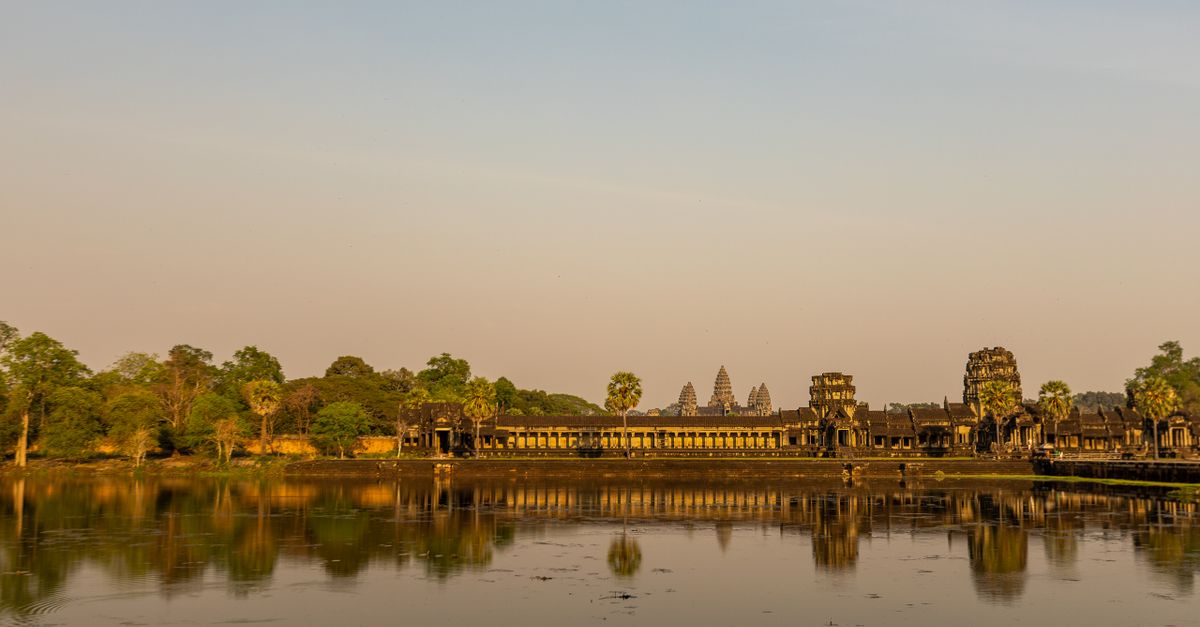
Leave the hotel before 5am if you want to catch the sun rising behind the five towers, Cambodia’s most repeated postcard shot: set aside two to three hours for the temple itself, and arrive with your Angkor Pass already bought, since the check line at the entrance backs up fast at sunrise.
Built in the early 12th century by King Suryavarman II as a Hindu temple dedicated to Vishnu, later converted to Buddhism, it is the largest religious monument in the world by built area. The first-level galleries hold 800 meters of carved bas-reliefs, including the Battle of Kurukshetra and the Churning of the Sea of Milk.
Bayon and Angkor Thom

A twenty-minute drive from Angkor Wat, inside the old walled city of Angkor Thom, the Bayon temple calls for one to two hours: 216 smiling stone faces carved into 54 towers, said to be the face of King Jayavarman VII or the bodhisattva Avalokiteshvara, depending on who tells the story.
Angkor Thom was the last capital of the Khmer Empire, founded in the late 12th century, and still holds the Terrace of the Elephants and the Terrace of the Leper King a few minutes’ walk from the Bayon, easy to fold into the same stop at no extra ticket cost.
Day 3: Banteay Srei and Ta Prohm
Banteay Srei

About an hour’s drive from Siem Reap, Banteay Srei takes up half a day once you count the trip, but it is worth it: set aside an hour at the temple, ideally early morning, when low light brings out the pink tone of the stone.
Built in 967 and dedicated to Shiva, it is the only Angkor temple carved in pink sandstone, harder and more weather-resistant than the grey stone used at Angkor Wat and Bayon: the carvings here, over a thousand years old, are better preserved than many reliefs on the main circuit that are far younger.
Ta Prohm

On the way back from Banteay Srei to Siem Reap, Ta Prohm is the afternoon stop: set aside an hour, and expect to share the space with other visitors, since it is the most photographed temple on the circuit after Angkor Wat.
Built in the late 12th century as a Buddhist monastery, it was deliberately left as French archaeologists found it: the roots of the spung tree (Tetrameles nudiflora) swallowing the stone corridors became the temple’s symbol, and the scenery gained worldwide fame after appearing in the 2001 film Tomb Raider.
Day 4: Tonle Sap and the Angkor National Museum
Kampong Phluk floating village

About 40 minutes by car plus a stretch by boat from Siem Reap, Kampong Phluk takes up two to three hours: wooden houses raised on six to seven-meter stilts, which look like they are floating in the dry season and sit nearly submerged during the flood, between September and November.
The village lives off fishing on Tonle Sap, Southeast Asia’s largest freshwater lake, which expands up to five times in size at the peak of the rainy season. The boat ride between the houses usually includes a stop at the flooded mangrove forest.
Angkor National Museum

Back in Siem Reap, the Angkor National Museum takes up an hour and a half: eight themed galleries explain the rise and fall of the Khmer Empire, with over 1,300 original pieces, including a room holding a thousand Buddha statues alone.
It is the ideal complement after two days of temples, since it explains the religious and historical context the stones alone do not. Admission costs US$12 for adults.
Day 5: Phnom Penh, the Royal Palace and the Silver Pagoda
Royal Palace of Phnom Penh

Still the official residence of Cambodia’s king, the Royal Palace takes up an hour: the Chanchhaya Pavilion, with its tiered golden roof, and the Silver Throne are the highlights of the section open to visitors, since the king’s private quarters stay closed to the public.
Built starting in 1866, when the capital moved from Oudong to Phnom Penh, the complex follows the canons of classical Khmer architecture, with tiered roofs and naga-shaped finials. Covered shoulders and knees are required to enter.
Silver Pagoda

Inside the same Royal Palace grounds, the Silver Pagoda takes up 45 minutes: the floor is covered with over 5,000 solid silver tiles, each weighing about a kilogram, most of it kept under carpet to protect the metal from wear.
The temple holds the Emerald Buddha, made of Baccarat crystal, and a 90-kilogram solid gold Buddha studded with over 9,000 diamonds, donated by King Sisowath in 1906.
Central Market (Phsar Thmey)

Fifteen minutes on foot from the Royal Palace, the Central Market is a 45-minute stop: the yellow art deco dome, built in 1937, is one of Phnom Penh’s most recognizable landmarks, with four cross-shaped wings selling everything from gold and watches to street snacks.
Day 6: Phnom Penh, memory and departure
Wat Phnom

Atop a 27-meter artificial hill, the only natural elevation in this flat city, Wat Phnom is a 30-minute stop: the temple gives Phnom Penh its own name, and local legend has it that a woman named Penh found four Buddha statues floating in the river and built the temple to house them, in the 14th century.
National Museum of Cambodia

Ten minutes on foot from the Royal Palace, the National Museum of Cambodia takes up an hour and a half: the terracotta-red 1920 building, in traditional Khmer style, holds the world’s largest collection of Khmer sculpture, with pieces taken directly from the Angkor temples.
The inner courtyard, with its enclosed tropical garden, is as much part of the visit as the galleries: a good spot to sit in the shade before the heavier museums of the afternoon.
Tuol Sleng Genocide Museum (S-21)

Set aside an hour and a half, and come prepared emotionally: this former secondary school became the Khmer Rouge’s detention and torture center between 1975 and 1979, known as S-21, through which around 20,000 prisoners passed. Only a handful survived.
The classrooms, with improvised cells and prisoner ID photos, remain as they were found in 1979. The audio guide, included in the US$5 ticket, helps make sense of it without needing a human guide.
Choeung Ek Killing Fields

A 40-minute drive from downtown, Choeung Ek takes up an hour and a half: it is the best known of more than 300 killing fields used by the Khmer Rouge regime, where prisoners brought from S-21 were executed and buried in mass graves.
A glass memorial stupa, built in 1988, holds more than 5,000 skulls as a permanent testimony. The audio guide, included in the US$6 ticket, is the recommended way to visit: walking in silence, at your own pace, with no group narration.
Do you need a visa to visit Cambodia?
Yes, but the process is quick: the e-Visa costs about US$30, is requested online and arrives by email within three business days. It is valid for 90 days from issuance for a single entry, with a stay of up to 30 days in the country.
Besides the e-Visa, Cambodia now requires an e-Arrival, an electronic arrival form filled out separately before the flight. Both documents are individual, including for children.
What is the best time to visit Cambodia?
November to February is the ideal window: the rains have ended, temperatures are milder, and Tonle Sap is still full enough for the boat trips in Kampong Phluk. March to May is the hottest stretch, with heat index passing 40 degrees Celsius.
September and October have their own appeal: that is when Tonle Sap hits its peak volume, and the stilt houses of Kampong Phluk sit nearly fully submerged, a very different sight from the dry season.
How to get to Cambodia and how to get around
There is no direct flight from Brazil. The most common connection runs via Doha, on Qatar Airways, or Istanbul, on Turkish Airlines, usually with one more leg to Phnom Penh or Siem Reap, and total travel time runs past 30 hours including layovers.
Between Siem Reap and Phnom Penh, about 315 km apart, the options are an express bus (6 to 7 hours), a shared van (faster, tighter) or a domestic flight (55 minutes). Within each city, the tuk-tuk is the standard ride, negotiated per trip or hired for a full day of temple visits.
Where to eat in Cambodia: local dishes and what to avoid
Amok, fish steamed with curry paste and coconut milk inside a banana leaf, is the dish most associated with Cambodia, and it is worth ordering the version made with Tonle Sap fish.

Nom banh chok, rice noodles with fish sauce and herbs served at breakfast, and lok lak, stir-fried beef strips in a pepper-lime sauce, round out the trio found on any Cambodian table. Cambodian coffee, strong and served over ice with condensed milk, is another local specialty, sold at any street stall for under a dollar.

What to avoid: restaurants with a host standing at the door waving passersby in and a laminated menu with photos of every dish, common on Siem Reap’s Pub Street. The food there is marked up for tourists and weaker than anything from a food stall at the Old Market, a few steps away.
What currency does Cambodia use, and can you pay in dollars?
The official currency is the riel (KHR), but the US dollar circulates freely and is accepted almost everywhere, from hotels to tuk-tuks: most prices are already quoted in dollars, and small change usually comes back in riel.
International cards work at hotels and larger restaurants in both cities, but markets, tuk-tuks and most temples off the main circuit take cash only, preferably dollar bills in good condition, without tears or pen marks.
Is 6 days enough to see Cambodia?
Six days cover the two sides of the country that weigh most in the decision to go: the Angkor temples, with room for both the small and grand circuits, and Cambodia’s recent history in Phnom Penh, without having to pick one over the other.
With four days, you can focus on Siem Reap and the temples alone. With ten days or more, add Battambang, a French colonial town three hours down the road, or the south coast around Sihanoukville and the Koh Rong islands.
Estimated budget per person
Prices checked on 15 September 2026. Check current prices at Angkor Enterprise, official Angkor Pass tickets · Tuol Sleng Genocide Museum, official site.
Frequently asked questions
Do Brazilians need a visa to visit Cambodia?+
Yes. The e-Visa costs about US$30, is done online and arrives by email within three business days, valid for 90 days for a single entry and a stay of up to 30 days in the country.
How much does a 6-day trip to Cambodia cost?+
A 6-day itinerary costs between US$1,600 and US$2,400 per person, including a connecting flight, lodging, food, transport and entrance tickets (Angkor Pass, museums and memorials), with prices checked in September 2026.
How many days do you need to see Cambodia?+
Six days cover Siem Reap (the Angkor temples) and Phnom Penh without rushing. With four days you can focus on the temples alone, and with ten or more you can add Battambang or the south coast around Sihanoukville.
Do you need to speak English to travel around Cambodia?+
It helps, but is not essential. Basic English is common among people working in tourism in Siem Reap and Phnom Penh, especially tuk-tuk drivers and hotel staff. Outside the tourist circuit, a translation app handles most situations.
Ready to go?
Save this itinerary to your Galmund and take the schedule, map and budget with you. Edit, share and track it all on the globe.
Save this itinerary to my GalmundBeen there already?
Pin this trip on your globe and keep your photos where they were taken.
Pin it on my globe