Delhi · Agra · Fatehpur Sikri · Abhaneri · Jaipur · 15 min read
India 7 Day Itinerary: Golden Triangle, Delhi, Agra and Jaipur
7 days · 3 cities
Duration
7 days
Estimated budget
US$ 1,500 to US$ 2,400 per person, 7 days
Best time to go
October to March, dry and not too hot
Visa
e-Visa required, applied for online
This India 7 day itinerary drives the Golden Triangle with a hired car and driver, three bases and one direction: Delhi, Agra, Jaipur. Hiring the driver is the decision that shapes the trip, because the best stops sit between the cities, not inside them.
In short: two days in Delhi, two in Agra with the Taj at sunrise, Fatehpur Sikri and Chand Baori on the road, three days in Jaipur. Visas, season and food are at the end.
Day 1: arriving in Delhi, Humayun Tomb and the gardens
Humayun Tomb: the rehearsal for the Taj Mahal

600 rupees for foreigners, 1h15, open daily until sunset. It is the first Mughal garden tomb in India, from 1570, and the model Shah Jahan followed at the Taj Mahal eighty years later.
Start here and the rest of the trip reads more easily: the double dome, the garden quartered by water channels and the red sandstone with white marble all come back in Agra and Sikandra.
Sunder Nursery: the park nobody puts on the itinerary

100 rupees, 1 hour, 500 metres from the tomb. It was a British colonial plant nursery and became a heritage park in 2018 after fifteen years of restoration by the Aga Khan Trust.
Thirty six hectares hold six Mughal monuments, water channels, a rose garden and 80 bird species. It is the calmest place on this route and almost never appears on an agency list.
Lodhi Garden: late afternoon with the locals

Free, 45 minutes, 3 kilometres from Sunder Nursery by rickshaw. It closes at 8pm, which makes it the last possible stop on arrival day.
The 15th and 16th century tombs stand loose on the lawn, unfenced, and the city uses the park to run and to court. If you only have one afternoon in Delhi, this is where it should end.
Day 2: Old Delhi and the Qutub Minar
Red Fort: the fortress that became a national symbol

600 rupees, 1h30, closed Mondays. It was the Mughal imperial residence for two centuries from 1648 and is where the prime minister speaks every 15 August.
An honest warning: the interiors were stripped by the British after 1857, and what remains is marble pavilions in a large park. If your time in Delhi is short, the Qutub Minar and Humayun Tomb give more per ticket.
Chandni Chowk: the 17th century market

Free, 45 minutes, right outside the fort. This is the avenue laid out in 1650 by Shah Jahan daughter, now a tangle of lanes for spices, silver and stationery. Take a cycle rickshaw and get off at Paranthe Wali Gali.
Jama Masjid: a courtyard for 25,000 people

300 rupees for a camera, 45 minutes, 600 metres from Chandni Chowk. It closes to visitors during prayers, with a wide window between 1.30pm and 6.30pm. Shoulders and knees covered, shoes off at the gate.
It is the largest mosque in India, finished in 1656 by the same emperor who built the Taj Mahal. Climbing the south minaret costs extra and gives the best view over Old Delhi.
Qutub Minar: the 73 metre minaret

550 rupees, 1h30, 16 kilometres south, 45 minutes by car. It opens daily from 7am to 5pm, and early light rakes across the inscriptions.
The brick tower was begun in 1199 and is the tallest masonry minaret in the world. The same grounds hold the Quwwat-ul-Islam mosque, built from the columns of dismantled Hindu temples, and the 4th century iron pillar that does not rust.
Day 3: the road to Agra, the fort and sunset at Mehtab Bagh
Agra Fort: the prison with a view of the Taj

650 rupees, 1h30, 3 hours from Delhi on the Yamuna Expressway. Arrive after check-in, around 3pm, when the sun no longer punishes the courtyards.
It was the Mughal capital until 1638 and the place where Aurangzeb held his own father prisoner for the last eight years of his life. From the octagonal tower Shah Jahan could see the Taj Mahal where his wife lay. You get the same view.
Itimad-ud-Daulah: the Baby Taj without a queue

310 rupees, 40 minutes, across the Yamuna. It dates from 1628, predates the Taj Mahal, and was the first Mughal building entirely faced in marble.
The pietra dura work, semiprecious stones inlaid into marble, is finer here than at the Taj itself, and you usually have it to yourself.
Mehtab Bagh: the Taj Mahal from across the river

300 rupees, 50 minutes, 3 kilometres from the Baby Taj. It is the Mughal garden aligned with the mausoleum on the opposite bank, and the place to watch the sunset hit the marble.
Get there 45 minutes before sunset. In November and December the winter fog can erase the view: if the sky closes in, swap it for the Yamuna riverside and save the Taj for the next morning.
Day 4: the Taj Mahal at sunrise and the tomb of Akbar
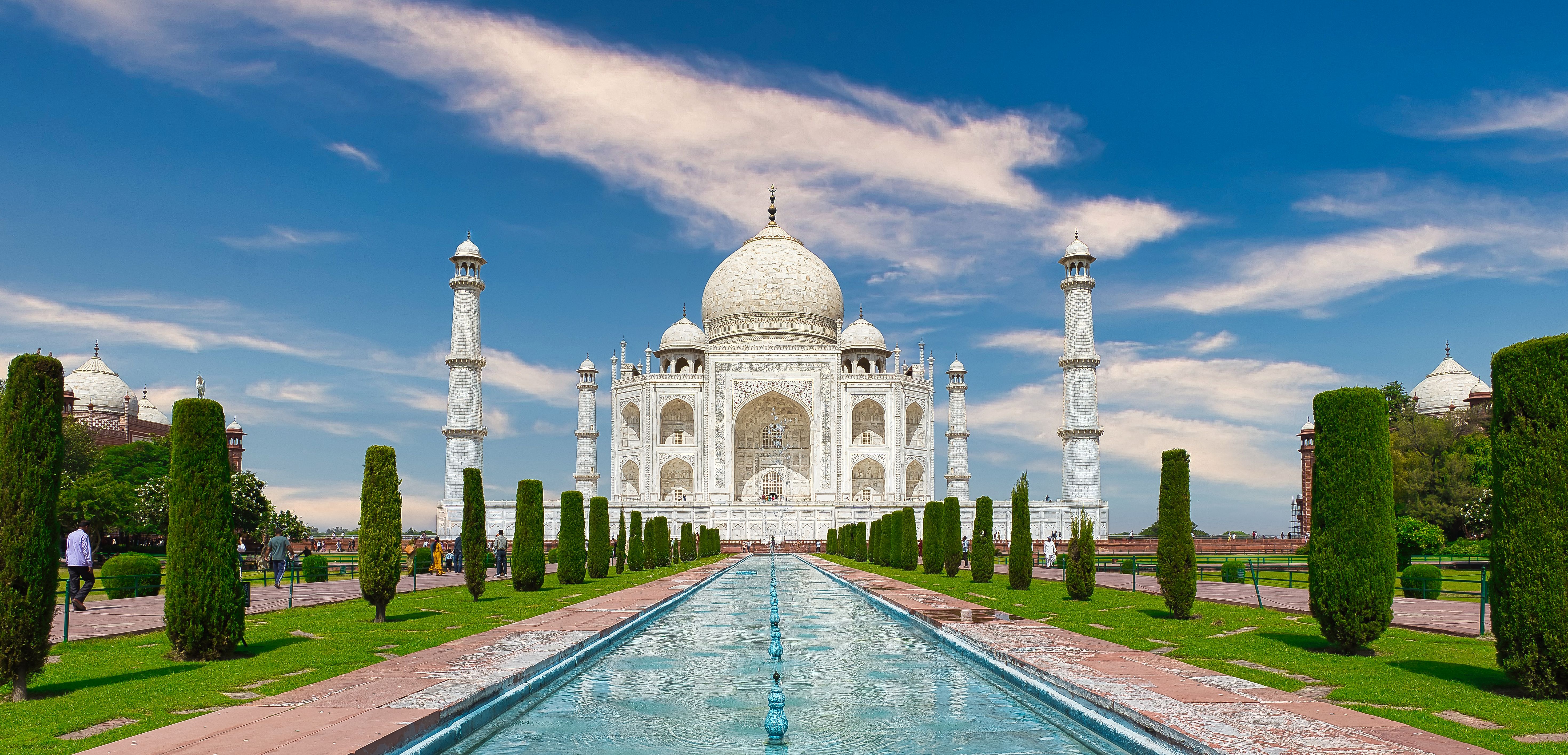
Taj Mahal: be there before the gate opens

1,300 rupees plus 200 to enter the mausoleum chamber, 3 hours, closed on Fridays. Buy online, because sales are capped at 5,000 tickets per time slot, and the east gate has the shorter queue.
Be at the gate 30 minutes before sunrise. That first half hour is the only one when the marble changes colour and the reflection in the pool comes without people in front of it; from 9am the flow is continuous.
Shah Jahan spent 21 years and 20,000 workers burying Mumtaz Mahal here. Note that both cenotaphs in the chamber are false: the real graves lie in the crypt, closed to the public.
Jama Masjid of Agra: the mosque inside the bazaar

Free, 45 minutes, 3 kilometres from the Taj. The 1648 mosque was built by princess Jahanara and stands inside Kinari Bazaar, the cloth and wedding market of Agra, which is the best walk in town outside the monuments.
Tomb of Akbar: the gateway with four minarets

650 rupees, 1h15, 10 kilometres northwest on the Delhi road. Akbar began his own tomb while alive and his son finished it in 1613.
The sandstone gateway with marble inlay is the high point, and the surrounding park holds free roaming deer and monkeys. Hold on to your glasses and do not carry food in your hand: the monkeys here are quick.
Day 5: Fatehpur Sikri, Chand Baori and arriving in Jaipur
Fatehpur Sikri: a capital abandoned in ten years

550 rupees, 2 hours, 1 hour from Agra. Leave at 7.30am to get the site empty: the buses from Agra arrive after 10am.
Akbar founded the city in 1571 and the court left barely a decade later, for lack of water. What is left is an entire Mughal city in red sandstone with no later layer on top. Enter through the Buland Darwaza, the 54 metre gateway, and ignore the unlicensed guides who approach in the car park.
Chand Baori: 3,500 steps across thirteen storeys

A token ticket, 1 hour, 2h30 from Fatehpur Sikri, in the village of Abhaneri, 95 kilometres from Jaipur. It is a 9th century stepwell dropping more than 20 metres across thirteen storeys of symmetrical steps.
You cannot go down, only walk the rim, and it is still the most photographed stop on this road. Add the ruined Harshat Mata temple on the other side of the wall. Abhaneri to Jaipur is another 1h30.
Day 6: Amer Fort, the hidden stepwell and Hawa Mahal
Amer Fort: arrive at 8am, before the buses

1,000 rupees since the price revision of 1 January 2026, 2h30, 11 kilometres north of Jaipur. It opens at 8am, which is when the light hits the palace head on, reflected in Maota Lake.
Do not ride up by elephant: the practice draws welfare campaigns, daily trips are capped, and a jeep covers the same stretch. Inside, look for the Sheesh Mahal, the mirror hall, and the Sukh Niwas, with the water channel that cooled the air before electricity.
Panna Meena ka Kund: the stepwell 500 metres from the fort

Free, 30 minutes, five minutes on foot from the fort car park. It is a 16th century stepwell with symmetrical stairs across eight levels. Walking down the steps is not allowed, and the good photo comes from the north rim in the morning.
Hawa Mahal: the 953 windows of the pink facade

600 rupees after the 2026 revision, 1 hour, 11 kilometres south of the fort. The 1799 facade is five storeys tall with almost a thousand latticed windows, built so the women of the court could watch the street without being seen.
The classic photo comes from the pavement across the avenue, early in the morning, when the sun is full on the facade. Inside it is ramps and views over the Jantar Mantar, and the visit is shorter than the queue suggests.
Day 7: the City Palace, the observatory and flying out of Jaipur
City Palace: the palace that is still lived in

1h30, 300 metres from Hawa Mahal. The ticket is separate because the palace belongs to the maharaja family, not the state, and it is not covered by the Jaipur pass: check the price on the official site before going.
The family has occupied the seven storey Chandra Mahal since 1732. What you visit are the courtyards, the costume museum and the four painted doors of Pitam Niwas Chowk, one for each season.
Jantar Mantar: the largest stone sundial in the world

200 rupees, 1 hour, next to the City Palace. Nineteen masonry instruments were built here in 1734 by maharaja Jai Singh II, an astronomer before he was a king.
Take the guide at the entrance or the audio guide: without an explanation the place looks like a park of staircases. The Samrat Yantra stands 27 metres tall and tells local time to within two seconds.
Patrika Gate: the last stop, on the way to the airport

Free, 30 minutes, 10 kilometres south at Jawahar Circle. The gateway opened in 2016 and each arch carries frescoes of one region of Rajasthan. It sits 8 minutes from Jaipur airport, an hour flight from Delhi.
Do you need a visa to visit India?
Yes, and it is done online. The tourist e-Visa is issued through the official site indianvisaonline.gov.in, usually within 72 hours, in 30 day, 1 year and 5 year versions, and it is open to citizens of Brazil, the United States, Canada, the United Kingdom, Australia and the European Union. Use only the gov.in domain: dozens of intermediary sites charge three times as much.
Since January 2026 a reciprocity agreement between Brazil and India has extended the ordinary tourist visa from 5 to 10 years of validity, with stays of up to 90 days per entry. The e-Visa remains faster for a single trip.
When is the best time to visit the Golden Triangle?
October to March. November to February brings days of 20 to 25 degrees and cool nights, and is high season. From April to June northern India passes 40 degrees and walking between forts becomes punishment; July to September is the monsoon.
Two winter caveats: the December and January fog closes airports and can erase the Taj Mahal in the morning, and air quality in Delhi collapses from October to December with stubble burning in Punjab. Anyone with asthma should consider February or March.
How to get to India and how to travel between Delhi, Agra and Jaipur
Delhi Indira Gandhi airport is the gateway, with direct flights from across Europe, the Gulf and Southeast Asia. From the Americas the trip runs 20 to 24 hours with one connection through Doha, Dubai, Abu Dhabi or Istanbul. This itinerary flies out of Jaipur, an hour from Delhi with several departures a day.
Between the cities, hire a car with a driver for the whole week, 200 to 300 dollars in total including fuel and tolls. It is not a luxury: the Yamuna Expressway and the NE-4 have traffic habits you do not want to learn on the spot, and the driver waits at every monument. The Gatimaan Express train does Delhi to Agra in 1h40 and is excellent, but it leaves you with no transport at Fatehpur Sikri and Abhaneri, which are half of this route.
The currency is the Indian rupee. Cards work at hotels and monuments, but carry cash for tips, bazaars and rickshaws. Always use an app rickshaw or agree the fare before getting in.
Where to eat in India: typical dishes and the best restaurants
Northern India eats bread, not rice, and the base is wheat, dairy and spice. Three things carry the trip, and none of them is the generic curry sold abroad.

Butter chicken, or murgh makhani, was invented in Delhi in the 1950s at Moti Mahal, using leftover tandoori chicken simmered in tomato and butter. It is the most copied dish in the world and it is still better here.

In Old Delhi, Karim, on Gali Kababian behind the Jama Masjid, has served since 1913 from recipes the family traces to the Mughal kitchens. Order the nihari, the meat stew that cooks overnight, for breakfast. Do not expect comfort: formica benches and aluminium plates.

Two blocks away, Paranthe Wali Gali is a whole lane of shops frying paratha since 1872, stuffed with potato, peas, cheese or banana. One plate comes with four pickles and makes lunch for a few rupees.

In Jaipur, swap the northern menu for the Rajasthani one: dal baati churma, round breads baked over coals, broken into lentils and served with a sweet wheat crumble in ghee. What to avoid everywhere on this route: raw salad, ice at street stalls and fresh juice poured into a reused glass.
Are 7 days enough to see India?
For the Golden Triangle, yes. Seven days cover Delhi, Agra, Fatehpur Sikri, Chand Baori and Jaipur with road legs of at most 3 hours, and it is the route almost every first trip to India takes, for a reason: the three cities tell the same Mughal story in order.
For the country, no. Left out are Varanasi, desert Rajasthan (Jodhpur, Udaipur and Jaisalmer), Kerala and Kashmir, each needing 4 to 8 days of its own. With 10 days, add Udaipur after Jaipur, a short flight away; with 12, Jodhpur between the two. For another South Asian destination with a similar climate and cost, see the Sri Lanka 8 day itinerary.
Estimated budget per person
Prices checked on 20 September 2026. Check current prices at Taj Mahal, site oficial da ASI · Archaeological Survey of India · Bilheteria eletronica da ASI · Rajasthan Tourism · Indian Visa Online, e-Visa oficial.
Frequently asked questions
Do you need a visa to visit India?+
Yes. The tourist e-Visa is applied for online at the official site indianvisaonline.gov.in and is usually issued within 72 hours, in 30 day, 1 year and 5 year versions, open to citizens of Brazil, the United States, Canada, the United Kingdom, Australia and the European Union. Since January 2026 a Brazil India reciprocity agreement has extended the ordinary tourist visa to 10 years of validity.
How much does a 7 day trip to India cost?+
Between 1,500 and 2,400 dollars per person, counting the long haul flight, mid range hotels, a car with driver split by two, food and tickets. The flight is most of the bill: on the ground India is cheap, and a full dinner runs 8 to 15 dollars.
When is the best time to do the Golden Triangle?+
October to March, with November to February at the best temperatures. Avoid April to June, when the north passes 40 degrees, and July to September, the monsoon. February and March dodge both the winter fog and the worst of the Delhi pollution.
Is the Taj Mahal closed on any day of the week?+
It closes all day on Fridays for prayers at the mosque inside the complex. On other days it opens from sunrise to sunset, with sales capped at 5,000 tickets per time slot, and the foreigner ticket costs 1,300 rupees plus 200 to enter the mausoleum chamber. Plan the Agra days around that.
Can you do the Golden Triangle without a driver?+
You can, but with a different route. The Gatimaan Express does Delhi to Agra in 1h40 and there are trains and buses from Agra to Jaipur, so all three cities are reachable. Fatehpur Sikri, Chand Baori and Amer Fort, however, sit away from the stations and need a taxi hired for the day or a paid tour.
Ready to go?
Save this itinerary to your Galmund and take the schedule, map and budget with you. Edit, share and track it all on the globe.
Save this itinerary to my GalmundBeen there already?
Pin this trip on your globe and keep your photos where they were taken.
Pin it on my globe