Antigua Guatemala · Lake Atitlan · San Pedro La Laguna · Flores · Tikal · Yaxha · 14 min read
Guatemala 7 Day Itinerary: Antigua, Lake Atitlan and Tikal
7 days · 3 cities
Duration
7 days
Estimated budget
US$ 1,200 to US$ 1,900 per person, 7 days
Best time to go
November to April, the dry season
Visa
No visa, up to 90 days in the CA-4
This Guatemala 7 day itinerary joins three bases: Antigua, Lake Atitlan and Flores in Peten. Sleeping in San Pedro La Laguna rather than Panajachel is the decision that shapes the week, because that is where the boats and the pre-dawn viewpoint vans leave from.
In short: two days in Antigua with Pacaya, three on the lake by boat, two at Tikal and Yaxha. Visas, season and food are at the end.
Day 1: arriving in Antigua, the Plaza Mayor and Cerro de la Cruz
Plaza Mayor: the square that organises Antigua

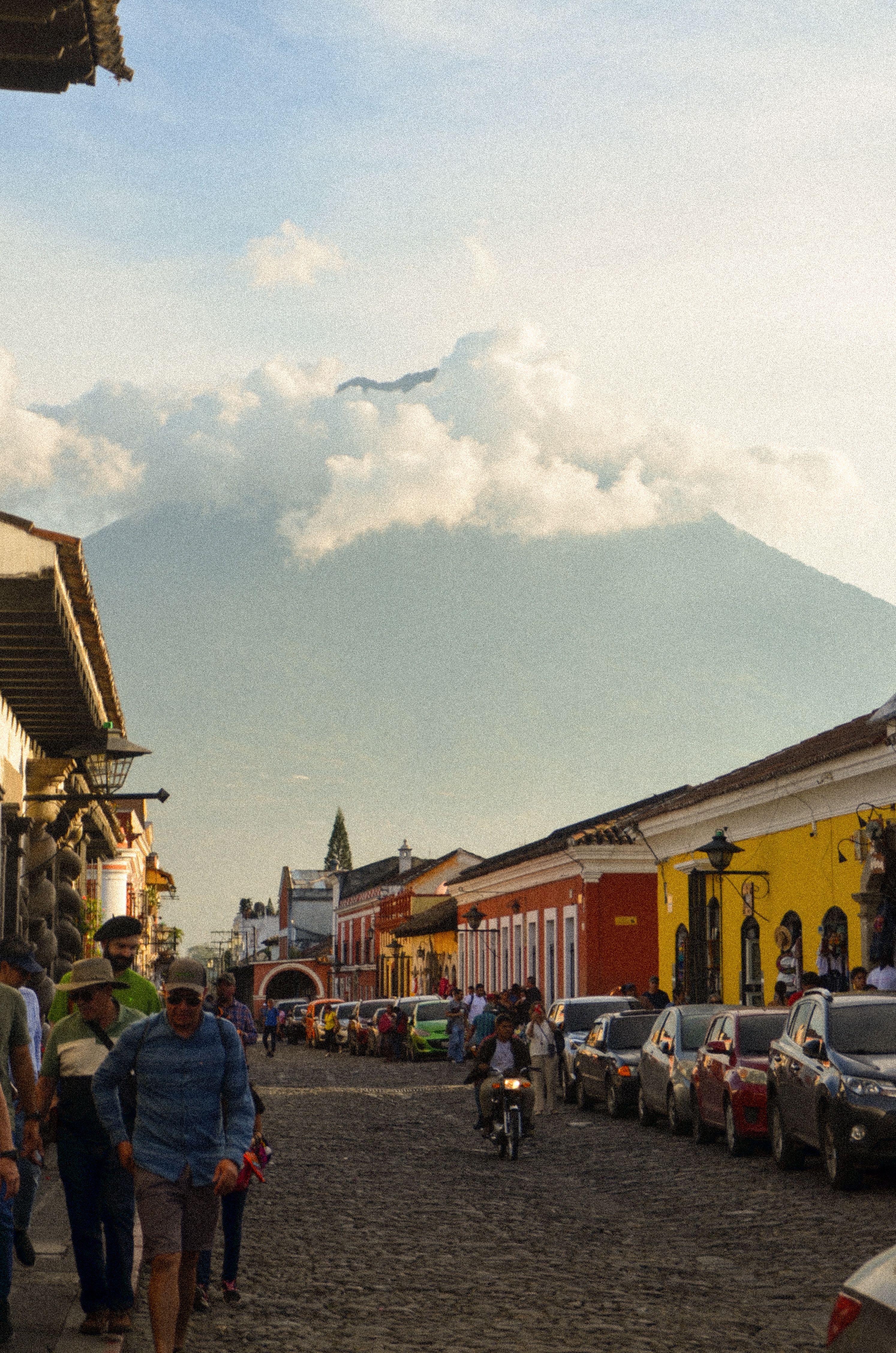
Free to walk the square, 1 hour, right after check-in. Antigua sits an hour from La Aurora airport and the whole city fits in twenty blocks, with the Agua, Fuego and Acatenango volcanoes closing off the streets.
The white facade of San Jose Cathedral is only the rebuilt part: behind it lie the ruins of the colonial cathedral brought down by the 1773 earthquake, which is what remains of the old capital of Spanish Central America.
Santa Catalina Arch: the photo everybody takes

Free, 20 minutes, 300 metres from the square. The yellow arch from 1694 linked two convent buildings so the nuns could cross the street unseen. The shot with the Agua volcano at the end of the road works best before 8am, when no car is parked underneath.
Cerro de la Cruz: sunset over the city

Free, 1 hour with the climb, 900 metres from the arch. Ten minutes of slope and a staircase take you to the stone cross, from where Antigua appears whole, lined up with the Agua volcano.
There is a tourist police post at the top and the climb is safe by day. Do not walk down after dark: take a tuk-tuk back, which costs a few quetzales.
Day 2: Pacaya volcano and the ruins of Antigua
Pacaya volcano: the walk to the lava field

Around 100 quetzales entry plus the tour, 6 hours in total with transport, leaving Antigua at 6am or 2pm. It is 1h30 by van to San Vicente Pacaya and two hours of trail there and back, a steady climb with nothing technical.
The top is a solidified lava field from 2010 and 2021, where guides still toast marshmallows in the hot cracks. Bring a jacket, it is windy, and prefer the morning departure: afternoons tend to close in cloud. Anyone with two extra nights swaps Pacaya for Acatenango, which camps facing the eruptions of Fuego.
La Merced Church: the most worked facade in town

A cheap ticket for the cloister, 45 minutes, on the way back from the volcano. The yellow 1767 church was built low and thick walled on purpose, to survive earthquakes, which is why it is one of the few in Antigua still in use.
Pay for the ruined cloister next door: in the middle of it stands the largest fountain in Central America, 27 metres across, shaped like a water lily.
Las Capuchinas: the circular cloister

40 quetzales for foreigners since January 2026, cash only, 1 hour, open 9am to 5pm, 400 metres from La Merced. It is the best preserved convent in Antigua, from 1736.
The part nobody expects is the retreat tower: a ring of eighteen cells around a courtyard, with a circular chamber underneath that amplifies any sound. Step in and speak quietly to understand why it exists.
Day 3: the road to Lake Atitlan and San Juan
San Pedro La Laguna: why sleep here

3 hours by shuttle from Antigua to Panajachel, plus 30 minutes on a public boat, around 30 quetzales. San Pedro sits at the foot of the volcano of the same name and is the practical choice: the 4am viewpoint vans and the boats to the other villages all leave from here.
San Juan La Laguna: the weaving cooperatives

Free to walk, 2 hours, ten minutes by boat from San Pedro, around 10 quetzales. The main street climbs from the jetty between painted houses under coloured umbrellas, and it is the tidiest village on the lake.
The Tzutujil women cooperatives demonstrate natural dyeing with bark, leaves and cochineal, and sell direct, with no middleman. That is the difference between buying textiles here and buying them on Calle Santander in Panajachel.
Day 4: sunrise at the viewpoint, San Marcos and Santiago
Cerro Kaqasiiwaan: sunrise over the three volcanoes

Around 100 quetzales with transport and guide, 4 hours, leaving at 4am from San Pedro or San Juan. The viewpoint, known as the Indian Nose, stands at 2,100 metres and takes 40 minutes to climb from where the van stops.
It is the one thing on the lake that forces you to sleep on the western side: public boats do not run at 3.30am, so anyone staying in Panajachel cannot get there in time. Bring a jacket, because it is 8 degrees up there before the sun.
San Marcos La Laguna: the diving and yoga village

Free, 1h30, 20 minutes by boat from San Pedro. The village turned into a yoga and meditation centre in the 1990s and keeps that air. In the Cerro Tzankujil reserve there is a seven metre rock platform to jump into the lake from.
Santiago Atitlan: the 1547 church and Maximon

Free to walk, 2h30, 25 minutes by boat from San Pedro, on the southern shore. It is the largest village on the lake and the most Tzutujil of them all, with a daily market and embroidered dress that women still wear every day.
In the colonial church a plaque marks where Stanley Rother, an American missionary, was murdered in 1981 during the civil war. A few blocks away stands the house of Maximon, a folk saint who smokes cigars, drinks liquor and moves house every year: entry costs a few quetzales and a photo costs a few more.
Day 5: Panajachel, the flight to Flores and the island
Panajachel: the last morning on the lake

Free, 1h30, 45 minutes by boat from San Pedro. Calle Santander is the craft corridor of the lake and the place to settle your shopping before the airport. The shuttle to Guatemala City takes 3 hours.
Flores Island: the base for Peten

Free, 2 hours, a 1 hour flight from Guatemala City with TAG or Avianca. The island sits in Lake Peten Itza, joined to the mainland by a causeway, and you can walk around it in twenty minutes.
Houses are painted in strong colours and the restaurants face the water. Save the late afternoon for the malecon: sunset over the lake is the only programme on the island, and the next day starts at 4.30am.
Day 6: Tikal, from the Great Jaguar to Temple IV
Temple of the Great Jaguar: the Gran Plaza as the gate opens

150 quetzales entry, plus 100 if you go in at 4am for sunrise, 6 hours in the park, 1h30 by van from Flores. The park opens at 6am and closes at 6pm, and by 8am the tour buses have arrived.
The 47 metre pyramid is the tomb of Jasaw Chan Kawiil I, finished around 734. You cannot climb it, but Temple II across the plaza has a wooden staircase and gives the head on view of the Great Jaguar.
Mundo Perdido: the oldest part of the city

Included in the ticket, 45 minutes, 600 metres southwest of the Gran Plaza. The central pyramid is an astronomical observatory built some 700 years before the temples on the plaza, and almost nobody comes here in the morning.
Temple IV: the view that became a Star Wars shot

Included in the ticket, 1h30 with the walk, another 500 metres west. It is the tallest pyramid at Tikal, 70 metres, and the wooden platform on top is the only point in the park above the forest canopy.
From up there the roof combs of the Great Jaguar and Temple III break out of the green, and that image appeared as the moon Yavin 4 in the first Star Wars, in 1977. Stay quiet for ten minutes: howler monkeys carry for kilometres.
Day 7: Yaxha, the lagoon and the way home
Yaxha: the ruins without a queue

Around 80 quetzales, 3 hours, 1h30 by van from Flores, with the last 11 kilometres on dirt. More than 500 structures stand in a city that was once a rival of Tikal, and on a normal day a few dozen visitors turn up, against thousands next door.
Climb the North Acropolis and Temple 216, the tallest at the site. Leave early: the Peten heat lands hard after 11am and the flight back to Guatemala City usually leaves mid afternoon.
Yaxha Lagoon: the viewpoint before the airport

Included in the ticket, 40 minutes, inside the site. From the top of the ruins you look over the green lagoon ringed by jungle, and from the jetty below boats leave for Topoxte, the island complex in the middle of the water. From there it is 2 hours back to Flores airport.
Do you need a visa to visit Guatemala?
Most visitors do not. Citizens of Brazil, the United States, Canada, the United Kingdom, Australia and the European Union enter on a passport alone for up to 90 days. Guatemala belongs to the CA-4 with El Salvador, Honduras and Nicaragua, and the 90 days are shared across all four countries: crossing into Honduras does not reset the clock.
The passport needs six months of validity and immigration may ask for an onward ticket. There is no entry fee, but there is a departure tax of about 30 dollars, almost always already included in the air ticket.
When is the best time to visit Guatemala?
November to April, the dry season. December to February has the clearest days and the coldest nights in the highlands, where Antigua and the lake sit above 1,500 metres; March and April warm up and the volcano views suffer from agricultural burning.
May to October it rains almost every late afternoon, which hurts Peten, a lowland jungle, more than the highlands. September is the wettest month. Holy Week in Antigua, with sawdust carpets laid on the streets, is the biggest event in the country and doubles accommodation prices: book months ahead or avoid it.
How to get to Guatemala and how to travel between Antigua, Atitlan and Tikal
La Aurora airport in Guatemala City is the gateway, with direct flights from the United States, Mexico, Panama and Colombia. From Brazil there is no direct flight and the trip runs 12 to 16 hours through Panama City, Bogota or Mexico City.
Do not sleep in Guatemala City: Antigua is an hour from the airport and handles arrivals better. Between Antigua and the lake, a shared shuttle costs 15 to 25 dollars and takes 3 hours. On the lake, everything is a public boat, 10 to 30 quetzales a leg, with the last departure around 5pm. For Peten, fly: TAG and Avianca link Guatemala City to Flores in 1 hour, against 9 hours on a night bus.
The currency is the quetzal. Cards work in hotels and restaurants in Antigua and Flores, but the lake villages and the markets are cash. Do not take a chicken bus with a big suitcase, and avoid driving between cities at night.
Where to eat in Guatemala: typical dishes and the best restaurants
Guatemalan cooking runs on corn, dried chillies and toasted seeds, and the three national dishes are stews, not grills.

Pepian is the oldest: chicken or pork in a thick broth of tomato, dried chilli and toasted ground pumpkin and sesame seeds. It tastes like Mexican mole, but rougher and less sweet.

Kak ik is a red turkey broth of the Qeqchi people of Coban, served with corn tamalitos. In Antigua, Fonda de la Calle Real, open since 1972 on 5a Avenida Norte, is the classic house for it and for pepian, without main square prices.

For dessert, rellenitos: cooked plantain balls stuffed with sweetened black beans and fried. It sounds odd and it works. What to avoid: restaurants with menus in four languages on the Plaza Mayor in Antigua and on Calle Santander in Panajachel, where the same dish costs twice as much. Drink bottled water only, including for brushing your teeth in the lake villages.
Are 7 days enough to see Guatemala?
For the main circuit, yes. Seven days cover Antigua, a volcano, three Lake Atitlan villages, Tikal and Yaxha, with a single 1 hour domestic flight solving the only long distance in the country.
Left out are Semuc Champey, with its limestone pools, which needs 8 hours of bad road and two nights, the Chichicastenango market, open only on Thursdays and Sundays, and the Caribbean coast at Livingston. With 10 days, add Semuc Champey between Antigua and the lake; with 12, Chichicastenango on a Sunday too. For another Maya destination, with the ruins on the Mexican side, see the Cancun and Yucatan 7 day itinerary.
Estimated budget per person
Prices checked on 20 September 2026. Check current prices at INGUAT, turismo oficial da Guatemala · Ministerio de Cultura y Deportes, parques e monumentos · TAG Airlines, voos a Flores.
Frequently asked questions
Do you need a visa to visit Guatemala?+
Most visitors do not. Citizens of Brazil, the United States, Canada, the United Kingdom, Australia and the European Union enter on a passport alone for up to 90 days. Guatemala is part of the CA-4 with El Salvador, Honduras and Nicaragua, and the 90 days are shared across all four: crossing into Honduras does not reset the count. The passport needs six months of validity.
How much does a 7 day trip to Guatemala cost?+
Between 1,200 and 1,900 dollars per person, counting the long haul flight, mid range hotels, shuttles, boats, the domestic flight to Flores, food and tickets. On the ground Guatemala is cheap: a full lunch away from the main squares runs 5 to 10 dollars.
When is the best time to visit Guatemala?+
November to April, the dry season, with December to February on the clearest days. May to October it rains almost every afternoon, which weighs more on Peten than on the highlands. Holy Week in Antigua is the biggest event in the country and doubles accommodation prices.
Is it better to sleep in San Pedro or Panajachel on Lake Atitlan?+
San Pedro, if you want the Cerro Kaqasiiwaan viewpoint at sunrise. The vans leave at 4am from the western villages and public boats do not run at 3.30am, so anyone sleeping in Panajachel cannot get there in time. Panajachel only pays off for a single night before an early departure.
Can you visit Tikal in one day from Flores?+
You can, and that is the norm. It is 1h30 by van each way and six hours inside the park, which opens at 6am and closes at 6pm. The foreigner ticket costs 150 quetzales, plus 100 for the 4am sunrise tour, which requires an authorised guide. Anyone who wants empty ruins trades the sunrise for Yaxha the next day.
Ready to go?
Save this itinerary to your Galmund and take the schedule, map and budget with you. Edit, share and track it all on the globe.
Save this itinerary to my GalmundBeen there already?
Pin this trip on your globe and keep your photos where they were taken.
Pin it on my globe