La Paz · El Alto · Tiwanaku · Uyuni · Salar de Uyuni · Isla Incahuasi · Coqueza · 16 min read
Bolivia 7 Day Itinerary: La Paz, Tiwanaku and Salar de Uyuni
7 days · 2 cities
Duration
7 days
Estimated budget
US$ 1,500 to US$ 2,500 per person, 7 days
Best time to go
May to October, dry crust
Visa
Visa free for most passports, 90 days
This Bolivia 7 day itinerary has two bases: La Paz, at 3,640 metres, and Uyuni, at 3,660. The order is physiology, not taste: three days in the city before the salt flat give the body the time it needs, and the Tunupa volcano, at 5,321 metres, is left for last.
In short: central La Paz, the cable car to El Alto, Tiwanaku, the salt flat and Tunupa. Entry rules, season and food are at the end.
Day 1: arriving in La Paz, the altitude and Plaza Murillo
Plaza Murillo: arriving slowly, the only way there is

Free, 1 hour, in the historic centre. The plane lands in El Alto, at 4,061 metres, and the taxi ride down to La Paz already takes off 400 metres. Do nothing else on day one beyond walking slowly around here.
The square is ringed by the Palacio Quemado, Congress and the cathedral, and there is a clock on the foreign ministry facade that runs backwards, installed in 2014 as a gesture of Andean sovereignty. It is also where you grasp that La Paz is the seat of government while Sucre remains the constitutional capital.
Drink coca tea, eat little and save the hot shower for the evening. Altitude sickness shows up in the first 12 hours and gets worse with effort, alcohol and a heavy dinner.
Calle Jaen: the one intact colonial street

Free street, 1 hour, 400 metres from the square. Some 300 metres of cobbles, facades in blue, red and yellow, and iron lamps. It is the only street in La Paz that survived the twentieth century whole.
Ten municipal museums are packed in here, among them Precious Metals, Musical Instruments and Coca. A single municipal ticket covers four of them for a few bolivianos. Pick one or two: on day one, standing for hours at 3,600 metres charges you for it.
Museo del Litoral: the sea Bolivia lost

Included in the Calle Jaen ticket, 30 minutes, on the same street. Maps, uniforms and documents about the War of the Pacific of 1879, when the country lost the 400 kilometres of coast it had. Bolivia still keeps a navy and marks Sea Day on 23 March: this museum is the key to that.
Day 2: San Francisco, the Witches Market and the cable car to El Alto
Basilica de San Francisco: the mestizo facade

Church free, museum ticketed, 1 hour, on the square of the same name. The present building was finished in 1790, after a snowstorm brought down the first church in the seventeenth century.
Look closely at the facade before you go in: among the baroque scrolls there are mermaids playing the charango, Andean masks, pine cones and parrots, carved by indigenous craftsmen who put their own repertoire inside the Spanish design. This is mestizo baroque, and this is its best facade in La Paz. The museum visit climbs to the roof and the bell towers, with a view of the whole square.
Mercado de las Brujas: offerings, not souvenirs

Free street, 45 minutes, up Sagarnaga from the church. Between Linares and Sagarnaga, Aymara vendors set out herbs, incense, tin amulets and dried llama foetuses.
None of it is decoration. The offering table, the mesa dulce, is buried under new buildings as payment to Pachamama, and the llama foetus is its centrepiece. Photograph the stalls, not the vendors, without asking first: here that is frowned upon, and the request is usually granted without fuss.
Teleferico Linea Roja: the finest public transport anywhere

3 bolivianos per line and 2 per transfer, 40 minutes round trip, at Central / Taypi Uta station. The Red Line opened in May 2014 and was the first of the eleven lines of Mi Teleferico, today the largest urban cable car system in the world.
This is not a tourist ride: it is the bus for people who live in El Alto and work in La Paz. The 400 metre climb takes 10 minutes and shows the whole city wedged into its basin, with the 6,438 metre Illimani at the head of the valley. Sit on the right going up. Between 7am and 9am and at 6pm the queue is long, because it is a real rush hour.
Feria 16 de Julio: the largest market in Bolivia

Free, 2 hours, at the 16 de Julio / Jach a Qhathu terminus. The Aymara name of the station means big market, and it is literal: some 200 blocks of stalls and 70,000 people per day.
It only runs on Thursdays and Sundays. If your day 2 falls on another weekday, ride up anyway and walk the Ceja of El Alto to see the cholets, architect Freddy Mamani party buildings, painted in strong colours and full of Aymara geometry. Go by day, carry little cash and nothing of value on show: this is a working market, not a mall.
Day 3: Valle de la Luna and the Killi Killi lookout
Valle de la Luna: what is left of an old lake

About 15 bolivianos, 1h30 with the ride, in Mallasa, 10 kilometres south of the centre. Minibus 231 leaves from Calle Sagarnaga and takes 40 minutes for under 5 bolivianos.
The field of pinnacles formed by leaching of the clay of an old lake: the water carried off the salts and left the needles standing. There are two marked trails, of 15 and 45 minutes, both easy. Take the long one, where the landscape closes in and the city disappears.
Set your expectations: the place is smaller than the name suggests and you cover all of it in an hour. What justifies it is the pairing with day 3, the last day of acclimatisation before the salt flat.
Mirador Killi Killi: the whole city at once

Free, 45 minutes, high in Villa Pabon. A taxi is 10 minutes from the centre and a few bolivianos, and it is worth asking the driver to wait, because walking back means going down empty streets.
Killi Killi is a spur that juts into the basin, so the view closes a full circle: the centre below, El Alto on the upper rim and the snow of Illimani behind. Go 40 minutes before sunset, when the brick slopes turn orange and the lights come on from the bottom up. Take a coat: the temperature drops fast once the sun goes.
Day 4: Tiwanaku, Puma Punku and the night bus to Uyuni
Tiwanaku: the capital before the Incas

100 bolivianos for foreigners, 3 hours, 72 kilometres from La Paz, 1h30 by road. Minibuses leave from the Cementerio General in the morning; a taxi hired for the day costs 350 to 500 bolivianos.
Tiwanaku was the capital of an empire that ruled the altiplano between 500 and 1000 AD, centuries before the Incas, and has been a World Heritage Site since 2000. The ticket covers both sites and both museums.
Start at the semi subterranean temple, with the stone heads set into its walls, climb to the Kalasasaya and finish at the Puerta del Sol, the andesite monolith with the central figure in relief. The lithic museum holds the Bennett monolith, 7.3 metres tall. Bring a hat and water: there is no shade anywhere and the sun at 3,850 metres burns in 20 minutes.
Puma Punku: the blocks that generate theories

Included in the ticket, 1 hour, 1 kilometre from the main site. It is a field of andesite and sandstone blocks cut at right angles, with grooves and drill holes of a precision that earned the place worldwide pseudo archaeological fame.
Radiocarbon dating puts construction between 536 and 600 AD, and Bolivian archaeology explains the cuts through moulds, abrasives and patience. Be honest about what you will see: a field of scattered stones, not a standing temple. The interest is in the precision of the joints, seen up close.
Head back to La Paz in the late afternoon and take the overnight sleeper bus to Uyuni, which leaves the Terminal de Buses around 9pm and arrives at 7am. It is 10 hours and costs 120 to 250 bolivianos. The alternative is the 55 minute morning flight with Ecojet or BoA.
Day 5: arriving in Uyuni, the train cemetery and Colchani
Cementerio de Trenes: the railway that failed

Free, 1 hour, 3 kilometres from the centre of Uyuni. Dozens of British steam locomotives have rusted beside the tracks since the 1940s, when mining collapsed and the line that carried ore to the Pacific stopped.
Every salt flat tour starts here, which means that by 10.30am there are five jeeps and thirty people climbing on the wagons. Come by taxi on your own right after the night bus, around 9am, and the place is yours. Mind the metal: it is rusted, sharp and entirely unguarded.
Colchani: where salt becomes salt

Free, museum 10 bolivianos, 1h30, 22 kilometres from Uyuni on the edge of the flat. This is the village that lives off the harvest: salt is scraped from the crust, piled into cones to dry in the sun, then iodised and bagged in brick sheds.
The Llama and Salt Museum is small and explains both trades of the region well. The workshop street sells the same carved salt pieces you will see across the flat, and here they cost less.
Sleep in Uyuni, not in a salt hotel out on the flat: the next day starts early and the hotels in the middle charge three times as much for the novelty of the walls.
Day 6: the whole salt flat, from the Ojos del Salar to Isla Incahuasi
Ojos del Salar: the water that rises by itself

Included in the tour, 30 minutes, a few kilometres from Colchani. These are holes about a metre across in the crust, where groundwater rises under pressure and bubbles all day long.
Do not get in and do not let children near the edge: the crust around them is thin and the water is at altiplano spring temperature. It is the spot that shows what the salt flat really is, a salt shell up to 10 metres thick over a brine that has never stopped moving.
Playa Blanca and the Dakar Monument

Included in the tour, 45 minutes, 25 kilometres out from Colchani. The monument was built from salt blocks in 2014, when the Dakar Rally crossed Bolivia for the first time, and became the stopping point for the flags and the jeep convoy photo.
Beside it stands Playa Blanca, the first salt hotel built out on the flat, now a museum. This is where most groups take the forced perspective photos, the ones where a person fits in someone else palm: ask the guide for the wide angle lens and allow 20 minutes, because it takes more work than it looks.
Isla Incahuasi: thousand year old cacti in the middle of nowhere

30 bolivianos, 2 hours, 80 kilometres from Colchani, at the centre of the flat. The island is coral rock, the remains of a volcano submerged in the lake that once stood here, and is covered in Echinopsis cacti up to 10 metres tall, which grow about a centimetre a year.
The loop trail takes 40 minutes and climbs to the top, from where the flat is a white surface horizon to horizon. In the wet season, December to March, the island is sometimes unreachable and the tour swaps it for the mirror effect. Confirm with the agency before paying, because neither version is bad, but they are different trips.
Finish with sunset on the flat, which most tours keep for last, and drive back to Uyuni in the evening.
Day 7: Coqueza, the Tunupa volcano and the way back
Coqueza: the village at the foot of the volcano

Free, cave 20 bolivianos, 1h30, 120 kilometres from Uyuni along the northern shore. Coqueza is a handful of adobe houses and a small church on the edge of the flat, and it is where the Tunupa climb begins.
A few minutes from the village, a cave holds five pre Inca mummies, preserved by the dry air and the cold of the altiplano, still with skin, hair and cloth. A local opens the gate and accompanies the visit. It is a real burial site, not a set piece: go in quietly and touch nothing.
Tunupa Volcano: the highest viewpoint of the trip

About 30 bolivianos community fee, 4 hours, starting from Coqueza. The jeep climbs to around 4,600 metres and from there it is a 1h30 walk to the crater viewpoint, at about 5,000. The summit, at 5,321 metres, needs a full day and a guide.
Do this on the last day and not the first: after six days above 3,600 metres the body has made the red cells it needs, and the same climb that would be punishing on arrival becomes a long, slow walk. Go up slowly, drink plenty of water and turn back without guilt if your head hurts.
The reward is the crater with its red, yellow and green bands and the whole salt flat below, white to the curve of the earth. Head back to Uyuni in the late afternoon and take the flight or the night bus to La Paz.
Do you need a visa for Bolivia?
It depends on your passport, and this changed recently. On 1 December 2025 the government of Rodrigo Paz scrapped the tourist visa requirement for the United States, Israel, South Korea, South Africa, Latvia, Estonia and Romania, reversing a policy in force since 2008. The foreign ministry put the cost of that policy at more than 80 million dollars in lost revenue and projected 320 million between 2026 and 2029.
Most European, Latin American and Commonwealth passports already entered visa free for up to 90 days. Mercosur citizens, Brazilians among them, can enter on a national identity card. Check your own case before booking, because the list moves.
What this means for everyone is the same thing: the salt flat is going to get busier. On 1 February 2026 the government announced 100 million bolivianos, financed by the IDB, to rebuild the Joya Andina airport in Uyuni, which already handles more than 2,000 tourists a week, 98 per cent of them foreign. The works confirm that the window on an empty salt flat is closing.
What is the best time to travel to Bolivia?
It depends which salt flat you want, and this is the only real decision in the itinerary.
May to October is the dry season: a firm white crust, hexagons drawn on the ground, jeeps reaching Isla Incahuasi without trouble and clear skies. This is the season for covering the whole flat. Nights fall to minus 10 in Uyuni, so bring a real coat, a hat and gloves.
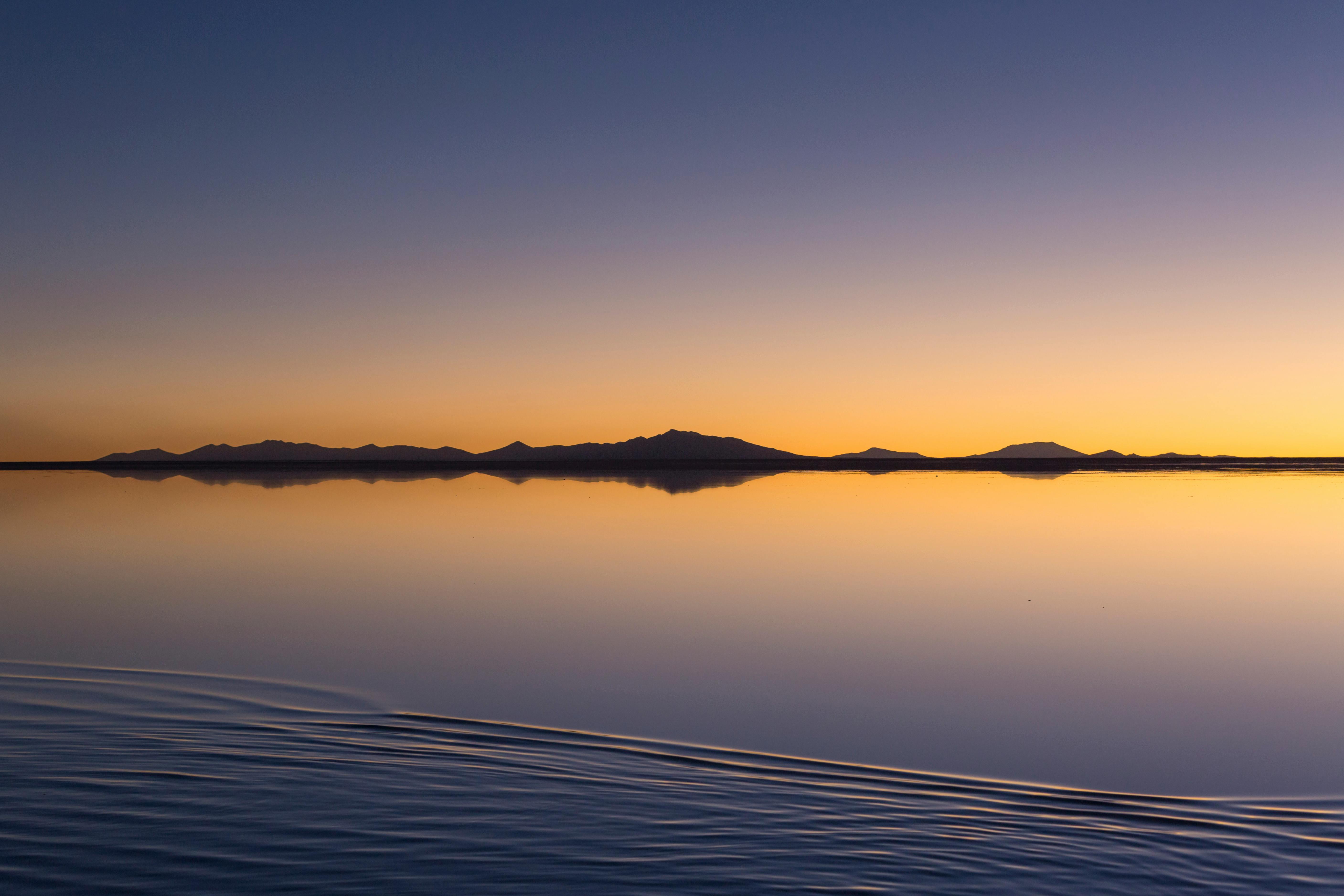
December to March it rains on the altiplano and a film of water a few centimetres deep covers part of the flat: this is the mirror effect, where the sky reflects on the ground and the horizon disappears. It is the photograph you see everywhere, but the island is sometimes closed and the route shrinks.
April and November are the transition months, with a chance of both and fewer people. In La Paz the difference is smaller: it is sunny almost every day all year, with late afternoon rain in summer.
How to get to Bolivia and how to move around
There are direct flights from Sao Paulo to Santa Cruz de la Sierra with BoA and a connection on to La Paz, plus routes via Lima or Santiago. La Paz airport, El Alto, is the highest international airport in the world at 4,061 metres: the taxi down to the city takes 30 minutes and already helps.
Between La Paz and Uyuni, the overnight sleeper bus leaves around 9pm from the Terminal de Buses and arrives at 7am, for 120 to 250 bolivianos, saving a night of hotel. The flight takes 55 minutes with Ecojet or BoA and costs 80 to 140 dollars. Either way, buy from an agency or the official site, not on the street.
Within La Paz, the cable car solves almost everything for 3 bolivianos, and minibuses cover the rest. On the salt flat, do not drive yourself: there are no landmarks, no signal, and the crust sinks in places. Hire an agency in Uyuni, check the jeep has a radio and ask how many people ride in the car, because six is the comfortable limit. Carry cash in bolivianos: outside La Paz hotels, cards barely work.
Where to eat in Bolivia: typical dishes and the best restaurants
Altiplano cooking is potato, corn, quinoa and dried meat, and people eat early: lunch at 12.30 is the big meal of the day, and dinner is light.

The salteña is breakfast in La Paz: a baked pastry with slightly sweet dough and a soupy filling of beef or chicken with olive, egg and potato. The broth is both the problem and the point. Hold it upright, bite the end and drink the broth before going on. Shops sell from 9am to noon and close when they run out, and that is that.

The plato paceño is the city dish: boiled broad beans, corn on the cob, fried cheese and potato, with llajua, the tomato and locoto sauce on every Bolivian table. It is vegetarian by origin, though almost every place offers a version with meat. Ask for little llajua the first time, because Bolivian locoto is serious.

On the Oruro and Uyuni altiplano the dish is charquekan: llama meat dried in the sun and cold, shredded and fried, served with corn, potato and egg. Llama has been the protein of the region for three thousand years, it is lean and it does not taste gamey. In Uyuni, also order api, a hot purple drink of morado corn with cinnamon, which is what people have before heading out to the flat at 6am.

To eat well and cheaply in La Paz, the comedor popular at Mercado Rodriguez, in San Pedro, serves a full lunch for under 20 bolivianos in the middle of the market that feeds the city. Go between noon and 1.30pm, pick the stall with the most locals sitting at it and ask for the lunch of the day. What to avoid: street juice with ice and raw salad outside restaurants, which is where most travellers come unstuck.
Are 7 days enough to see Bolivia?
For the altiplano axis, yes. Seven days cover La Paz, El Alto, Tiwanaku, the Salar de Uyuni and Tunupa with the acclimatisation margin the altitude demands, and that margin is exactly what the five day itinerary sacrifices.
Left out are Lake Titicaca, with Copacabana and the Isla del Sol, 3h30 from La Paz, and the coloured lagoons of the southwest, between Uyuni and the Chilean border, which need the classic three day jeep crossing to San Pedro de Atacama. With 10 days, add Titicaca between day 3 and day 4; with 12, swap day 7 for the lagoon circuit and leave through Chile. For the Andean neighbour with the same kind of altitude, see the Peru 8 day itinerary.
Estimated budget per person
Prices checked on 20 September 2026. Check current prices at Sitio oficial de Tiwanaku, tarifas e horarios · Mi Teleferico, tarifas e baldeacoes · Custo dos tours do Salar de Uyuni em 2026 · Aeroporto Joya Andina de Uyuni, obra de 100 milhoes de bolivianos.
Frequently asked questions
Do you need a visa for Bolivia?+
It depends on your passport and it changed recently. On 1 December 2025 Bolivia scrapped the tourist visa for the United States, Israel, South Korea, South Africa, Latvia, Estonia and Romania, reversing a rule in force since 2008. Most European, Latin American and Commonwealth passports already entered visa free for up to 90 days, and Mercosur citizens can enter on a national identity card. Check your own case before booking, because the list moves.
How much does a 7 day trip to Bolivia cost?+
Between 1,500 and 2,500 dollars per person, counting the international flight, mid range hotels, transport between La Paz and Uyuni, food and tours. Bolivia is the cheapest country in South America to travel: a full lunch at a market comedor costs under 3 dollars and the La Paz cable car is 3 bolivianos per line.
When is the best time to see the mirror effect at Salar de Uyuni?+
December to March, in the wet season, when a film of water a few centimetres deep covers part of the flat and reflects the sky. In exchange, Isla Incahuasi is sometimes unreachable and the route shrinks. May to October the crust is dry and firm, with the hexagons drawn on the ground and the whole flat drivable. April and November catch both, with fewer people.
How do you handle the altitude in La Paz and Salar de Uyuni?+
By giving the body time. La Paz sits at 3,640 metres, El Alto airport at 4,061 and the Salar de Uyuni at 3,660, so there is no arriving at sea level on this trip. Take day one without effort, drink coca tea, eat lightly, avoid alcohol for the first 48 hours and leave Tunupa volcano, at 5,321 metres, for the last day. Acetazolamide helps, but only on prescription.
Is the bus or the plane better from La Paz to Uyuni?+
The overnight sleeper bus leaves around 9pm and arrives at 7am, costs 120 to 250 bolivianos and saves a night of hotel, which is why this itinerary uses it on day 4. The flight takes 55 minutes with Ecojet or BoA and costs 80 to 140 dollars: worth it if your time is short or you cannot sleep sitting up. Buy from an agency or the official site, never on the street.
Ready to go?
Save this itinerary to your Galmund and take the schedule, map and budget with you. Edit, share and track it all on the globe.
Save this itinerary to my GalmundBeen there already?
Pin this trip on your globe and keep your photos where they were taken.
Pin it on my globe