
Uzbekistan · Tashkent · Samarkand · Bukhara · Khiva · 15 min read
Uzbekistan 8-Day Itinerary: Tashkent, Samarkand, Bukhara and Khiva
8 days · 4 cities
Duration
8 days
Estimated budget
$1,800 to $2,600, 8 days
Best time to go
Apr-May or Sep-Oct (mild weather)
Visa
Visa-free, free stamp up to 30 days
This 8 day Uzbekistan itinerary links Tashkent, Samarkand, Bukhara and Khiva on the Afrosiyob high-speed train, with one short flight only for the final leg into Khiva, spending two nights in each Silk Road city and using Tashkent only on arrival and departure.
In short: Tashkent on arrival, two days in Samarkand, two in Bukhara, two in Khiva, then back through Tashkent to fly home. Visa, weather and where to eat are at the end of the article.
Day 1: Tashkent, arrival
Amir Timur Square, the heart of Tashkent

The equestrian statue of Timur, put up in 1994 at the centre of the park, replaced first a monument to Karl Marx and later one to Stalin, a neat summary of the square's changes of regime through the 20th century. Hotel Uzbekistan, a Soviet building shaped like an open book, is the visual landmark across the street.
Half an hour is enough to walk the garden and look at the clock tower next to it, a gentle first stop after checking in.
Independence Square, the largest in the country
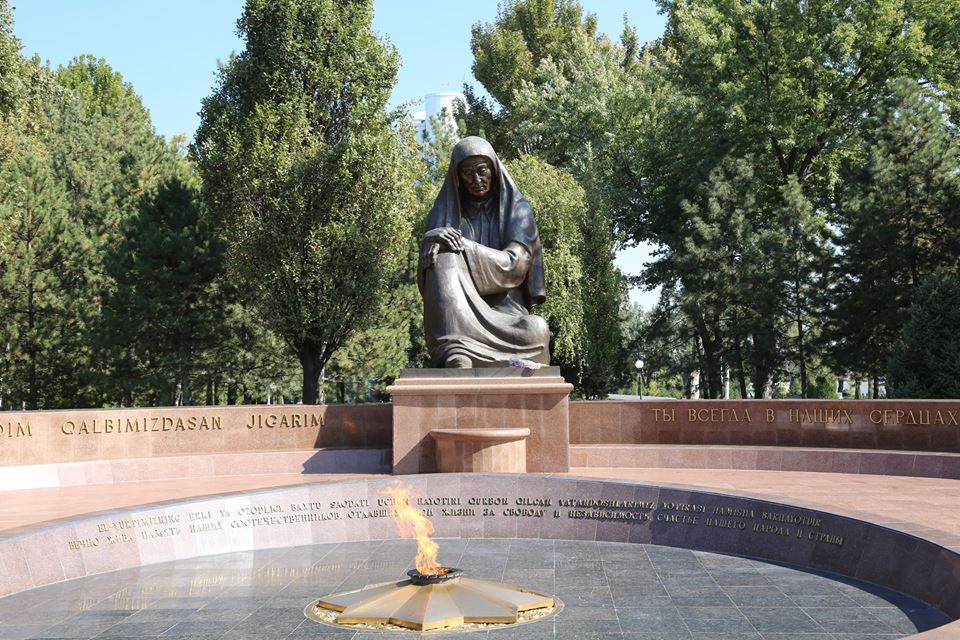
A ten-minute walk away, this is Uzbekistan's largest square, home to the Arch of Good Intentions and the Motherland statue honouring Uzbek soldiers of the Second World War. The fountains light up at night, when the square gets busiest with local families out for a stroll.
Allow an hour, ideally in the late afternoon to catch the light changing.
Day 2: Tashkent, the old town
Chorsu Bazaar, Tashkent's round market

The market sits inside a turquoise dome that has become a landmark of the old town, with three floors of meat, spices, dried fruit and textiles. Go before 10am, while the crowd is still more local than tourist.
Try the hot samsa sold from the tandoor stalls near the east entrance. Ninety minutes is enough to work through the floors and haggle at the dried fruit stalls.
Khast Imam Complex and the Uthman Quran

A ten-minute walk from Chorsu, this 16th century group of mosques and madrasahs holds, in its library museum, the Uthman Quran, one of the oldest surviving copies in the world, with stains attributed to the caliph assassinated in 656.
Entry costs about $3, and the complex still works as an active mosque, so shoulders and knees need covering. Seventy-five minutes covers the main courtyard and the museum.
Day 3: Tashkent to Samarkand
Arriving in Samarkand: the Gur-e-Amir mausoleum

The Afrosiyob high-speed train leaves Tashkent's central station around 8am and reaches Samarkand in 2h15, the fastest leg of the whole trip. A ten-minute walk from the hotel, Gur-e-Amir is the final resting place of Tamerlane and his descendants, including his grandson Ulugbek.
The 34-metre ribbed turquoise dome is said to have inspired the design of the Taj Mahal, built by a great-grandson of Timur married to a Timurid princess. Forty-five minutes covers the gold-leaf interior.
The Registan, the most famous square in Central Asia

A ten-minute walk from Gur-e-Amir, the Registan brings together three madrasahs, Ulugbek, Sher-Dor and Tilya-Kori, built between the 15th and 17th centuries and covered in blue and turquoise mosaic.
Entry runs about 65,000 som ($5), and it is worth returning at night, when the complex is lit up from around 8pm. Allow at least ninety minutes.
Bibi-Khanym Mosque, the largest in medieval Central Asia

A fifteen-minute walk from Gur-e-Amir, it was built between 1399 and 1404 with loot from Timur's campaign in India, and was, at the time, the largest mosque in the Islamic world.
The inner courtyard holds a huge stone Quran stand. Half an hour is enough for the courtyard.
Day 4: Samarkand in full
Siyob Bazaar, next to Bibi-Khanym

Right next to the mosque, this is the most photographed market in the country, known for round, stamped Uzbek naan sold stacked at the entrance stalls. Sunday mornings are the busiest.
Forty minutes is enough for a loop and to try the region's dried fruit and watermelon.
Shah-i-Zinda necropolis, the avenue of mausoleums

A fifteen-minute walk from the bazaar, this is a corridor of more than twenty mausoleums built between the 11th and 19th centuries, each with a different mosaic pattern. The name means 'living king' and refers to Qusam ibn Abbas, a cousin of the Prophet Muhammad, whom local tradition holds never died.
An hour is the right amount of time to walk the staircase slowly.
Ulugbek Observatory, 15th-century astronomy

A twenty-minute drive from the centre, this was built in 1420 by Timur's grandson Ulugbek, himself an astronomer who calculated the length of the year to within a minute of today's accepted value.
Only the half-buried base of the giant sextant survives, but the museum next door explains the original 40-metre-radius instrument. Forty-five minutes covers the site.
Day 5: Samarkand to Bukhara
Arriving in Bukhara: the Ark fortress

The Afrosiyob train from Samarkand to Bukhara takes about 1h20 and usually leaves early afternoon. The Ark, home to the emirs of Bukhara for over a thousand years until 1920, is a five-minute walk from the old town and the natural first stop after arriving.
Much of the interior was destroyed by Soviet bombardment in 1920, but the entrance gate, flanked by two towers, still gives a sense of scale. An hour covers the museum inside the walls.
Bolo Hauz Mosque and its wooden columns

Right across from the Ark, this 1712 mosque is known for a portico held up by twenty carved wooden columns, reflected in the pool in front of it, which earned it the nickname 'mosque of forty columns'.
Half an hour is enough, and it is a good spot to sit in the shade after the sun of the fortress.
Poi-Kalyan complex and the Kalyan minaret

A ten-minute walk from the Ark, the Kalyan minaret stands 47 metres tall and was built in 1127, tall enough to have doubled as an execution tower and to have been spared by Genghis Khan in 1220, who was reportedly struck by its height.
The mosque next to it holds up to 12,000 worshippers, and the Mir-i-Arab madrasah across the square still works as an active Islamic school. Ninety minutes covers the whole complex.
Day 6: Bukhara in full
Lyab-i Hauz, the square built around a pool

Built between the 16th and 17th centuries, the 42 by 36 metre pool is ringed by centuries-old mulberry trees and has become Bukhara's social hub, with tea tables and restaurants along its edges.
Half an hour in the morning is enough, and it is worth coming back for dinner.
The trading domes: Toki Zargaron

A five-minute walk from Lyab-i Hauz, this 16th-century brick dome was built over the crossing of the caravan routes and once housed the city's jewellers, which is where the name comes from.
Today it works as a small market for handicrafts and carpets. Twenty minutes is enough to walk through and browse the stalls.
Magok-i-Attari Mosque, the oldest in Bukhara

A hundred metres from Toki Zargaron, this 12th-century mosque was excavated five metres below today's street level, proof of how many layers the city has built up over itself.
The south facade, with its original geometric carving, is one of Bukhara's rare pre-Mongol survivals. Forty minutes covers the interior, now a carpet museum.
Chor Minor, the four minarets

A fifteen-minute walk away, this small 1807 madrasah is known for the four blue-domed minarets at each corner of its roof, no two alike in mosaic pattern.
Tucked into a residential street, it is one of the most photographed and least obvious sights to find in the city. Twenty minutes is enough, including the climb to the small rooftop terrace.
Day 7: Bukhara to Khiva
Arriving in Khiva: the Kalta Minor minaret

The direct train between Bukhara and Khiva takes about 6h30 and leaves around midday, the only link that avoids changing vehicles; the alternative is flying into Urgench, a 35-minute drive from Khiva.
Walk through the west gate of Itchan Kala, the walled city, and the turquoise and white Kalta Minor minaret is the first thing you see. It was left unfinished in 1855, at 29 metres instead of the planned 70, after the emir who commissioned it died. Twenty minutes is enough from the outside, since climbing it is not possible.
Kunya-Ark, the citadel of Khiva's khans

Across the same square, this was the residence and fortress of Khiva's khans from the 17th century, with a throne room, a tiled summer mosque and a platform once used to watch for caravans in the desert.
Sunset from the top of the wall is one of the best in the city. Forty-five minutes covers the interior.
Day 8: Khiva and back to Tashkent
Juma Mosque and its 213 wooden columns

Khiva's most unusual mosque has no dome and no courtyard: it is a single hall held up by 213 carved wooden columns, some dating from the 10th century and reused from earlier buildings, with small skylights letting light in.
The main door, over 700 years old, keeps its original carving. Half an hour is enough to walk among the columns in silence.
Islom-Khoja Minaret, the tallest in Khiva

Built in 1910, at 57 metres, it is the newest and tallest monument in Itchan Kala, with bands of turquoise, blue and white tile that narrow as they climb.
You can climb the 118 internal steps for an extra fee of about $2, with a view over the walled city and the desert beyond. Forty minutes, more if you climb.
Pakhlavan Makhmud Mausoleum, Khiva's patron saint

A ten-minute walk away, this is the tomb of the 14th-century poet, wrestler and leather tanner who became the city's patron saint, which makes it the most visited mausoleum among locals, not just tourists.
The interior tiles, in a darker blue than the rest of Khiva, were redone in the 19th century. Thirty minutes is enough, and it usually has shorter queues than the other monuments.
Do you need a visa to travel to Uzbekistan?
Most Brazilian and Western passport holders do not. Tourists can stay up to 30 days visa-free, with a free entry stamp on arrival by air or land, provided the passport is valid for at least six months. The exemption covers tourism, business, family visits, exchange and transit, but not work or long-term study.
Immigration may ask for a return or onward ticket and proof of accommodation. The 30 days start counting at midnight the day after entry, so arriving on the 1st allows a stay until the 31st.
When is the best time to visit Uzbekistan?
April, May, September and October are the best months, with temperatures between 20°C and 27°C in Samarkand and Bukhara, avoiding both the summer heat of up to 40°C and the dry winter cold. September and October also coincide with harvest season, when the bazaars fill up with fresh pomegranate, fig and walnuts.
Avoid July and August if possible: desert heat near Khiva and Bukhara is intense and most monuments have no air conditioning. Winter, from December to February, is cold, with occasional snow in Tashkent, but the monuments are empty and hotel prices drop.
How to get to Uzbekistan and travel between cities
There is no direct flight from Brazil to Uzbekistan: the most common connection leaves São Paulo with a stop in Istanbul, Doha or Frankfurt, reaching Tashkent after 20 to 26 hours of total travel.
Between Tashkent, Samarkand and Bukhara, the Afrosiyob high-speed train is the fastest option: 2h15 from Tashkent to Samarkand and about 1h20 from Samarkand to Bukhara, with reclining, air-conditioned seats for $15 to $25 a leg. Tickets open weeks ahead and morning departures sell out first.
Between Bukhara and Khiva, the direct train takes about 6h30 and only runs on Mondays, Thursdays and Saturdays; on other days the alternative is flying into Urgench airport, a 35-minute drive from Khiva, or a shared taxi, a 6 to 7 hour road trip. Inside each historic centre, everything is done on foot.
Where to eat in Uzbekistan: classic dishes and the best restaurants
The national dish is plov, rice cooked in lamb fat with yellow carrot, chickpeas and raisins, made in giant open-air cauldrons. Other dishes to look for: laghman, hand-pulled noodles with meat and vegetables, samsa, a pastry baked in a clay tandoor oven, and non, the round stamped bread whose pattern changes from city to city.
In Tashkent, the Besh Qozon Central Asian Plov Centre, at Guards Colonel Khodjaev Street 1 near the TV Tower, cooks plov in cauldrons over a metre wide from the morning, and the queue usually starts around 11am.

In Samarkand, a chaikhana inside Siyob Bazaar serves plov and tea at local market prices. In Bukhara, look for one of the terraces near Lyab-i Hauz, overlooking the historic pool. In Khiva, the terraces facing Kunya-Ark, inside the walled city, are the most scenic option.
Skip the hotel restaurants inside Itchan Kala in Khiva, with generic menus and tourist pricing; the terraces facing Kunya-Ark sit a few steps away and cost half as much.
Are 8 days enough to see Uzbekistan?
Yes, for the classic Silk Road route. Eight days cover Tashkent, Samarkand, Bukhara and Khiva with time to spare in the three historic cities, which is where the trip really happens; Tashkent works well as an arrival and departure base without needing more than a day and a half.
With less time, 5 to 6 days, you can cut Khiva and keep Tashkent, Samarkand and Bukhara, linked by the high-speed train in a few hours. With more time, 12 to 14 days, it is worth adding Shakhrisabz, Tamerlane's birthplace two hours from Samarkand, or stretching to Nukus in the west for its Soviet avant-garde art museum.
To keep going through Central Asia, our 7 day Kyrgyzstan itinerary swaps Silk Road cities for mountains, lakes and nights in a yurt, an hour’s flight from Tashkent.
Estimated budget per person
Prices checked on 11 September 2026. Check current prices at Uzbekistan Railways (Afrosiyob tickets) · Official Uzbekistan tourism portal.
Frequently asked questions
Do Brazilians need a visa for Uzbekistan?+
No. The visa exemption for Brazilian tourists covers up to 30 days, with a free stamp on arrival, and remains in force until 31 December 2026 under the renewed agreement between the two countries.
How many days are needed to see Uzbekistan?+
Eight days cover the classic Tashkent, Samarkand, Bukhara and Khiva route without rushing. Five or six days works if you cut Khiva.
Is there a direct flight from Brazil to Uzbekistan?+
No. The most common route leaves São Paulo with a connection in Istanbul, Doha or Frankfurt, for a total of 20 to 26 hours.
How do you travel between Tashkent, Samarkand and Bukhara?+
By Afrosiyob high-speed train: 2h15 between Tashkent and Samarkand, and about 1h20 between Samarkand and Bukhara, with reclining seats for $15 to $25 a leg.
When is the best time to visit Uzbekistan?+
April, May, September and October, with temperatures between 20°C and 27°C. Avoid July and August for the extreme desert heat.
How much does an 8-day trip to Uzbekistan cost?+
A realistic estimate is $1,800 to $2,600 per person, including the international flight, accommodation, internal trains, food and entrance tickets.
Ready to go?
Save this itinerary to your Galmund and take the schedule, map and budget with you. Edit, share and track it all on the globe.
Save this itinerary to my GalmundBeen there already?
Pin this trip on your globe and keep your photos where they were taken.
Pin it on my globe