Istanbul · Cappadocia · Göreme · Uçhisar · Derinkuyu · Ihlara · 16 min read
Turkey 8 Day Itinerary: Istanbul and Cappadocia, with a Balloon Ride
8 days · 2 cities
Duration
8 days
Estimated budget
US$ 1,150 to US$ 1,850 plus flights, 8 days
Best time to go
April to June and September to October
Visa
Visa free for many; others use the e-Visa
This 8 day Turkey itinerary splits the trip in half between Istanbul and Cappadocia, linked by a 1h15 flight, and leaves the Aegean coast for another trip, because each of the two needs four days.
In short: Galata, Sultanahmet, Topkapi, Balat and Kadıköy; then Uçhisar, the balloon, Göreme, Derinkuyu and Ihlara. Visa, timing and where to eat are in the practical sections.
Day 1: arrival in Istanbul, Galata Tower and the bridge
Galata Tower: all of Istanbul at sunset

About 30 euros, 1 hour, open until late. It is the first plan after check-in: go up late in the afternoon and stay until the sun sets behind the mosques of the historic peninsula.
The Genoese built the tower in 1348, when Galata was an Italian colony across the Golden Horn. From the circular balcony, 51 metres up, you see the domes and minarets of Sultanahmet, the Bosphorus and the Asian side. There is a queue late in the day; buy tickets on the official museums platform.
Galata Bridge: the fishermen and the fish sandwich

Free, 1 hour including dinner, a 10 minute walk down from the tower. It is the end of the first evening.
On the upper level, dozens of fishermen line their rods along the railing at all hours; on the lower level, fish restaurants. Cross to Eminönü at the southern end, where boats rocking at the quay grill balık ekmek, the fish sandwich in bread with onion and lettuce: it is the city’s most traditional street food.
Day 2: Sultanahmet, from Hagia Sophia to the Blue Mosque
Hagia Sophia: the 1,500 year old dome at opening time

About 25 euros for foreigners, 75 minutes. Arrive at opening time: in the afternoon in high season the gallery is packed and queues soar.
Built by Emperor Justinian in 537, it was the largest church in the world for almost a thousand years, became a mosque in 1453, a museum in 1934 and a mosque again in 2020. Since 2024 tourists enter through the upper gallery with a ticket, while the ground floor is reserved for prayer. From up there you see the gold Byzantine mosaics beside the great medallions of Arabic calligraphy. Women cover their hair; everyone covers shoulders and knees.
Basilica Cistern: the 336 columns beneath the square

About 38 euros for foreigners, 45 minutes, 150 metres from Hagia Sophia. It is pricey for the length of the visit, but it is one of the few things that exist only here.
Justinian had the reservoir built in 532 to supply the palace, with 336 columns recycled from ancient temples. At the far end, two of them rest on Medusa heads, one on its side and one upside down, and nobody knows for sure why. The lighting and the shallow water on the floor do the rest.
Blue Mosque: the Iznik tiles between prayers

Free, with an optional donation, 45 minutes, 400 metres from the Cistern. It closes to tourists during the five daily prayers, so go before the midday prayer.
Built between 1609 and 1616 facing Hagia Sophia, deliberately, it is the only imperial mosque in Istanbul with six minarets. The name comes from the more than 20,000 blue Iznik tiles lining the interior. Take off your shoes at the entrance, where plastic bags are provided, and stay in the area reserved for visitors.
Day 3: Topkapi Palace, the Grand Bazaar and Süleymaniye
Topkapi Palace: the sultans’ harem and treasury

About 55 euros for foreigners, 3 hours, opens at 9am and closes on Tuesdays. Start here early, because it is the biggest and most tiring visit of the day.
For almost four centuries this was the heart of the Ottoman Empire. The palace is not one building but a sequence of courtyards and pavilions: the Harem, with more than 300 rooms, the Treasury, with the Topkapi dagger and the 86 carat Spoonmaker’s Diamond, and the last courtyard, overlooking the meeting of the Bosphorus and the Sea of Marmara.
Grand Bazaar: 60 covered streets and the art of haggling

Free, 90 minutes, a 20 minute walk from Topkapi along the tram avenue. Closed on Sundays.
One of the oldest covered markets in the world, dating from 1461, with more than 60 streets and around 4,000 shops. Today it is more touristy than it was, so use it for looking and for buying things you will not find elsewhere: mosaic lamps, rugs and ceramics. Haggling is expected: start at half the asking price and accept the tea the sellers offer, without feeling obliged to buy.
Süleymaniye: Sinan’s masterpiece above the Golden Horn

Free, 1 hour, 700 metres uphill from the Grand Bazaar. It is the city’s most beautiful mosque and the least crowded of the big three.
Commissioned by Suleiman the Magnificent and completed in 1557 by the architect Mimar Sinan, it has a lighter, brighter interior than the Blue Mosque. Both men are buried in mausoleums in the garden. From the rear terrace you see the whole Golden Horn with Galata on the far side: it is the best free viewpoint on the peninsula.
Day 4: Balat, the Spice Bazaar and the ferry to Kadıköy
Balat: the colourful houses of the old Jewish and Greek quarter

Free, 90 minutes. Go on a weekday morning, when the slopes are empty and photos come without queues.
For centuries Balat and neighbouring Fener were home to the city’s Jewish and Greek communities. Today the brightly painted timber and masonry houses have become a photo backdrop, but the district still has the Ahrida synagogue, the Ecumenical Orthodox Patriarchate and the Church of St Stephen of the Bulgars, made entirely of cast iron shipped in pieces from Vienna in 1898.
Spice Bazaar: Urfa pepper and lokum to take home

Free, 45 minutes, in Eminönü, 15 minutes by taxi from Balat and next to the ferry pier for the Asian side.
The L shaped bazaar, from 1664, is smaller and easier than the Grand Bazaar, and it is where you buy the souvenirs that fit in your suitcase: Urfa pepper, sumac, apple tea, Antep pistachios and lokum, Turkish delight. Ask to taste first and buy it vacuum packed.
Kadıköy: the ferry to Asia and the locals’ market

The public ferry from Eminönü to Kadıköy takes 25 minutes and costs the same as a metro ride with the Istanbulkart. Set aside the whole afternoon.
Across the Bosphorus, Kadıköy is where Istanbul’s residents go shopping and go out at night. The market streets have fishmongers, cheese shops, olive stores and lokanta, restaurants serving home style food from a display counter. Late in the afternoon, walk to Moda pier to watch the sun set over the historic peninsula across the water.
Day 5: flight to Cappadocia, Love Valley and Uçhisar
Love Valley: the tallest fairy chimneys

Free, 45 minutes at the viewpoint. The flight from Istanbul to Nevşehir or Kayseri takes 1h15, plus 40 minutes to an hour to Göreme; it is the first stop after check-in.
These are the region’s tallest fairy chimneys: columns of volcanic tuff up to 40 metres high, carved by erosion over millions of years. From the viewpoint on the road between Göreme and Uçhisar you see the whole valley; to walk down among them, the trail takes about an hour.
Uçhisar Castle: sunset from the highest point

Paid entry, 1 hour, 3 kilometres from Love Valley. Go up an hour before sunset.
The rock was hollowed into dozens of rooms over the centuries and served as a fortress and refuge for the village around it. From the top, the highest point in the region, you see Pigeon Valley, Göreme and, in the distance, the Erciyes volcano, which covered Cappadocia in ash and created this whole landscape.
Day 6: balloon at dawn, Göreme and Rose Valley
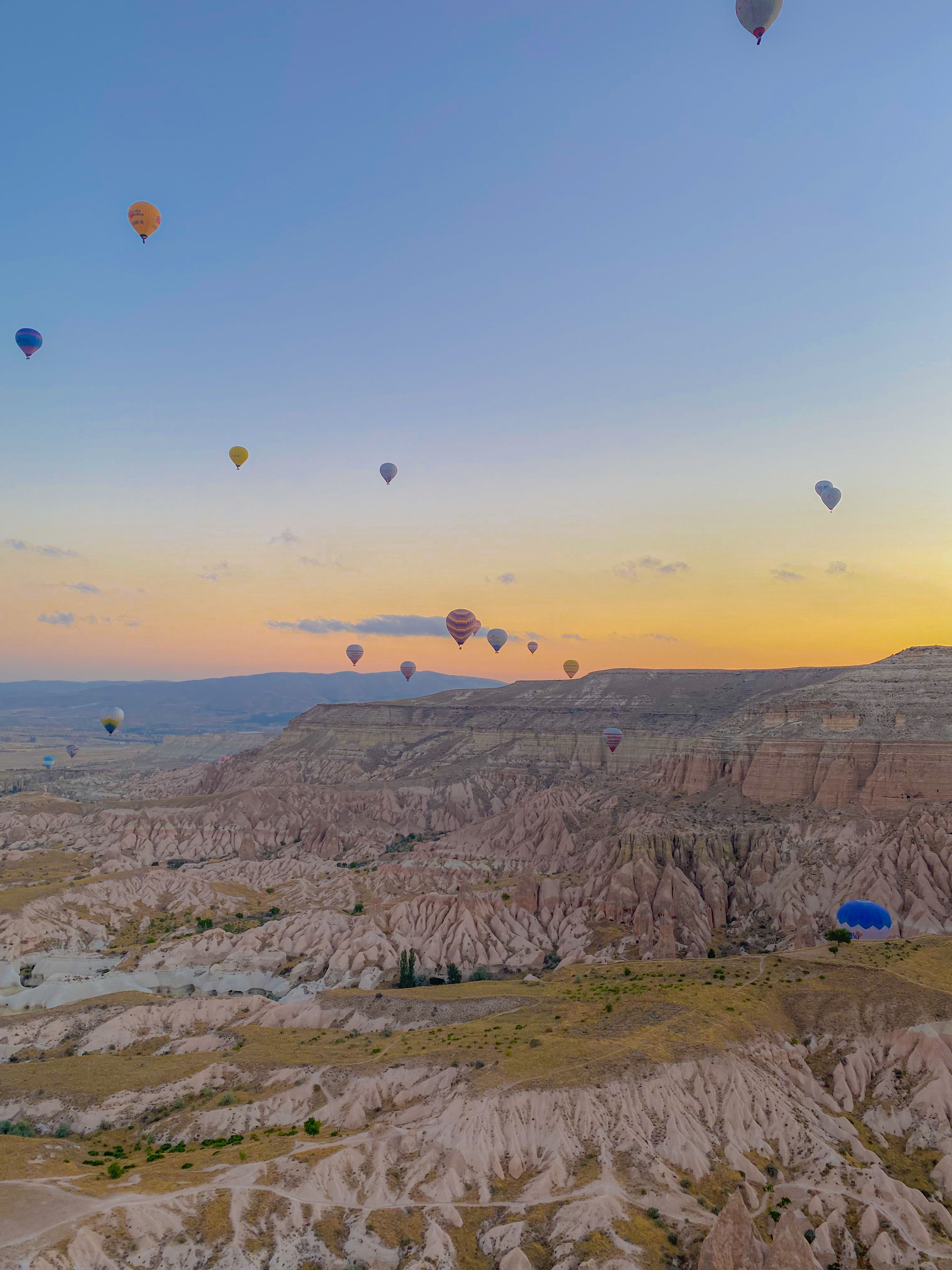
Balloon over Cappadocia at sunrise

150 to 280 euros per person in a shared basket, 1 hour in the air, with hotel pickup around 5am. Book as soon as you set your dates and schedule the flight for your first morning: if wind cancels it, you still have the next one.
Every morning with good weather, up to a hundred balloons rise together at sunrise over Göreme, and the sky fills with dots of colour above the valleys. Even if you do not fly, you can watch: the terraces of the cave hotels and the village viewpoints fill up at dawn.
Göreme Open Air Museum: the rock cut churches

About 20 euros, plus 6 for the Dark Church; 2 hours; opens at 8am. It is 1.5 kilometres from the village, and after the balloon you arrive at opening time, before the tour groups.
Between the 10th and 12th centuries, monks carved churches, refectories and cells into the rocks of this valley and covered them in frescoes. The best preserved are in the Dark Church, which went centuries with almost no light, which is why the colours still look fresh. It is worth the separate ticket.
Rose Valley: the trail to the pink sunset

Free, two and a half hours of easy walking, 2 kilometres from Göreme. Set off two hours before sunset and bring a torch for the way back.
The rocks of this valley turn pink in the late afternoon, and the trail passes little visited rock cut churches, such as the Column Church, and apricot orchards and vines. The viewpoint at the top, where the trail ends, is the region’s most popular sunset spot, with stalls selling freshly squeezed pomegranate juice.
Day 7: the underground city and the Ihlara Valley
Derinkuyu: the eight storey city underground

About 13 euros, 90 minutes, 40 minutes by car from Göreme. Arrive at opening time, before the tour groups, because the tunnels are narrow and the queue jams.
The city descends about 85 metres over several levels, with stables, wine cellars, kitchens, a chapel and ventilation shafts, and it once sheltered thousands of people and their animals during raids and persecutions. The doors are round millstones that rolled to seal the corridors from inside. If you are claustrophobic, think twice: some stretches are walked crouching.
Ihlara Valley: the riverside trail and the canyon churches

About 15 euros, 4 hours including lunch, 1 hour from Derinkuyu. Go down the Ihlara stairway and walk the 4 kilometres to Belisırma, the most beautiful stretch.
The Melendiz River carved a canyon 14 kilometres long and up to 150 metres deep, and Byzantine monks cut dozens of churches into its walls, some with frescoes. Unlike the rest of Cappadocia, it is green and cool here. In Belisırma, restaurants serve trout at tables on platforms set in the river.
Day 8: Çavuşin, Paşabağ and home
Çavuşin: the abandoned village in the cliff

Free, 45 minutes, 3 kilometres from Göreme on the road to Avanos. It is the easy walk of the last morning.
The old village was carved into the cliff and abandoned in the 1960s after rockfalls, when residents moved to new houses below. Climb through the ruins to the 5th century Church of St John the Baptist, one of the oldest in Cappadocia, with a view across the plain to Avanos.
Paşabağ: the hermit monks’ fairy chimneys

Paid entry, 1 hour, 1.5 kilometres from Çavuşin. After it, Avanos is 10 minutes away: stop at a pottery workshop on the Kızılırmak River before heading to the airport.
Monks Valley has fairy chimneys with two and even three basalt caps, and inside several of them Christian hermits carved cells to live in isolation, among them followers of St Simeon Stylites. It is the landscape closest to the Cappadocia postcards, and the easiest to walk.
Do you need a visa for Turkey?
Many nationalities, including citizens of the European Union, the United Kingdom, Brazil and most of Latin America, enter Turkey visa free for up to 90 days in 180. Since January 2024, citizens of the United States and Canada also no longer need the e-Visa for tourism. Others apply for the e-Visa online on the official government site before travelling.
Your passport should be valid for at least six months. Travel insurance is recommended, and keep your hotel booking and return ticket handy in case immigration asks.
What is the best time to visit Turkey?
April to June and September to October. In those months Istanbul is pleasant for walking all day and Cappadocia has calm mornings, the best for balloons to fly.
Summer, July to August, is hot and busy in Istanbul, but it is high season in Cappadocia. Winter is cold and rainy in Istanbul and can bring snow to Cappadocia, which makes the landscape beautiful but cancels more balloon flights. During Ramadan the sights open as usual and the evenings get livelier.
How to get to Turkey and from Istanbul to Cappadocia
Istanbul Airport is one of the world’s biggest hubs, with direct Turkish Airlines flights from across Europe, the Americas, Asia and Africa. It is about 45 minutes from Sultanahmet; the M11 metro and Havaist buses are the cheap options.
From the city to Cappadocia, the flight takes 1h15 to Nevşehir or Kayseri, with several departures a day; Göreme hotels usually offer the transfer. In Cappadocia, the Day 7 and Day 8 outings are done by rental car or with the guided tours sold in Göreme, known as the green and red tours. On the way home, fly from Cappadocia to Istanbul and connect onward.
In Istanbul, buy an Istanbulkart for the metro, tram and ferries.
Where to eat in Turkey: local dishes and what to avoid
Food is one of the reasons for the trip, and the best of it is simple and cheap.
Start the day with kahvaltı, Turkish breakfast: cheeses, olives, tomato, cucumber, honey with clotted cream, eggs with peppers, menemen, and bread without limit, with tea in small tulip glasses. At weekends it is a two hour meal.

In Istanbul, the most traditional snack is balık ekmek, a grilled fish sandwich sold from boats at the Eminönü quay. For dessert, baklava with Antep pistachio, flaky pastry in syrup, is better at traditional confectioners than at tourist street shops.


In Cappadocia, the dish is testi kebab, meat stewed with vegetables in a sealed clay pot that the waiter breaks open at the table.

What to avoid: restaurants with menus in several languages and a waiter calling from the door in Sultanahmet, where you eat worse and pay more, and shoeshiners who drop their brush in front of you to start a conversation.
How much does an 8 day trip to Turkey cost?
Excluding the international flight, which depends on where you fly from, between 1,150 and 1,850 dollars per person travelling as a couple, including the balloon, with prices checked in September 2026.
The breakdown: hotels cost 80 to 150 dollars a night per room, a little more in Göreme’s cave hotels; food 30 to 50 dollars a day; and transport, with the domestic flight, transfers and a car or tours in Cappadocia, 250 to 400 dollars per person. From Brazil, the direct flight to Istanbul and the domestic leg add 1,200 to 1,900 dollars, bringing the total to 2,400 to 3,700.
Tickets and the balloon add up to 380 to 530 dollars. Since 2024 tickets for foreigners have become much more expensive: about 25 euros for Hagia Sophia, 38 for the Cistern, 55 for Topkapi, 30 for Galata Tower, 20 for Göreme, 13 for Derinkuyu and 15 for Ihlara. The balloon costs 150 to 280 euros. The Blue Mosque and Süleymaniye are free.
The table above links to the official sites so you can check current prices before you travel.
Is 8 days enough to see Turkey?
For Istanbul and Cappadocia, yes, and it is the combination that makes most sense on a first trip. Four days in each give you time for the historic peninsula, the Asian side, the balloon and the valleys, without rushing.
For the whole country, no. The Aegean coast, with Ephesus and Pamukkale, and the turquoise Mediterranean coast, with Antalya and Kaş, are another trip, hours away. With 11 or 12 days, add Ephesus and Pamukkale between Istanbul and Cappadocia, flying to Izmir; with 15, add the Antalya coast.
What is not worth doing is cutting Istanbul to two days: it is one of the densest cities in the world for history per square metre, and it is what gives meaning to the rest.
Estimated budget per person
Prices checked on 18 September 2026. Check current prices at Turkish e-Visa and exemptions, official government site · Museums of Turkey, official tickets (Topkapi, Galata, Göreme, Derinkuyu) · Basilica Cistern, official site.
Frequently asked questions
Do I need a visa to travel to Turkey?+
Citizens of the EU, the UK, the United States, Canada, Brazil and many other countries enter visa free for tourism, usually up to 90 days in 180. Other nationalities apply for the e-Visa online on the official Turkish government site before travelling.
How much does an 8 day trip to Turkey cost?+
Between 1,150 and 1,850 dollars per person travelling as a couple, excluding the international flight, covering the domestic flight to Cappadocia, hotels, food, transport, tickets and the balloon, with prices checked in September 2026.
How much is a hot air balloon ride in Cappadocia?+
150 to 280 euros per person in a shared basket, with about an hour in the air and hotel pickup, depending on the season and how far ahead you book. Schedule it for your first morning: if wind cancels it, you still have the others.
What is the best time to visit Turkey?+
April to June and September to October, when Istanbul is pleasant for walking and Cappadocia has calmer mornings for the balloons. Summer is hot and busy; winter can bring snow to Cappadocia and more cancelled flights.
Can I add Ephesus and Pamukkale to this 8 day itinerary?+
Not without cutting Istanbul or Cappadocia. The Aegean coast is hours away and needs at least three days of its own. With 11 or 12 days, add Ephesus and Pamukkale by flying to Izmir between the two halves of this itinerary.
Ready to go?
Save this itinerary to your Galmund and take the schedule, map and budget with you. Edit, share and track it all on the globe.
Save this itinerary to my GalmundBeen there already?
Pin this trip on your globe and keep your photos where they were taken.
Pin it on my globe