Seoul · DMZ · Gyeongju · Busan · Haeundae · 17 min read
South Korea 8 Day Itinerary: Seoul, DMZ, Gyeongju and Busan
8 days · 4 cities
Duration
8 days
Estimated budget
US$ 2,100 to US$ 3,200 per person, 8 days
Best time to go
April to June and September to November
Visa
K-ETA required, no visa up to 90 days
This South Korea 8 day itinerary uses three bases linked by KTX high speed rail: four days in Seoul, two in Gyeongju and two in Busan.
In short: the palaces and neighbourhoods of Seoul, a day at the DMZ, the Silla royal tombs of Gyeongju, the temples of Bulguksa and Seokguram, and Busan with Gamcheon, Jagalchi market and Haeundae beach. Visas, seasons and food are in the practical sections.
Day 1: arriving in Seoul and the northern palaces
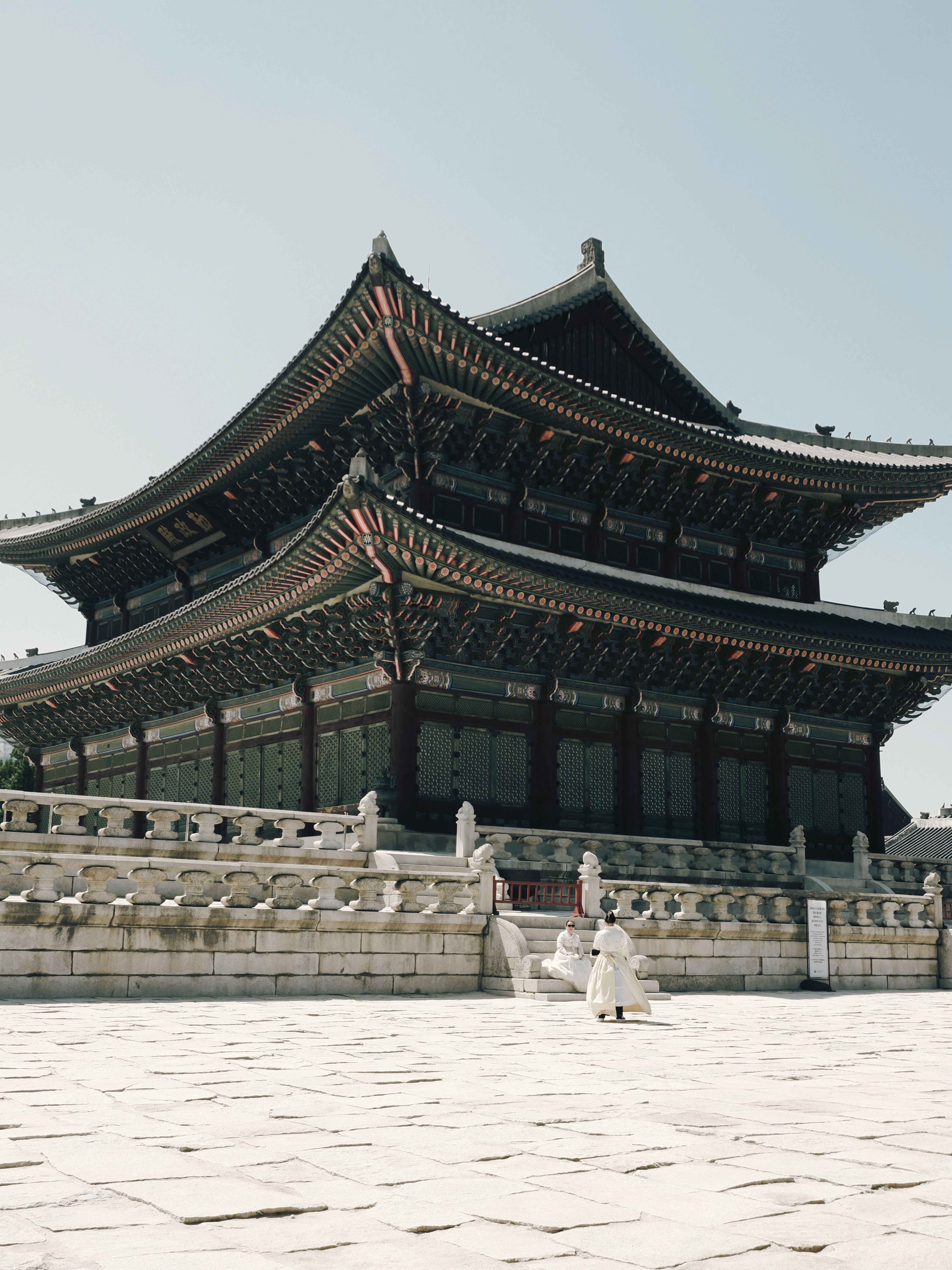
Gyeongbokgung Palace: where Seoul begins

About 3,000 won, 90 minutes, closed on Tuesdays. Arrive near 3pm to catch the changing of the guard, held at 10am and 2pm at the Gwanghwamun gate.
Gyeongbokgung is the principal palace of the Joseon dynasty, founded in 1395, and it was levelled twice: by the Japanese invasion of 1592 and by the twentieth century occupation, which went as far as building the colonial government headquarters directly in front of it. What stands today is patient reconstruction, still under way.
Anyone arriving in rented hanbok gets in free, and there are rental shops along the side street. That rule explains why half the courtyard is dressed in period costume in every photograph.
Bukchon Hanok Village: the quarter where people still live in hanok

No ticket, 60 minutes, uphill. This is a genuine residential district, with signs asking for quiet after 5pm.
The roughly 900 hanok of Bukchon sit between the two great palaces, where the court nobility lived. Bukchon-ro 11-gil is the street from the photographs, curved tile roofs in the foreground and the modern city behind.
Insadong: the street of paper, tea and galleries

No ticket, 60 minutes, walking down from Bukchon. The main street closes to traffic on Sundays.
Insadong concentrates shops selling hanji, the traditional Korean paper, along with tea houses, galleries and ceramics. It is touristy, but it remains the easiest place to buy craft that is not airport souvenir. Ssamziegil, a shopping centre built as a continuous spiral ramp, is the quick stop halfway along.
Day 2: Seoul from palace to market, heading south east
Changdeokgung Palace: the secret garden you must book ahead

About 3,000 won plus 5,000 won for the Huwon garden, 2 hours, closed on Mondays. The garden is guided only, on fixed timed slots, and the English ones are few: book online before you travel.
Changdeokgung is the best preserved palace of the dynasty and the only one on the UNESCO list, because it was laid out to follow the terrain instead of imposing symmetry on it. The Huwon, the secret garden, takes up 60% of the grounds and was reserved for the royal family for three centuries.
Ikseon-dong: 1920s hanok turned cafes and bars

No ticket, 75 minutes, a 10 minute walk from the palace. This is where to have lunch or coffee.
Ikseon-dong is a block of hanok built in the 1920s as workers' housing, which escaped demolition and has become, over the past decade, the most inventive address in the old centre: the same low houses now hold traditional dessert cafes, makgeolli bars and vintage clothing shops. It is the modern counterweight to Bukchon, with far fewer people photographing it.
Gwangjang Market: Korea's most famous stand-up lunch

No ticket, 75 minutes, open 9am to 11pm. Bring cash: many stalls do not take cards.
Gwangjang dates from 1905 and is the best known street food market in the country. Three dishes justify the visit: bindaetteok, a mung bean pancake fried to order, mayak gimbap, small rice rolls served with a mustard dip, and yukhoe, seasoned raw beef. Sit at the stall counter; eating standing in the aisle blocks the flow.
Dongdaemun Design Plaza: Zaha Hadid's ship in the middle of the market district

Outdoor areas free, exhibitions from 10,000 won, 90 minutes. Best after dark.
The DDP was designed by Zaha Hadid and opened in 2014, with 45,000 aluminium panels and not one straight line. During construction the excavation uncovered a stretch of the Seoul city wall and a Joseon era water gate, preserved in the park alongside. At night the roof lawn carries the LED rose installation, and the Dongdaemun garment market around it trades through the small hours.
Day 3: the DMZ, the most closely watched border on earth
Imjingak: where the line of the war becomes visible

The DMZ can only be entered on an authorised guided tour, leaving Seoul around 7.30am and costing 60,000 to 100,000 won. Carry your passport: without it you do not pass the first checkpoint.
Imjingak sits outside the controlled zone and is the opening stop. It holds the Freedom Bridge, over which 12,773 prisoners of war returned in 1953, and the fence covered in coloured ribbons left by families separated by the division. It is the part of the visit with nothing military about it, and the hardest to forget.
Dora Observatory: North Korea through binoculars

Included in the tour, 60 minutes, with a document check at the entrance to the zone.
From the platform you can see, with the naked eye on a clear day, the North Korean village of Kijong-dong, built in the 1950s as a showcase and nicknamed the propaganda village, with its 160 metre flagpole. Photography is allowed today, which was not always so: until 2018 a yellow line on the floor marked the point beyond which cameras were forbidden.
Third Infiltration Tunnel: 73 metres under the border

Included in the tour, 60 minutes. Skip it if you are claustrophobic or have knee trouble: the access ramp descends 350 metres with a low ceiling, and cameras and bags go in a locker.
This is the third of four tunnels discovered, found in 1978 after a defector reported it. It runs 1.6 km and passes 73 metres beneath the demarcation line, wide enough to move an infantry division an hour. North Korea claimed it was a coal mine and even painted the walls black to support the story.
Day 4: contemporary Seoul, from Yeonnam to Namsan
Gyeongui Line Forest Park: the railway that became a park

No ticket, a 90 minute walk, starting from exit 3 of Hongik University station.
The Gyeongui line was buried in 2005 and the trackbed became a 6.3 km linear park. The Yeonnam-dong stretch, nicknamed Yeontral Park by Koreans themselves, is the liveliest: lawn full of people sitting, small cafes on one side and the Hongdae bar district on the other. It is the morning walk that shows what Seoul is like away from the postcards.
Seoullo 7017: the overpass turned sky garden

A 30 minute stop, no ticket, open around the clock, connected to Seoul Station.
The 1970 road overpass was due for demolition on structural grounds and became, in 2017, a garden walkway holding more than 200 plant species in concrete pots, designed by the Dutch practice MVRDV. It links Seoul Station to the Namdaemun district and is the pleasantest walking shortcut in the centre.
N Seoul Tower: sunset over the whole city

Cable car about 14,000 won return plus 21,000 won for the observatory, 2 hours. Go up 40 minutes before sunset and come down after dark: the lit city is half the reason.
The tower stands on top of Namsan mountain, and tower plus mountain together put the deck 480 metres above sea level. You can walk up through the park in 40 minutes, which avoids the weekend cable car queue. The love padlocks clipped to the railings are a 2000s habit that became the signature of the place.
Day 5: Seoul to Gyeongju, capital of the Silla kingdom
Daereungwon: the hills that are royal tombs

Take a morning KTX out of Seoul: two hours to Singyeongju station, plus 15 minutes by bus into town. Tickets about 3,000 won, 75 minutes.
Daereungwon is a park holding 23 royal tombs of the Silla kingdom, which ruled the peninsula from here for nearly a thousand years. The tombs are grass hills up to 20 metres high, and one of them, Cheonmachong, has been excavated and can be entered, with a replica of the gold crown set where it was found.
Cheomseongdae: the oldest observatory in East Asia

A 25 minute stop, visible from outside without a ticket, a 10 minute walk from the tombs.
Cheomseongdae is a nine metre stone tower built in the 7th century, during the reign of Queen Seondeok, and is the oldest surviving astronomical observatory in East Asia. It uses 362 stones, the number of days in the lunar year, in 27 courses, because Seondeok was the 27th ruler of Silla.
Donggung Palace and Wolji Pond: the visit that is worth doing at night

About 3,000 won, 90 minutes, open until 10pm. Come at night: that is when it earns the visit.
This was the crown prince's palace, built in 674 beside an artificial pond curved so that the far shore could never be seen all at once. The old name, Anapji, was replaced by Donggung and Wolji in the 2010s, when excavation confirmed the original name. With the pavilions floodlit and reflected in still water, it is the most reproduced image of Gyeongju.
Day 6: Gyeongju, from the museum to the Toham mountain temples
Gyeongju National Museum: the context the sites do not give you

Free entry, 90 minutes, closed on Mondays. Start here: it is what gives the rest of the day meaning.
The museum holds the Silla gold crown, found in the tombs you saw yesterday, and the bell of King Seongdeok, cast in 771 and weighing 19 tonnes, the largest surviving bronze bell in Korea. The piece that tends to surprise people is much smaller: a 7th century roof tile with a smiling face, which has become the city's informal emblem.
Bulguksa Temple: the masterpiece of Silla Buddhism

About 6,000 won, 2 hours, 30 minutes by bus from the centre. Go before 10am to stay ahead of the school groups.
Bulguksa was built in 774 and is the masterpiece of Silla Buddhist architecture. What impresses is the base: two stone stairways, Cheongungyo and Baegungyo, representing the passage from the earthly world into the land of Buddha, assembled without mortar and standing for more than 1,200 years. The wooden halls above them are reconstruction, because they burned in the Japanese invasion of 1593.
Seokguram Grotto: the Buddha facing the sunrise

About 6,000 won, 75 minutes, 20 minutes by bus up the mountain from Bulguksa. Photography inside is forbidden.
The grotto is man made: it was assembled stone by stone near the summit of Mount Toham in the 8th century and covered with earth, with a 3.5 metre granite Buddha seated at the centre of a circular chamber. He faces east, towards the sea, and in the original design the first sunrise of the year struck the exact point of his forehead. Today you view him through glass, installed to control the humidity that nearly destroyed the chamber in the twentieth century.
Day 7: Gyeongju to Busan, from the painted village to the sea
Gamcheon Culture Village: the hillside settlement turned open air museum

Fifty minutes by train to Busan. Map ticket about 2,000 won, 2 hours, a lot of stairs.
Gamcheon began as a settlement for refugees from the Korean War, built in terraces up the hillside. In 2009 a public programme paid artists and residents to paint the facades and install sculptures, and the district became the emblem of Busan without ceasing to be residential: buy the map at the entrance, follow the marked route, and do not walk into alleys signed as private homes.
Jagalchi Market: pick your fish downstairs, eat it upstairs

No ticket, 75 minutes, closed on the first and third Sunday of the month. This is dinner.
Jagalchi is the largest seafood market in Korea and runs on a system of its own: on the ground floor you choose the live animal from the tank and pay by weight, then carry it to the second floor, where they charge a preparation fee and cook it on the spot. Order hoe, the Korean sashimi, and be wary of any stall that will not show the price per kilo before weighing.
Huinnyeoul Culture Village: white lanes above the sea

No ticket, 75 minutes, 20 minutes from Jagalchi across the bridge to Yeongdo island. Go late in the afternoon.
Huinnyeoul is a narrow band of white houses wedged between a cliff and the sea, also founded as refugee shelter. Some lanes are barely a metre wide, and the lower path, at the water's edge, looks straight out at the cargo ships anchored in the bay. The name means white stream, after the water that once ran down the cliff.
Day 8: the eastern coast of Busan and the way home
Haedong Yonggungsa Temple: the temple built on the sea rocks

Free entry, 90 minutes, opens at 5am. Come early: by 10am the access corridor becomes single file.
Almost every Korean Buddhist temple stands in the mountains, by doctrinal preference. Haedong Yonggungsa is the well known exception: raised in 1376 directly on the coastal rocks, with its halls hanging above the surf. You descend 108 steps, the number of afflictions in Buddhism, and the gilded facade with the sea behind it is why the photograph travels so far.
Haeundae Blueline Park: the yellow capsule along the shore

About 12,000 won for the beach train, 90 minutes including the wait. The suspended capsule costs more and sells out: book online ahead.
The old coastal railway between Mipo and Songjeong was decommissioned and became a 4.8 km park with two rides on the same alignment: the beach train, which runs the full route with stops, and the Sky Capsule, four seat pods raised above the track that run only as far as Cheongsapo. If you have to choose, the capsule has the better view and the train goes further.
Haeundae Beach: closing the itinerary

No ticket, 2 hours, a 10 minute walk from Mipo station. From here it is 55 minutes by metro to Gimhae airport.
Haeundae is the most famous urban beach in the country, 1.5 km of sand between high rises. Outside the Korean summer it empties out and works better as a walk: follow the Dalmaji promenade at the eastern end, which climbs the headland between cafes with a view and is where locals go to watch the moon rise.
Do you need a visa for South Korea?
Not a consular visa, but yes to the K-ETA electronic authorisation. Brazilians and most Western passport holders enter for tourism for up to 90 days without a visa, and the application is made on the official site, costs about 10,000 won and clears within 72 hours. Apply at least a week ahead.
Watch out for a common confusion: Korea keeps a temporary K-ETA waiver for some countries through the end of 2026, and Brazil is not on that list. Brazilians still need the K-ETA, whatever you may read about it being suspended.
On arrival you also fill in the Q-CODE health declaration, which is free and saves queueing at the airport. A passport valid for six months and proof of onward travel are the usual requirements.
When is the best time to visit South Korea?
April to June and September to November. These are the two windows where the weather cooperates, and each has its own argument: the cherry blossom opens between late March and mid April, and autumn colour peaks between late October and early November, when the Gyeongju temples turn red.
July and August carry the monsoon, with heavy rain, high humidity and the occasional typhoon, and that is also when Busan's beaches fill up with the Korean holidays. December to February is dry and bright, but Seoul spends whole days below freezing, and the DMZ outdoors at that temperature is hard going.
If your dates fall in Chuseok week, the harvest holiday in September or October, book everything months ahead: the whole country travels at once and KTX trains sell out.
How to get to South Korea and how to travel between cities
There are no direct flights from Brazil. The usual routings to Incheon go via Doha with Qatar Airways, Istanbul with Turkish, Dubai with Emirates or Addis Ababa with Ethiopian, totalling 28 to 34 hours with one stop. From the airport into central Seoul, the AREX express train takes 43 minutes.
Between cities this itinerary uses the KTX, and that is the right call: Seoul to Gyeongju takes two hours, and Gyeongju to Busan fifty minutes. Buy through the Korail app or at the station; no rail pass pays for itself over just two legs.
Within the cities the metro handles everything and is signed in English. Buy a T-money card at any convenience store, which works on metro, buses and taxis in all three cities. One thing that catches visitors out: Google Maps will not calculate walking or driving routes in Korea, because of a legal restriction on exporting mapping data. Download Naver Map or Kakao Map before you fly.
Where to eat in South Korea: local dishes and what to avoid
Eating is cheap and almost always good. A full meal in a neighbourhood restaurant costs 8,000 to 15,000 won, and always arrives with banchan, the side dishes that are free and refillable.
Bibimbap is the safest first dish for a newcomer: rice with sauteed vegetables, beef, egg and gochujang chilli paste, mixed at the table. The Jeonju version is the classic, and the one served in a hot stone bowl, dolsot bibimbap, forms a crust of toasted rice at the bottom that is the best part.

Samgyeopsal is everyday Korean barbecue: strips of pork belly grilled on the plate set into the table, cut with scissors and eaten wrapped in lettuce with garlic and ssamjang paste. There is usually a two portion minimum, so it is a meal for two or more.

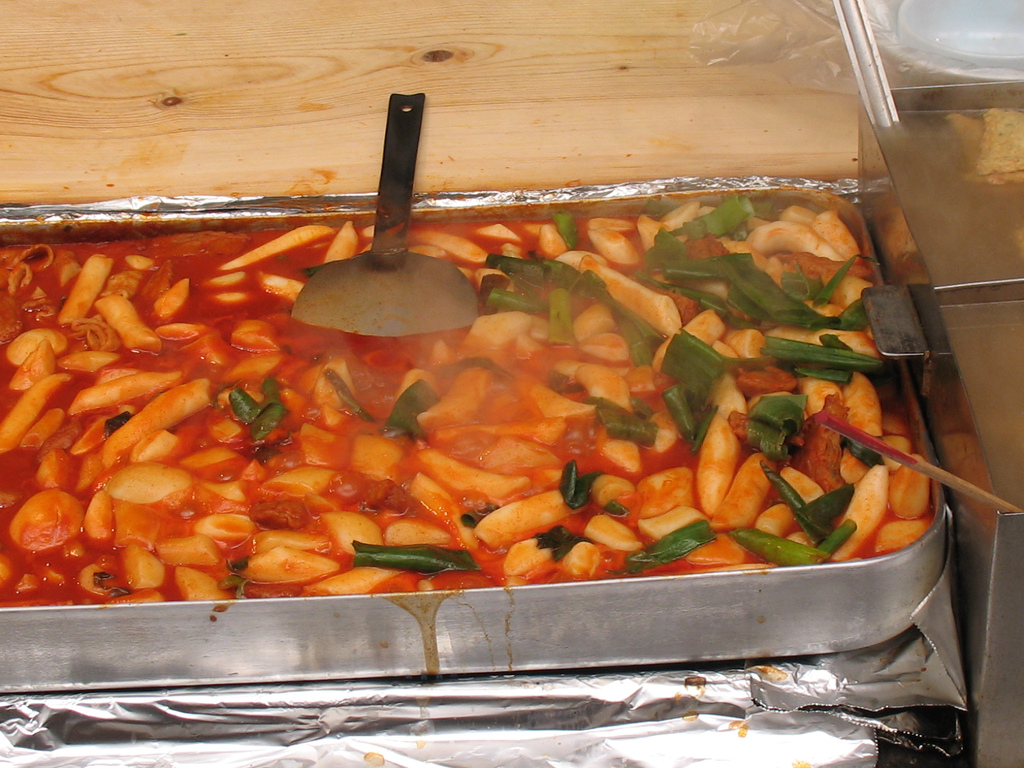
On the street, tteokbokki is everywhere: cylinders of rice cake simmered in gochujang sauce, sweet and hot at the same time. At Gwangjang market it shares the stall with bindaetteok and with odeng, fish cake on a skewer served with the cooking broth, which is free and rescues you in cold weather.
What to avoid: the second floor seafood restaurants at Jagalchi that will not show the price per kilo before weighing your fish, because the bill can triple, and the street stalls of Myeongdong, which charge two to three times the going rate for the same skewer sold at Gwangjang. Another quiet trap is ordering spicy without calibrating: the Korean baseline for chilli sits well above most visitors', and the phrase for mild is deol maepge.
How much does an 8 day trip to South Korea cost?
Between 2,100 and 3,200 dollars per person, with prices checked in September 2026. The flight is the largest share, and Korea itself costs less than Japan for the same standard.
The breakdown: a one stop flight runs 1,100 to 1,700 dollars return; mid range accommodation costs 60 to 110 dollars a night, higher in Seoul and lower in Gyeongju; food is 25 to 45 dollars a day; the two KTX legs come to about 70 dollars, and urban transport on a T-money card stays under 30 dollars for the whole trip; and the itinerary's tickets, covering both palaces, the DMZ tour, the temples and Blueline Park, total 130 to 180 dollars, with the DMZ alone more than half of that.
One detail that helps the budget: the won has fallen about 15% against several emerging market currencies over the past twelve months, part of why the destination became popular in 2026. The table above carries the official links for checking current prices.
Is 8 days enough to see South Korea?
For the Seoul, Gyeongju and Busan axis, yes. Eight days cover the two principal palaces, a full day at the DMZ, the historic capital of the Silla kingdom and the Busan coast with time left over to walk, and the KTX handles both transfers in under three hours combined.
What stays out is Jeju, and that is deliberate. The island needs a domestic flight, two or three days of its own and a rental car, and fitting it into eight days would mean cutting Gyeongju or reducing Seoul to two days, which is thin for a city of ten million. With 11 or 12 days, Jeju slots naturally between Gyeongju and Busan.
With less time you can cut Day 6 and see Bulguksa and Seokguram on the afternoon of Day 5, turning this into a 7 day trip. What is not worth cutting is the DMZ: it is the one part of the itinerary that exists in no other country, and the part travellers mention most after they get home.
Estimated budget per person
Prices checked on 17 September 2026. Check current prices at Visit Korea, the official Korean tourism organisation · Haeundae Blueline Park, official ticketing · Paju tourism, official DMZ information · Gyeongju city, official tourism information · Visit Busan, official city information.
Frequently asked questions
Do Brazilians need a visa for South Korea?+
Not a consular visa, but the K-ETA electronic authorisation is required for tourist stays of up to 90 days. It costs about 10,000 won, is filed online and clears within 72 hours. The temporary K-ETA waiver running to the end of 2026 does not include Brazil.
How much does an 8 day trip to South Korea cost?+
Between 2,100 and 3,200 dollars per person, covering a one stop flight, accommodation, food, the two KTX legs and entrance tickets, with prices checked in September 2026. The DMZ tour alone accounts for more than half the ticket budget.
When is the best time to visit South Korea?+
April to June and September to November. Cherry blossom opens between late March and mid April, and autumn colour peaks between late October and early November. July and August are monsoon season, and Seoul winters sit below freezing.
Can you visit the DMZ independently?+
No. The zone is only accessible on an authorised guided tour, leaving Seoul early in the morning and costing 60,000 to 100,000 won. A passport is required at the entrance, and some dates close without notice for military reasons, so leave slack in the itinerary.
Do you need to speak Korean to travel in South Korea?+
No. The metro, trains and attractions are signed in English, and translation apps handle the rest. The real catch is different: Google Maps cannot calculate routes in Korea because of a legal restriction, so download Naver Map or Kakao Map before you fly.
Is it worth adding Jeju island to this 8 day itinerary?+
Not in eight days. Jeju needs a domestic flight, a rental car and two to three days of its own, and fitting it in would mean cutting Gyeongju or reducing Seoul to two days. With 11 or 12 days it slots naturally between Gyeongju and Busan.
Ready to go?
Save this itinerary to your Galmund and take the schedule, map and budget with you. Edit, share and track it all on the globe.
Save this itinerary to my GalmundBeen there already?
Pin this trip on your globe and keep your photos where they were taken.
Pin it on my globe