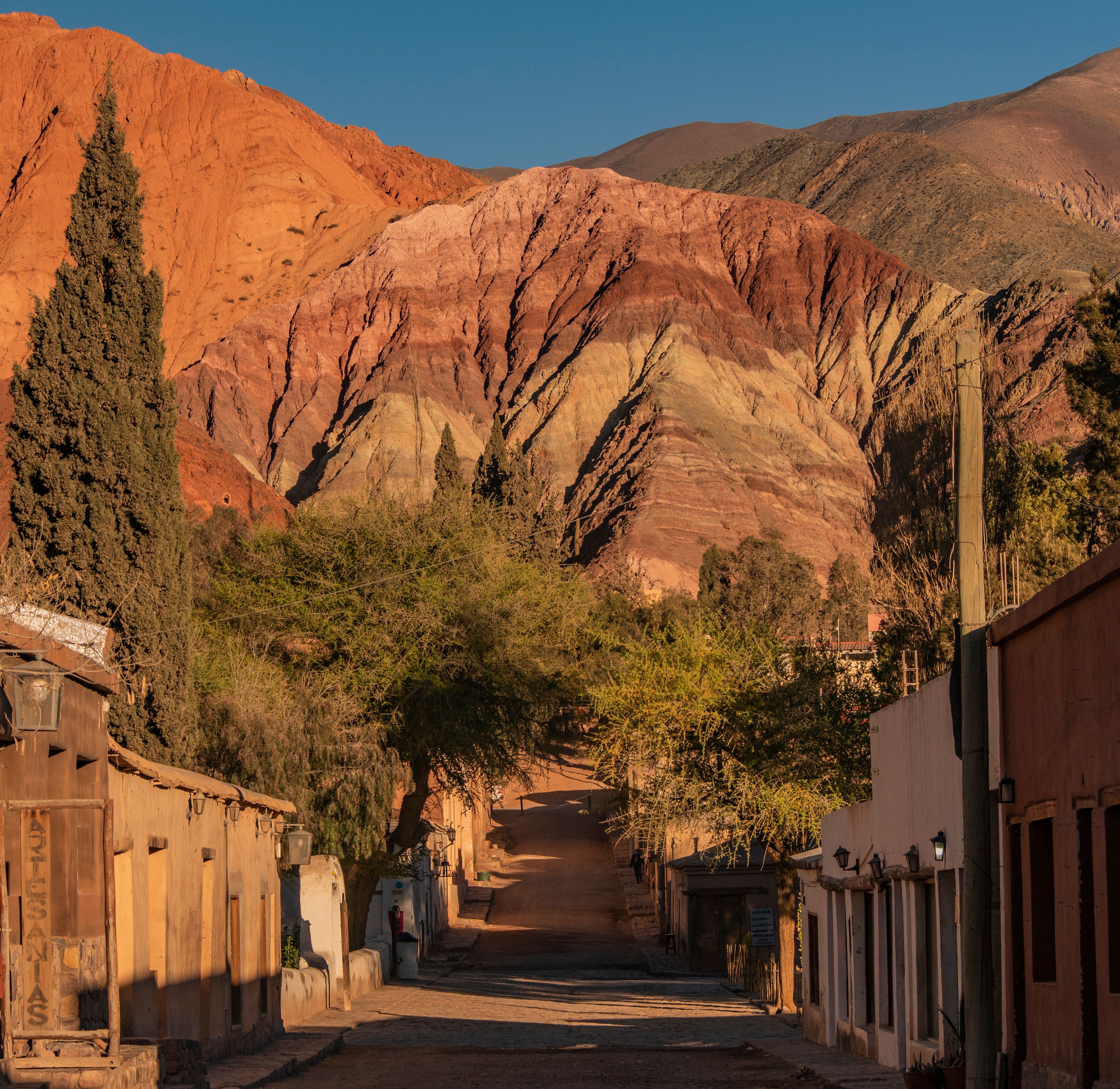
Salta · Cafayate · Quebrada de las Conchas · Purmamarca · Salinas Grandes · Tilcara · Humahuaca · Hornocal · 13 min read
Salta and Jujuy 8 Day Itinerary: Cafayate, Purmamarca and Hornocal
8 days · 3 cities
Duration
8 days
Estimated budget
US$ 700 to US$ 1,250 plus flights, 8 days
Best time to go
April to November, the dry season
Visa
Visa free for most; check your nationality
This 8 day Salta and Jujuy itinerary is done with a rental car and sleeps in three bases, Salta, Cafayate and Purmamarca, so you never drive more than one long stretch a day and you climb in altitude gradually.
In short: Salta, the Quebrada de las Conchas to the Cafayate wineries, then Purmamarca, Salinas Grandes, Tilcara, Humahuaca and Hornocal. Visa, timing and where to eat are at the end.
Day 1: arrival in Salta, the Cathedral and the MAAM mummies
Salta Cathedral: the pink facade on Plaza 9 de Julio

Free, 30 minutes, the first stop after check in. The cathedral faces Plaza 9 de Julio, the heart of the city, and all three stops of the day are around it.
Inside are the images of the Lord and the Virgin of the Miracle, which the whole city follows in procession every 15 September. Notice the pink facade against the green hills around Salta.
MAAM: the Llullaillaco children, the museum worth the trip

About 16,000 pesos for foreigners, 90 minutes, closed on Mondays. It is across the square, 100 metres from the cathedral, and it is the most important visit in Salta.
In 1999 archaeologists found three Inca children on the summit of the Llullaillaco volcano, at 6,739 metres, offered in sacrifice more than 500 years ago and preserved by the cold with clothes, hair and offerings intact. The museum shows one of them at a time, in rotation, in a refrigerated chamber. It is striking and respectful; photos are not allowed inside.
Cabildo of Salta: the white arcades in the late afternoon

About 30 minutes, 120 metres from the MAAM on the south side of the square. It is the best preserved colonial town hall in the country, from 1783, and now houses the Northern History Museum.
Even without going in, walk under the two rows of arches as the sun drops and the square fills up. At night, a peña is the plan: options are in the where to eat section.
Day 2: San Francisco, San Bernardo and the cable car
San Francisco Church: the 53 metre red bell tower

Free, 40 minutes, two blocks from the square along Calle Caseros. Start the day here: the facade looks best in the morning light.
It is the postcard of Salta: red, gold and white, with a 53 metre bell tower, one of the tallest in South America. The adjoining convent has a small religious art museum.
San Bernardo Convent: the cedar door from 1762

Free, 20 minutes, at the end of the same Calle Caseros, 400 metres on. It is a closed convent and cannot be visited inside: what you see is the facade.
It is the oldest building in Salta, and the cedar door was hand carved by Indigenous craftsmen in 1762. From here the cable car is a five minute walk, at the edge of Parque San Martín.
San Bernardo Cable Car: all of Salta from above

About 20,000 pesos return for foreigners, an 8 minute ride up; allow two and a half hours with lunch at the top. If you prefer walking, climb the stairway of about 1,000 steps in an hour and ride down.
At the top there is a viewpoint, gardens with waterfalls and a café overlooking the city and the Lerma Valley. The afternoon is free to rest before the next day on the road.
Day 3: the Quebrada de las Conchas to Cafayate
Devil's Throat: the first slot of the Quebrada de las Conchas

Free, 40 minutes, about 2h30 from Salta on Ruta Nacional 68. Leave at 8am: the road to Cafayate is 185 kilometres and all the stops are in the second half.
It is a narrow slot rising between red sandstone walls; you can walk in and scramble a little over the rocks. Park on the signposted shoulder.
The Amphitheatre: the gorge's natural acoustics

Free, 30 minutes, less than 1 kilometre from the Devil's Throat. It is a circular hollow with very high walls, and the acoustics are so good that there is often a musician playing quena or guitar for visitors.
Los Castillos: the sandstone towers by the road

A 15 minute stop on the shoulder, already close to Cafayate. The rocks look like the walls and towers of a castle, and the midday sun makes the red deeper.
Cafayate square: the five nave cathedral

After the 2pm check in, a late afternoon walk around the main square, 45 minutes. The Cathedral of Our Lady of the Rosary is one of the few in the country with five naves.
Around the square are the cafés, wine shops and the crafts fair. Cafayate sits at 1,660 metres: the first step of acclimatising for the Puna.
Day 4: the Cafayate wineries and torrontés
Vasija Secreta: the oldest winery, walking from town

Tour with tasting from about 15,000 pesos, 75 minutes, a 15 minute walk from the square along Ruta 40. No booking needed on most days.
It is one of the oldest wineries in Cafayate, with a small museum of 19th century presses and barrels. Taste the torrontés, the aromatic white grape that only does this well at the altitude of the Calchaquí Valleys.
El Esteco Winery: the most complete tasting in Cafayate

Guided tour with tasting from about 30,000 pesos, 2 hours with the tour, 350 metres from Vasija Secreta. Book a day ahead on the winery website.
Founded in 1892 by the Michel brothers, it is the former Michel Torino, and the tour covers the high altitude vineyards and the cellar and ends with premium wines. The afternoon is free: if you want to hike, the Río Colorado waterfalls trail is 6 kilometres away, always with a local guide.
Day 5: from Cafayate to Purmamarca and the Paseo de los Colorados
Santa Rosa de Lima Church: Purmamarca's square

This is the longest day on the road: about 6 hours and 390 kilometres back through Salta and up Ruta 9 and Ruta 52. Leave at 7.30am to check in at 2pm.
Then 20 minutes on the square. The adobe church dates from the 17th century, with a cardón cactus wood ceiling, and the textile and poncho market sets up around it. Purmamarca is at 2,324 metres: walk slowly and drink water.
Paseo de los Colorados: the 3 km loop through the red hills

Free, 90 minutes on foot at an easy pace, starting 500 metres from the square. Do it in the late afternoon, when the sun makes the red most intense.
The dirt track loops around hills of red rock, with viewpoints back to the Hill of Seven Colours. It is flat, but the altitude weighs on the first day: take your time.
Day 6: Salinas Grandes over the Cuesta de Lipán and the Pucará de Tilcara
Cuesta de Lipán: the switchbacks up to 4,170 metres

A 20 minute stop at one of the viewpoints, about an hour from Purmamarca. Ruta 52 climbs in tight bends to the Abra de Potrerillos, at 4,170 metres, the highest point of the trip.
Get out of the car slowly and do not rush up there: this is where altitude sickness usually shows up.
Salinas Grandes: the white salt flat and the pools

A guided visit with the local community is required, about 8,000 pesos, 90 minutes, booked at the stand by the entrance. Sunglasses and sunscreen are essential.
The salt flat lies at 3,450 metres and covers more than 200 square kilometres of white crust. The guides take you to the piletones, the rectangular pools where salt is extracted, with turquoise water. Head back to Purmamarca for lunch.
Painter's Palette: the coloured bands of Maimará

A 15 minute stop on Ruta 9, 20 minutes from Purmamarca, on the way to Tilcara. The ochre, pink and green bands really look like a painter's palette, and the colourful hillside cemetery opposite completes the photo.
Pucará de Tilcara: the Omaguaca fortress above the valley

About 12,000 pesos for foreigners, 2 hours, last entry 5.15pm. It is 1 kilometre from the centre of Tilcara, 8 kilometres past Maimará.
The pre Hispanic fortress of the Omaguaca people commands the Río Grande valley, with rebuilt stone houses, cardón cacti and, at the top, the pyramid honouring the archaeologists who excavated the site. The archaeology museum on Tilcara's square has a separate ticket.
Day 7: Uquía, Humahuaca and the Serranía de Hornocal
Uquía Church: the harquebusier angels

Free, 20 minutes, 45 minutes from Purmamarca on Ruta 9. The 1691 church holds a rare series of Cusco school paintings of angels dressed as Spanish soldiers and armed with harquebuses.
Quebrada de las Señoritas: Uquía's red trail

Entry with a mandatory local guide, about 2h30 return, starting behind the church. It is an easy walk, good once you have acclimatised, and far quieter than the roadside viewpoints.
The path follows a dry riverbed between red walls and ends in a rock corridor with the white formations that give the place its name. Bring water and a hat: there is no shade.
Humahuaca: the monument and the noon Saint Francis

Free, 75 minutes, 12 kilometres from Uquía. Arrive before noon: at 12 sharp, the articulated figure of Saint Francis Solano comes out of the Cabildo tower and blesses the square.
Then climb the stone stairway to the Monument to the Heroes of Independence at the top of the town. Humahuaca is at 2,940 metres; have lunch here before Hornocal.
Serranía de Hornocal: the 14 colour mountain in the afternoon

A token community fee, 2 hours with the drive, 25 kilometres from Humahuaca on a dirt road. Go in the afternoon, when the sun lights the colours head on. A regular car makes it carefully when dry; if it has rained, take the 4x4 van from the Humahuaca bus terminal.
From the viewpoint, at 4,350 metres, the range shows bands of 14 colours folded in a zigzag. It is cold and windy: bring a jacket even in summer.
Day 8: the Hill of Seven Colours and back to Salta
Hill of Seven Colours: the photo that only works in the morning

Free, 45 minutes, walking from the square. The hill faces east, and the morning light is what makes the bands glow; in the afternoon it falls into shade, which is why it is saved for the last day.
The best known viewpoint is on Cerro El Porito, a 15 minute walk up along Ruta 52.
Salta Crafts Market: shopping before the flight

Free, 90 minutes, about 3 hours from Purmamarca on Ruta 9. It is on the way back to the airport and the best place to buy ponchos, llama wool textiles, pottery and silver.
It is housed in an arcaded colonial mansion on Avenida San Martín. Flights home often leave late at night, so there may be time for one last peña.
Do I need a visa to travel to Salta and Jujuy?
Citizens of the EU, the UK, the United States, Canada, Australia and most of Latin America enter Argentina visa free for tourism, usually for up to 90 days. Check the Argentine immigration website for your nationality. To drive, carry your licence (an International Driving Permit is recommended), the rental car papers and the mandatory insurance, which police ask for at Ruta 9 checkpoints.
When is the best time to visit Salta and Jujuy?
From April to November, in the dry season: clear skies, good roads and sharp colours. Days are warm and nights cold, especially in Purmamarca and Humahuaca, where temperatures drop below freezing in June and July.
Avoid January and February, when summer rains cut dirt roads, including the Hornocal track, and the Quebrada clouds over. The Quebrada Carnival in February is a huge festival, but everything fills up.
How to get to Salta and how to get around: car, altitude and roads
Salta and Jujuy have airports with daily Aerolíneas Argentinas flights from Buenos Aires, about 2 hours, and from 17 December 2026 Gol adds a direct flight from Rio de Janeiro to Salta twice a week.
Rent the car at Salta airport: the whole route is paved except the last stretch to Hornocal. Altitude is the thing to watch: the route climbs from 1,187 metres in Salta to 1,660 in Cafayate, 2,324 in Purmamarca and 4,170 on the Cuesta de Lipán. Drink plenty of water, eat light, skip alcohol on your first day in Jujuy and chew coca leaves or drink coca tea, sold in any market.
Where to eat in Salta and Jujuy: empanadas, peñas and what to avoid
The salteña empanada is small, filled with knife cut beef, potato, egg and spring onion, and comes out juicy from the clay oven. Eat it with your hands, biting from the tip, no cutlery.

Across the region corn rules: humita en chala, fresh corn paste with cheese cooked in its own husk, the tamal, with meat, and locro, a thick stew of corn, beans, squash and meat, served mostly in winter. In Jujuy you will find llama meat, lean, breaded or stewed.


In Cafayate, order torrontés, the dry aromatic white that is the signature grape of the Calchaquí Valleys, and try the wine ice cream sold around the square.

At night in Salta, the plan is a peña: dinner with live folk music, zamba and chacarera. Most are on Calle Balcarce, near the old railway station, and the most traditional ones have rooms around patios where musicians play from table to table.

What to avoid: the Balcarce venues with stage shows and a steep cover charge that serve frozen empanadas to tour buses. Ask whether there is a cover before sitting down.
How much does an 8 day trip to Salta and Jujuy cost?
Between 700 and 1,250 US dollars per person plus international flights, sharing a double room and splitting the car between two. The budget table breaks it down.
Tickets are cheap: MAAM, the cable car, the Pucará, Salinas Grandes and one tasting together come in under 150 dollars. The car is the big cost. Peso prices change fast with Argentine inflation, so check the official sources before you go; foreign credit cards usually get the more favourable exchange rate.
Are 8 days enough for Salta and Jujuy?
For the essentials, yes: Salta, the Quebrada de las Conchas, Cafayate and the Quebrada de Humahuaca with Salinas Grandes and Hornocal fit into 8 days without rushing, because the three bases cut the driving into short stretches.
Left out are Ruta 40 through Cachi and Los Cardones National Park, which link Salta and Cafayate the other way round and need two more days, and Iruya, the village clinging to the mountain, one more day from Humahuaca. The Tren a las Nubes is out too: it is expensive, it leaves from San Antonio de los Cobres and most of the journey is done by bus. With 10 days, add Cachi; with 12, Iruya as well.
Estimated budget per person
Prices checked on 19 September 2026. Check current prices at Museum of High Altitude Archaeology (MAAM), official tickets · San Bernardo Cable Car, hours and fares · Pucará de Tilcara, Tilcara University Centre (UBA) · Official Jujuy tourism board (Salinas Grandes and Hornocal).
Frequently asked questions
Do I need a visa for Salta and Jujuy?+
Most visitors from the EU, the UK, the United States, Canada, Australia and Latin America enter Argentina visa free for tourism, usually for up to 90 days. Check the Argentine immigration website for your nationality before booking.
How much does an 8 day trip to Salta and Jujuy cost?+
Between 700 and 1,250 US dollars per person plus international flights, with a double room, a rental car split between two, food and tickets. The tickets together come in under 150 dollars.
Do you need a car for Salta and Jujuy?+
It is the most practical way and the one this itinerary uses: almost everything is paved and the stops in the Quebrada de las Conchas and the Quebrada de Humahuaca are right by the road. Without a car you can use day tours from Salta, but with much more time in a van.
How do you avoid altitude sickness in Jujuy?+
By climbing gradually, as this itinerary does: Salta at 1,187 metres, Cafayate at 1,660 and only then Purmamarca, at 2,324. Drink plenty of water, eat light, skip alcohol on the first day and walk slowly above 4,000 metres, at the Cuesta de Lipán and Hornocal. Coca tea, sold in any market, helps.
Is the Tren a las Nubes worth it?+
For most people, not on an 8 day trip. It is expensive, departs from San Antonio de los Cobres and most of the journey from Salta is by bus, taking a full day. The Cuesta de Lipán and Salinas Grandes deliver the Puna landscape with far less time on the road.
Ready to go?
Save this itinerary to your Galmund and take the schedule, map and budget with you. Edit, share and track it all on the globe.
Save this itinerary to my GalmundBeen there already?
Pin this trip on your globe and keep your photos where they were taken.
Pin it on my globe