Windhoek · Sesriem · Sossusvlei · Deadvlei · Swakopmund · Spitzkoppe · Etosha · 15 min read
Namibia 7 Day Itinerary: Sossusvlei, Swakopmund and Etosha
7 days · 4 cities
Duration
7 days
Estimated budget
US$ 1,900 to US$ 2,900 per person, 7 days
Best time to go
May to October, the dry season
Visa
Visa on arrival for many passports
This Namibia 7 day itinerary is a 4x4 loop out of Windhoek, with four bases: the capital, Sesriem, Swakopmund and Etosha. Sleeping inside the Sesriem gate is the decision that shapes the week: only those inside reach Deadvlei at sunrise.
In short: Windhoek, the Namib dunes, the Swakopmund coast, the Spitzkoppe and the Etosha safari. Visas, season and food are at the end.
Day 1: arriving in Windhoek, the museum and the German centre
Independence Memorial Museum: the history before the landscape

Free, 1h15, in central Windhoek, right after check-in. The golden glass building was put up by a North Korean contractor and opened in 2014, where the German equestrian monument used to stand.
Three floors cover German colonisation, the Herero and Nama genocide of 1904 to 1908 and the independence war, which only ended in 1990. Start here: the rest of the trip is landscape, and this is the one place on the route that explains the country. The glass lift reaches a rooftop restaurant with the best view in town.
Christuskirche: the 1910 sandstone church

Free when open, 30 minutes, 100 metres from the museum. The Lutheran sandstone church with its red roof dates from 1910 and is the image that stands for Windhoek in every brochure.
The stained glass was a gift from Kaiser Wilhelm II. It sits on a roundabout, so the good photo comes from the museum steps across the road.
Tintenpalast: the ink palace

Gardens free, 30 minutes, 250 metres from the church. The name, ink palace, was a joke by colonial civil servants about how much paper was used inside. Today it is Parliament, and the public palm garden in front is where Windhoek has lunch.
Day 2: the desert road to Sesriem
Solitaire: apple pie in the middle of nowhere

Free, 30 minutes, 3h30 from Windhoek. Solitaire is a petrol pump, a workshop and a bakery at a desert crossroads, with 1950s cars rusting in the sand.
Sesriem Canyon: the late afternoon walk

Included in the park fee, 1 hour, 4 kilometres from the Sesriem gate and 1h30 on from Solitaire. The Tsauchab river cut a corridor a kilometre long and 30 metres deep into the rock.
You drop in on a ramp and walk the bed, between walls that narrow to two metres in places. It is the right thing for the late afternoon of arrival day, because the dunes demand a pre dawn start.
Sleep inside the Sesriem gate, at the park campsite or the Sossus Dune Lodge: the inner gate opens an hour before the outer one, and that hour is what separates photographing an empty Deadvlei from arriving with the sun high.
Day 3: Dune 45, Deadvlei and Sossusvlei
Dune 45: climb it before the sun

Included in the park fee, 1h30 with the climb, 45 kilometres of tarmac from the gate. Leave camp when the inner gate opens, around 5.45am in summer.
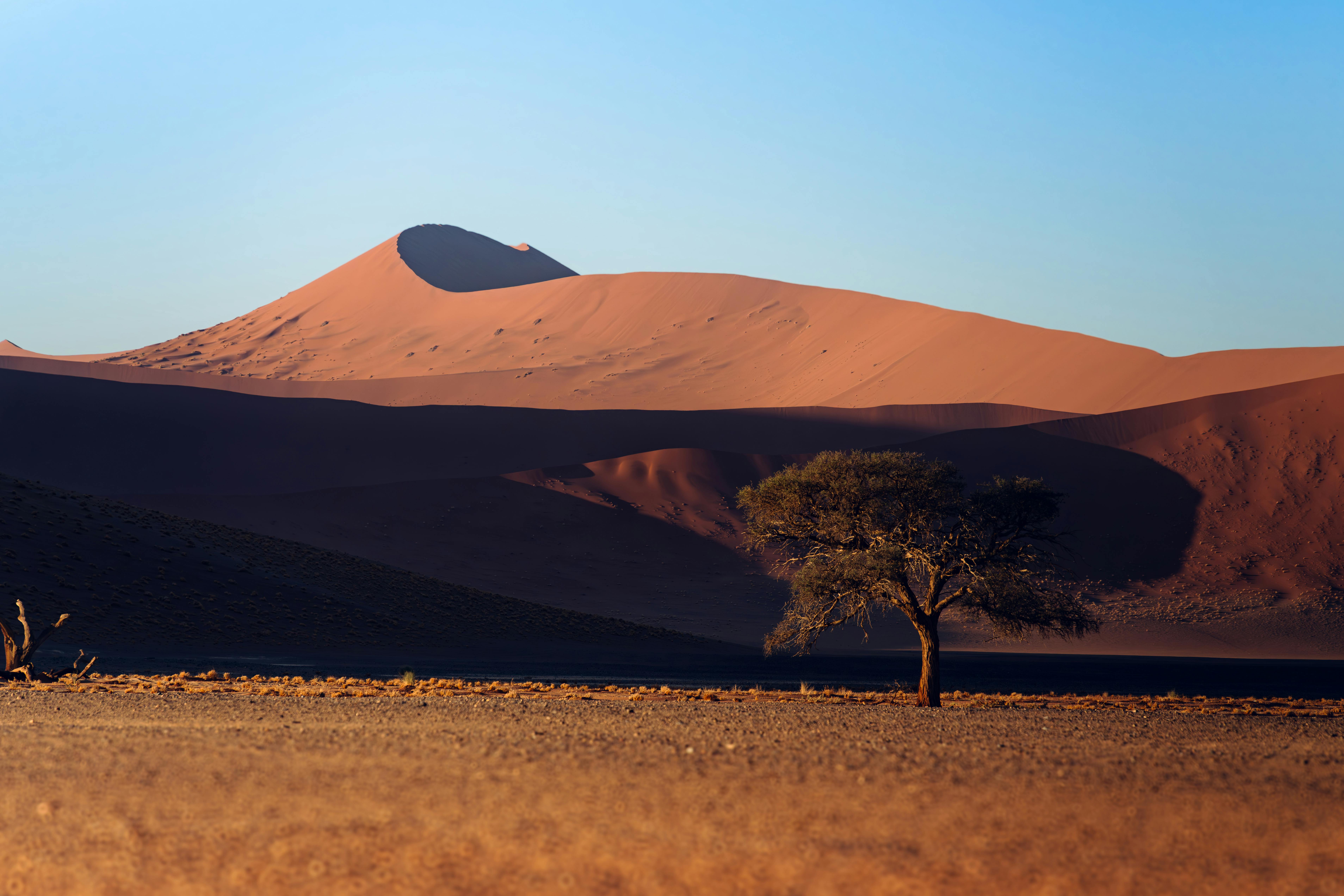
The dune is 170 metres and the ridge climb takes 30 to 40 minutes, with sand giving way at every step. Carry water and come down barefoot, which is faster and more fun. The lone acacia at the foot is the classic shot.
Deadvlei: acacias dead for 700 years

Included in the fee, 2h30 with the walk, 15 kilometres past Dune 45. The last 5 kilometres are deep sand: a real 4x4, or the park shuttle that leaves the 2x4 car park every 20 minutes.
From the car park it is a 1.1 kilometre walk to the pan. The floor is cracked white clay, the dunes around it are orange, and in the middle stand skeletons of camel thorns that died when the river changed course about 700 years ago and never rotted, because there is no moisture in the air. Be there before 9am: after that the contrast goes and the sand burns your feet.
Sossusvlei and Big Daddy

Included in the fee, 1 hour, 2 kilometres from Deadvlei. This is the salt pan that gives the place its name, ringed by the tallest dunes in the world.
Big Daddy is 325 metres and takes 1h30 to climb in sand, which only makes sense before 8am. Anyone who climbs runs down the steep face straight into Deadvlei, which solves both at once. On the way out, the park gate closes at sunset and the late fine is real.
Day 4: from the desert to the Atlantic at Swakopmund
Walvis Bay Lagoon: the flamingos

Free, 1 hour, 4h30 from Sesriem, much of it on gravel. The lagoon is a Ramsar site and holds up to 50,000 flamingos, greater and lesser, along with pelicans.
You can watch from the shore road, from the car, with no boat or tour. Afternoon light is better, and the water changes colour with the tide.
Swakopmund Jetty: Germany in the desert

Free, 45 minutes, 30 kilometres north of the lagoon. Swakopmund has a German bakery, German street names and 1900s colonial houses facing the cold Atlantic of the Benguela current.
The iron jetty dates from 1912 and reaches 262 metres out to sea. Walk to the end late in the day and eat at the restaurant on the pier. The town is the trip pause: here you do laundry, refuel and sleep two nights.
Day 5: Sandwich Harbour and the crystals
Sandwich Harbour: where the dune falls into the sea

About 1,800 Namibian dollars for the full day tour, 5 hours, leaving from Walvis Bay. You do not go on your own: the route runs along the beach, depends on the tide table and bogs a car easily.
The guide deflates the tyres, runs the hard sand strip and climbs the dunes that drop straight into the Atlantic, 100 metres above the surf. It is the most improbable landscape on this route, and it almost always includes lunch with sparkling wine on top of a dune.
Kristall Galerie: the largest quartz crystal in the world

About 140 Namibian dollars, 1 hour, in central Swakopmund. The centrepiece is a 14 tonne quartz crystal taken from a mine at Otjua. It works well for the late afternoon, when the coastal wind picks up.
Day 6: the Spitzkoppe and arriving at Etosha
Spitzkoppe: the Matterhorn of Namibia

About 150 Namibian dollars per person, 2 hours, 2h30 from Swakopmund. The granite peaks are 700 million years old, older than the desert around them.
The rock arch is the compulsory photo, and there are San rock paintings 2,000 to 4,000 years old on a wall minutes from the car park, reachable only with a local guide. Anyone with a spare night camps here: there is no electric light for kilometres and the sky is the best of the trip.
Okaukuejo waterhole: the safari that comes to you

280 Namibian dollars per person and 50 for the car, per day, 1h30 at dusk, plus 4h30 of road from the Spitzkoppe. Enter through the Andersson gate and go straight to camp.
The Okaukuejo waterhole is floodlit all night and sits metres from the camp fence, with tiered seating. Elephant, black rhino, lion and hyena take turns without you driving anywhere. Stay until at least 10pm: the black rhino tends to arrive late.
Day 7: crossing Etosha to Namutoni
Etosha Pan: the plain you can see from space

Included in the park fee, 3 hours with stops, leaving Okaukuejo at first light. The salt pan covers 4,800 square kilometres and stays dry almost all year, which forces the wildlife onto the waterholes around its rim.
Drive slowly, waterhole to waterhole, between Okaukuejo, Halali and Namutoni: that is how you see lion, oryx, springbok and the black rhino Namibia protects better than any other country. The Etosha Lookout runs out onto the pan itself, and is the only part of the park where you may leave the car.
Fort Namutoni: the end of the park and the trip

Included in the fee, 1h30, at the far east of the park. The white fort dates from 1903, was destroyed by Ovambo fighters the following year and rebuilt; today it is a camp and a national monument.
Climb the watchtower at sunset and look over the King Nehale waterhole just north. From here the Von Lindequist gate is 10 minutes away, and Windhoek 5 hours on the tarred B1: if your flight is in the morning, sleep at Otjiwarongo halfway.
Do you need a visa to visit Namibia?
It depends on your passport, and this changed recently. On 1 April 2025 Namibia ended visa free entry for 33 countries that did not offer reciprocity, among them the United States, Canada, the United Kingdom, Germany, France, Italy, Spain and Australia. Those passports now pay 1,600 Namibian dollars, about 90 US dollars, for a visa on arrival or an e-visa applied for before travel.
Brazil kept its exemption: Brazilians enter on a passport alone for up to 90 days in any 12 month period. The visa on arrival queue at Windhoek airport can run over an hour, so applying online first is worth it.
The passport needs six months of validity and two blank pages. A minor travelling without both parents needs a birth certificate and an authorisation, and Namibian immigration genuinely checks.
When is the best time to visit Namibia?
May to October, the dry season. That is when the vegetation dies back, the waterholes on the rim of the Etosha Pan become the only water in the park and the wildlife concentrates on them: July to October are the best safari months of the year.
June and July bring 5 degree nights in the desert and near freezing dawns at Etosha, so pack a jacket even going to Africa. November to April it rains in the north, tall grass hides the game and some gravel roads become impassable, but the dunes get dramatic skies and prices drop.
Sossusvlei has no bad season, only a bad hour: December to February passes 40 degrees at midday, and the rule of being on the dune before 8am holds all year.
How to get to Namibia and how to travel around the country
Hosea Kutako airport, 45 minutes from Windhoek, is the gateway, with flights from Johannesburg, Cape Town, Frankfurt, Addis Ababa and Doha. From the Americas the trip runs 15 to 19 hours with one connection.
Inside the country, drive yourself. There is no public transport between the places on this route and the total distance passes 2,000 kilometres. Rent a 4x4 with two spare wheels: 90 to 150 dollars a day, and almost everything outside the towns is gravel road.
Three rules that head off the most common problem of the trip: you drive on the left, the gravel limit is 80 km/h, and a blown tyre is the number one incident rental companies see. Fill up whenever you pass a station, because they sit 200 kilometres apart, and carry cash: many interior stations take no cards and there is no self service. The currency is the Namibian dollar, pegged one to one to the South African rand, which also circulates.
Where to eat in Namibia: typical dishes and the best restaurants
Namibian food is game meat, braai and German inheritance, and in the interior the menu repeats itself: oryx, kudu, springbok and ostrich grilled, almost always with pap, the maize porridge.

Biltong is meat cured with salt, vinegar and coriander, cut into strips and eaten in the car. Buy it at a supermarket before hitting the road, because between Sesriem and Swakopmund there is nowhere to stop. Kudu is the best.

Kapana is the national street food: thin strips of beef grilled to order at market stalls, served on paper with salt, pepper and a dry mix called chili. The place is the Single Quarters Market in Katutura, Windhoek. Go with a local or a guide, in daylight, and pay a few dollars for a whole lunch.

In Windhoek, Joe Beerhouse on Nelson Mandela Avenue has been open since 1991 and is where almost every traveller eats game for the first time: oryx, zebra, crocodile and ostrich over coals, in a shed covered in bric-a-brac. Book, because it fills. What to avoid on the coast: fried fish from a beach stall in Swakopmund outside lunch hours, because turnover is low.
Are 7 days enough to see Namibia?
For the classic loop, yes. Seven days cover Windhoek, Sossusvlei, Swakopmund, the Spitzkoppe and Etosha across about 2,100 kilometres, which is the limit before a trip becomes only driving.
Left out are Damaraland, with the Twyfelfontein engravings and the desert elephants, the Fish River Canyon in the far south, and the Caprivi strip in the northeast, each needing 2 to 3 days of its own. With 10 days, add Damaraland between the Spitzkoppe and Etosha, which is the natural fit; with 14, the Fish River Canyon right after Windhoek. For another southern African safari, with water instead of desert, see the Botswana 6 day itinerary.
Estimated budget per person
Prices checked on 20 September 2026. Check current prices at Namibia Wildlife Resorts, taxas de parque · Embaixada da Namibia em Paris, taxas e isencoes de visto · Missao da Namibia em Genebra, regras de visto desde 2025.
Frequently asked questions
Do you need a visa to visit Namibia?+
It depends on the passport. On 1 April 2025 Namibia ended visa free entry for 33 countries without reciprocity, among them the United States, Canada, the United Kingdom, Germany, France and Australia, which now pay 1,600 Namibian dollars, about 90 US dollars, for a visa on arrival or an e-visa. Brazil kept its exemption of 90 days in any 12 month period. The passport needs six months of validity and two blank pages.
How much does a 7 day trip to Namibia cost?+
Between 1,900 and 2,900 dollars per person, counting the long haul flight, mid range lodges, a 4x4 split by two, fuel, food and park fees. The car is the biggest line after the flight: the route runs over 2,000 kilometres and a 4x4 costs 90 to 150 dollars a day.
When is the best time to visit Namibia?+
May to October, the dry season, with July to October the best safari months, when wildlife concentrates on the Etosha waterholes. Pack a jacket: in June and July dawn reaches freezing in the park and 5 degrees in the desert. November to April it rains in the north and tall grass hides the game.
Do you need a 4x4 for this route?+
Yes. The last 5 kilometres to Deadvlei are deep sand, and without a 4x4 you depend on the park shuttle from the 2x4 car park. Beyond that, almost everything between towns is gravel, where the number one incident is a blown tyre: rent with two spare wheels and respect the 80 km/h limit.
Is it worth sleeping inside the Sesriem gate?+
It is, and it is the decision that shapes the route. The inner park gate opens an hour before the outer one, so only people sleeping at Sesriem camp or the Sossus Dune Lodge reach Dune 45 and Deadvlei in sunrise light. Anyone sleeping outside arrives around 8am, with the contrast gone and the sand already hot.
Ready to go?
Save this itinerary to your Galmund and take the schedule, map and budget with you. Edit, share and track it all on the globe.
Save this itinerary to my GalmundBeen there already?
Pin this trip on your globe and keep your photos where they were taken.
Pin it on my globe