
Ulaanbaatar · Terelj · Gobi Desert · Dalanzadgad · Bayanzag · Khongoryn Els · 15 min read
Mongolia 8-Day Itinerary: Ulaanbaatar, Terelj and the Gobi Desert
8 days · 5 cities
Duration
8 days
Estimated budget
US$ 2,900-4,300 per person, 8 days
Best time to go
Jun-Sep (mild summer)
Visa
Visa-free 30 days (through Dec 2026)
This 8-day Mongolia itinerary splits the trip between Ulaanbaatar, Terelj and the Gobi Desert, linked by a one-hour domestic flight between Ulaanbaatar and Dalanzadgad instead of the two-day overland route.
In short: 3 days in the capital and Terelj, 1 transfer day, 4 days in the Gobi across Yolyn Am, Bayanzag and the Khongoryn Els dunes. Visa, season and how to get around the desert are at the end of the article.
Day 1: Ulaanbaatar, arrival and Sükhbaatar Square
Sükhbaatar Square

The plane lands at Chinggis Khaan International Airport, and the transfer into the center takes about 50 minutes. After hotel check-in at 2pm, the afternoon walk starts at Sükhbaatar Square (also called Chinggis Khaan Square), Ulaanbaatar's civic center since 1921. On the north side stands the Government Palace, with a seated 4-meter statue of Genghis Khan flanked by Ogedei and Kublai Khan; in the middle of the square, the equestrian statue of Damdin Sükhbaatar, leader of the 1921 revolution that fought for Mongolia's independence.
Set aside at least 40 minutes to cross the square unhurried and photograph the palace. In the evening, especially in summer, it's a gathering spot for families and skateboarders.
State Department Store

An eight-minute walk from the square, the State Department Store (Ikh Delguur) is Mongolia's largest department store, open since 1921. The third floor is packed with Mongolian cashmere shops, cheaper here than at any airport, and the basement has a supermarket handy for stocking up on water and snacks before the trip to the desert.
Day 2: Ulaanbaatar, monasteries and viewpoints
Gandantegchinlen Monastery

3 km west of downtown, Gandantegchinlen Monastery is Mongolia's main active Tibetan Buddhist center, rebuilt after being shut down by the communist regime in 1938. The main temple, Migjid Janraisig, houses a 26.5-meter gilded statue of Avalokiteshvara (the original was melted down by the Soviets and rebuilt in 1996 with donations from Japan and Nepal). Monks spin the prayer wheels around the courtyard; inside the main temple, paid admission, photos without flash are allowed.
Set aside 1 to 1.5 hours. Arriving before 9am avoids the tour groups.
Choijin Lama Temple Museum

On the way back to the center, the Choijin Lama Temple Museum, built between 1904 and 1908, is one of the few religious complexes to survive the communist purges of the 1930s, preserved because it became a museum in 1942. The five temples hold ceremonial tsam masks, sculptures by the artist Zanabazar and thangka paintings. It's surrounded by modern skyscrapers, a contrast that alone makes the visit worthwhile.
Zaisan Memorial

South of the city, the Zaisan Memorial is a circular Soviet mosaic mural built in 1979 to remember the Mongolian and Soviet soldiers killed in World War II, atop a hill reached by 300 steps. From the top, the view covers all of Ulaanbaatar framed by the Bogd Khan mountains.
Golden Buddha (Buddha Park)

At the foot of Zaisan hill, a 23-meter standing Buddha statue, gilded and donated by South Korean Buddhists in 2006, marks the start of the climb. Worth a five-minute stop before tackling the steps.
Day 3: Ulaanbaatar, the Mongol empire and the black market
Chinggis Khaan National Museum

Opened in October 2022, the Chinggis Khaan National Museum is the largest museum in Asia dedicated to a single subject: the 2,000-year history of Mongol territory, with a focus on Genghis Khan's empire. Nine floors and over 10,000 pieces, 90% original, including 13th-century armor and extremely precise replicas of relics from museums in 14 countries. Set aside 2 to 3 hours; the permanent exhibition ticket costs 30,000 MNT (about US$ 9) for foreigners, plus a separate photo fee.
Zanabazar Museum of Fine Arts

A fifteen-minute walk from there, the Zanabazar Museum of Fine Arts holds nearly 20,000 pieces from the Paleolithic period to the early 20th century, with a highlight on gilded bronze sculptures by Zanabazar himself (1635-1723), the first Bogd Gegen and Mongolia's leading Buddhist sculptor.
Naran Tuul (Black) Market

At the southeastern edge of downtown, about a 20-minute taxi ride away, Naran Tuul Market (the "Black Market", despite the name nothing illegal about it) is the country's largest open-air market: fur-lined leather boots, deels (the traditional Mongolian robe), cashmere and ger camping gear. Closed on Tuesdays; bring small bills and compare prices at at least three stalls before buying.
Day 4: Gorkhi-Terelj National Park
Genghis Khan Equestrian Statue

54 km east of Ulaanbaatar, on the way to Terelj, the Genghis Khan Equestrian Statue is the largest equestrian statue in the world: 40 meters of stainless steel raised in 2008 over a circular base that doubles as a museum and viewpoint. An elevator goes up to the horse's neck, with a view over the surrounding steppe. Worth 45 minutes to an hour.
Turtle Rock

Inside Gorkhi-Terelj National Park, Turtle Rock is a 24-meter granite formation carved by wind and ice over millions of years, with the unmistakable shape of a turtle's shell and head. A short, steep trail leads to the top.
Aryabal Meditation Temple

A few minutes from there, a wooden staircase of 108 steps (the number of beads on a Buddhist rosary) leads up to the Aryabal Meditation Temple, rebuilt in the early 2000s after being destroyed in the 1930s purges. The path there crosses a bridge over the Terelj river with a view of the surrounding cliffs.
Day 5: Flight to the Gobi Desert
Ulaanbaatar-Dalanzadgad flight

The overland route between Ulaanbaatar and the Gobi Gurvansaikhan Desert takes 10 to 12 hours on the road, mostly unpaved. The domestic flight to Gurvan Saikhan Airport, in Dalanzadgad, cuts that down to about an hour, flown by Hunnu Air and AeroMongolia. From the airport, a 4x4 van with a driver and guide, practically mandatory outside Ulaanbaatar, takes you to the ger camp near the Yolyn Am valley, about 1.5 hours on dirt roads.
First views of the Gobi
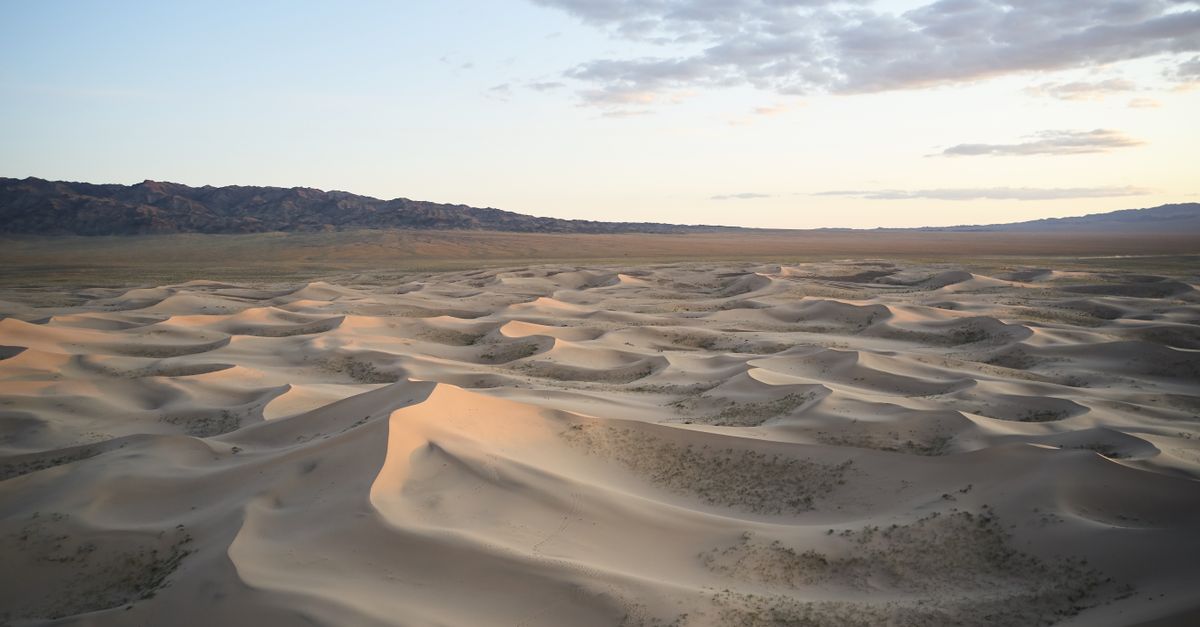
On the 4x4 ride to the camp, the landscape shifts from dry steppe to low dunes and bare rock mountain ranges on the horizon, the first visual sense of the Gobi's scale: over 1.3 million km² between Mongolia and China, one of the largest deserts in the world.
Day 6: Gobi, the Valley of the Eagles
Yolyn Am: the Valley of the Eagles

Yolyn Am, the Valley of the Eagles, is a canyon inside Gobi Gurvansaikhan National Park cutting through the Zuun Saikhan mountains. The walk starts at the parking lot next to a small natural history museum and runs about 3 km along a stream, between increasingly narrow rock walls. Bearded vultures and argali, the world's largest wild sheep species, are commonly spotted.
Yolyn Am ice gorge

In the gorge's deepest, shadiest stretches, a layer of perennial ice covers the valley floor until midsummer, even with the surrounding desert topping 30°C during the day. Horse-drawn carts cover the final stretch for those who'd rather not walk.
Day 7: Gobi, the Flaming Cliffs and the Khongoryn Els dunes
Bayanzag Flaming Cliffs

About 3 hours by road from Yolyn Am, the Bayanzag Flaming Cliffs became famous in 1923, when American paleontologist Roy Chapman Andrews's expedition found the first fossilized dinosaur eggs ever identified by science there. The red sandstone formations are most intense at dusk, when the low light lights up the rock's orange tone.
Khongoryn Els Dunes

After another 3 to 4 hours on the road, the Khongoryn Els Dunes (also called "Duut Mankhan", singing dunes) stretch for over 100 km, with ridges reaching 300 meters in height. It's the most photographed stop in the Gobi, and the ger camp sits right at the foot of the dunes.
Day 8: Last dunes and back to Ulaanbaatar
Bactrian camels

At sunrise, before the heat of the day, nomadic families living around the dunes offer short Bactrian camel rides, the two-humped species native to Central Asia. It's also the best light for photographing the dunes, with long shadows bringing out the curves of the sand.
Dalanzadgad-Ulaanbaatar flight

Back in Dalanzadgad (about 3.5 hours by road), the return flight lands at Chinggis Khaan International Airport, opened in 2021, 52 km from downtown Ulaanbaatar. For those with an international connection only the next day, it's worth saving the last afternoon for the State Department Store, already visited on Day 1, or simply resting before the longer flight back to Brazil.
Do you need a visa to travel to Mongolia?
No. Brazilians can enter Mongolia visa-free for tourism for up to 30 days, under a temporary exemption covering 34 countries, confirmed through December 2026 and possibly extended to 2028. Staying longer than 30 days (up to 90 total) requires registering with Mongolia's Immigration Agency within 7 days of arrival; travelers staying up to 30 days don't need that registration. It's worth checking the rule's validity shortly before buying tickets, since it's a temporary policy, not a permanent law.
What's the best time to travel to Mongolia?
June through September, Mongolia's summer: long days, mild temperatures in the capital (15-25°C) and on the steppe, and the ger camps in the Gobi and Terelj open for the season. July brings the Naadam festival (July 9-11), with horse racing, wrestling and archery, but also peak prices and fully booked flights and hotels; book months ahead if traveling in that window. Mongolian winter (November to March) drops to -30°C in Ulaanbaatar and shuts down nearly all tourism infrastructure outside the capital.
How to get to Mongolia and get around the Gobi Desert
There are no direct flights from Brazil. The usual connections run through Istanbul (Turkish Airlines), Seoul (Korean Air or MIAT Mongolian Airlines) or Beijing (Air China or MIAT), with the final leg landing at Chinggis Khaan International Airport (UBN), 52 km from Ulaanbaatar. Inside the country, public transport barely exists outside the capital: the standard way to travel is a hired 4x4 with a driver-guide, practically mandatory to reach rural areas and the desert. For the Gobi specifically, the domestic Ulaanbaatar-Dalanzadgad flight (about 1 hour, on Hunnu Air or AeroMongolia) replaces the 10-12 hour overland trip, and moving between the desert's own stops (Yolyn Am, Bayanzag, Khongoryn Els) is always done in that same 4x4.
Where to eat in Ulaanbaatar: local dishes and the best restaurants
Mongolian cuisine is built on meat (lamb, goat, horse) and dairy, a direct reflection of nomadic life: almost no vegetables or spices.

Buuz are thin-skinned steamed dumplings filled with minced lamb or beef, onion and a bit of fat, the most common dish on any Mongolian table, especially for Lunar New Year (Tsagaan Sar). Khuushuur is the fried, half-moon-shaped version, sold at street stalls and the signature snack of the Naadam festival in July.

Khaan Buuz, a 24-hour Mongolian fast-food chain, has a green-fronted branch right across from the State Department Store and serves buuz and khuushuur for under US$ 2 a plate, no reservation needed.

Airag is fermented mare's milk, mildly alcoholic and tangy, a ceremonial drink offered to visitors at nomadic camps in summer; a single sip is politely enough if the taste isn't for you. Avoid ordering airag at Ulaanbaatar's tourist restaurants outside summer: the real thing only exists where mares are being milked, out in the countryside.

Trivia: during Naadam in July, khuushuur consumption is so high that the number of fried dumplings sold around the central stadium is even used as an informal gauge of the festival's crowd size.
Is 8 days enough to see Mongolia?
For Ulaanbaatar, Terelj and the three main stops in Gobi Gurvansaikhan (Yolyn Am, Bayanzag and Khongoryn Els), yes, as long as the leg between the capital and the desert is flown rather than driven. With more time, stretch it to 10 or 12 days and add Hustai National Park (Przewalski's wild horses) or head west to the lakes and Altai mountains, both outside the scope of this itinerary. With only a week, cut a day from Ulaanbaatar (merging Days 2 and 3) rather than shortening the Gobi, which is the real reason to come this far.
Estimated budget per person
Prices checked on 16 September 2026. Check current prices at Chinggis Khaan National Museum, official ticket · Stone Horse Mongolia, Gobi Desert package.
Frequently asked questions
Do Brazilians need a visa for Mongolia?+
No. Brazilian citizens can enter visa-free for up to 30 days under a temporary rule valid through December 2026, which may be extended to 2028. Staying longer than 30 days requires registering with Mongolia’s Immigration Agency within 7 days of arrival.
Is the domestic flight to the Gobi Desert worth it?+
Yes. The overland route between Ulaanbaatar and Gobi Gurvansaikhan takes 10 to 12 hours, mostly on unpaved roads, against roughly 1 hour by air to Dalanzadgad, flown by Hunnu Air and AeroMongolia.
How much does an 8-day trip to Mongolia cost?+
Counting the international flight, the domestic flight, ger camps in the desert, a hotel in Ulaanbaatar and food, the total runs US$ 2,900-4,300 per person.
Is it safe to travel around Mongolia alone?+
Ulaanbaatar is calm by regional standards, but driving yourself outside the capital isn’t recommended: Gobi roads have no signage, and a local driver-guide is practically mandatory to reach the dunes and valleys.
Ready to go?
Save this itinerary to your Galmund and take the schedule, map and budget with you. Edit, share and track it all on the globe.
Save this itinerary to my GalmundBeen there already?
Pin this trip on your globe and keep your photos where they were taken.
Pin it on my globe