Tokyo · Hakone · Kyoto · Nara · Osaka · 15 min read
Japan 8 Day Itinerary: Tokyo, Hakone, Kyoto, Nara and Osaka
8 days · 5 cities
Duration
8 days
Estimated budget
US$ 1,000 to US$ 1,600 plus flights, 8 days
Best time to go
October to November and late March
Visa
Visa free up to 90 days for many passports
This 8 day Japan itinerary crosses the country by train in one direction, arriving in Tokyo and flying home from Osaka, with a ryokan night in Hakone in between, so you never go back to a place you have already passed.
In short: three days in Tokyo, Hakone, two days in Kyoto, Nara and Osaka. Visa, timing and where to eat are in the practical sections.
Day 1: arrival in Tokyo and Shinjuku from above and within
Tokyo Metropolitan Government Building: the free 45th floor lookout

Free, 1 hour, open until 10pm. It is the right first plan after check-in: it is in Shinjuku, needs no booking and gives you a sense of Tokyo’s scale before you start walking it.
The 1991 building is by the architect Kenzo Tange, and the two 45th floor observatories are 202 metres up. On a clear day, especially in winter and late afternoon, Mount Fuji appears on the western horizon. After 7:30pm the facade becomes the screen for a projection mapping show.
Omoide Yokocho: a yakitori dinner in the postwar alley

Dinner for 2,000 to 4,000 yen, 90 minutes, 900 metres from the lookout on the other side of the Shinjuku station tracks.
The alley began as a black market after the Second World War and today is dozens of counters with five or six seats each, where chicken skewers, yakitori, go straight from the charcoal to your plate. Many charge a table fee, the otoshi, which comes with a small appetiser: it is normal, not a scam.
Day 2: old Tokyo, from Asakusa to Yanaka
Senso-ji: Tokyo’s oldest temple before the crowds

Free, 90 minutes. The temple grounds open early, and arriving at 7am is the difference between seeing Senso-ji and seeing the backs of other tourists.
Founded in the 7th century, it is Tokyo’s oldest temple. The Kaminarimon, the Thunder Gate, with its 700 kilo red paper lantern, opens onto Nakamise, the street of little shops leading to the main hall. At the foot of the temple, people waft smoke from the incense burner over their bodies for good health.
Yanaka Ginza: the old Tokyo that survived the war

Free, 1 hour, 20 minutes by train from Asakusa, getting off at Nippori station. It is a mid morning snack on foot.
Yanaka was one of the few Tokyo districts to escape the 1945 bombings and the great fire after the 1923 earthquake, which is why it still has wooden houses, small temples and narrow lanes. Yanaka Ginza, a 170 metre shopping street, sells beef croquettes, sweets and crafts. Street cats have become the neighbourhood’s symbol.
Nezu Shrine: the torii tunnel without the queue

Free, 45 minutes, 900 metres downhill on foot from Yanaka Ginza. In April and May the shrine’s azalea hillside blooms all at once.
The main hall, from 1706, is one of the oldest in Tokyo, lacquered in orange and gold. Beside it a row of red torii climbs the slope like a miniature of Fushimi Inari, which you will see in Kyoto: the same photo, without fighting for space.
Day 3: Meiji Jingu, Harajuku and Shibuya
Meiji Jingu: the forest in the middle of Tokyo

Free, 90 minutes, opens at sunrise. Enter through the Harajuku gate and follow the gravel avenue for 10 minutes to the shrine.
Opened in 1920 in honour of the emperor who modernised Japan, the shrine stands in a 70 hectare forest planted by hand with trees donated from all over the country. Early in the morning, with luck, you will see a Shinto wedding crossing the courtyard, the bride in white under a red parasol.
Shibuya Crossing: crossing with 3,000 other people

Free, 20 minutes, 2 kilometres from Meiji Jingu, walking down Omotesando avenue or Takeshita Street in Harajuku.
At every green light, traffic stops in all four directions and up to 3,000 people cross at once, diagonally too. Cross it properly once and then watch from above, from a café window at the station or, late in the afternoon, from the Shibuya Sky observation deck. Beside the station exit stands the statue of Hachiko the dog.
Shibuya Sky: sunset on the rooftop 229 metres up

2,700 to 3,400 yen online depending on the slot, 90 minutes. Book the sunset slot weeks ahead: it is the first to sell out. The entrance is in the building attached to Shibuya station.
The rooftop is open air at the top of the tower, with only a glass edge, and from there you see the crossing far below, Tokyo Tower, the Skytree and, on a clear day, Mount Fuji. Bags and loose phones go in lockers before you go up, because of the wind.
Day 4: Hakone, the volcanic valley and a night in a ryokan
Owakudani: Hakone’s sulphur valley and black eggs

An hour and a half here. From Shinjuku it is about 90 minutes by train to Hakone-Yumoto; from there the Hakone Freepass covers the mountain railway, cable car, ropeway and lake boat, in the order of this day.
The ropeway passes over the still active valley, with sulphur vents and a smell of eggs that arrives before the view. At the top, kuro-tamago, eggs boiled in the hot spring water, turn black; tradition says each one adds seven years to your life. On a clear day Mount Fuji appears behind the slopes.
Hakone Shrine: the torii standing in Lake Ashi

Free, 1 hour. From the ropeway, the pirate ship crosses Lake Ashi in 40 minutes to Moto-Hakone, and the shrine is a 10 minute walk from the pier.
The red Peace Torii stands in the water at the lake’s edge, and the queue to take the photo beneath it can exceed half an hour at weekends. Climb the stone steps between the cedars to the shrine, founded in the 8th century. At night the rule is to sleep in a ryokan with a hot spring bath, an onsen, and eat the traditional dinner served in your room.
Day 5: bullet train to Kyoto, Kiyomizu-dera and Gion
Kiyomizu-dera: the wooden terrace above Kyoto

500 yen, 90 minutes, open until 6pm. From Odawara the bullet train takes about 2 hours to Kyoto; drop your bag at the hotel and head up to the temple mid afternoon.
Founded in 778, the temple is famous for its wooden stage jutting 13 metres above the hillside, held up by 139 pillars fitted together without a single nail. Below, the Otowa spring splits into three spouts, each promising something different: long life, success in study or in love. Drink from only one.
Sannenzaka: the stone slope of Higashiyama

Free, 30 minutes, walking down from Kiyomizu-dera toward Gion. It is the route, not a detour.
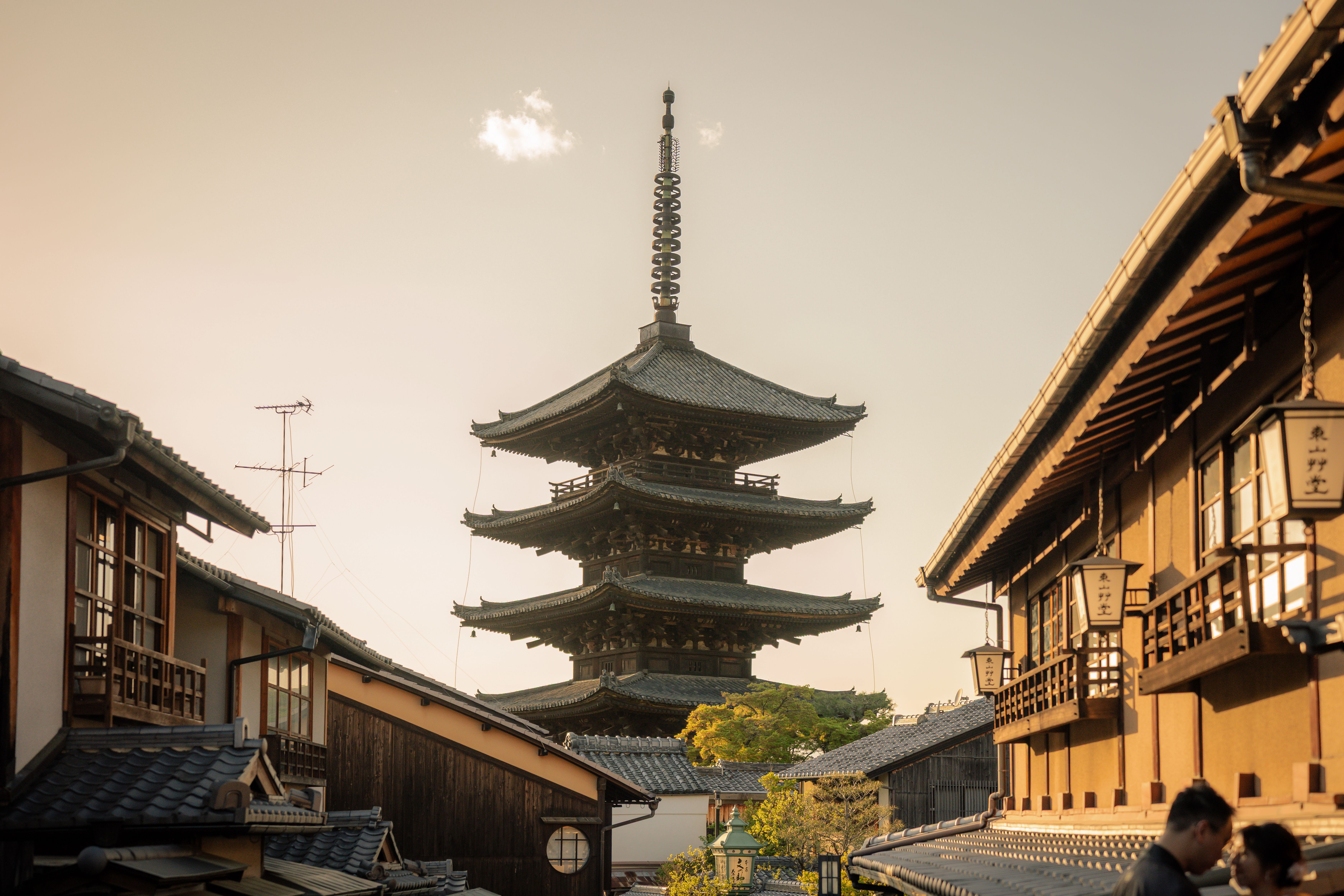
The slope and neighbouring Ninenzaka keep 19th and 20th century wooden houses turned into pottery, tea and sweet shops. Tradition says anyone who trips on Sannenzaka will have three years of bad luck, which is why the shops sell lucky gourds. Look back halfway down: that is where you see the Yasaka Pagoda above the rooftops.
Hanamikoji: Gion at dusk

Free, 1 hour, 800 metres from Sannenzaka. Come at dusk, when the lanterns light up and the maiko, apprentice geisha, head out to their evening engagements.
The teahouses of Hanamikoji are the same ones from the Edo period. Since 2024 the private side alleys have been closed to tourists, with fines, because of harassment of the maiko: stay on the main street, do not block the way and never photograph anyone up close without permission.
Day 6: Fushimi Inari at dawn and Nijo Castle
Fushimi Inari: the thousand torii at dawn

Free and open 24 hours, two and a half hours. Arrive at 6:30am: by 9am the first stretch of torii turns into a queue, and that is what leaves so many people disappointed.
There are thousands of orange gates donated by companies and families, the donor’s name painted in black, forming tunnels up Mount Inari. The secret is not to stop at the first stretch: from the Yotsutsuji junction, halfway up, the crowds thin out and there is a viewpoint over Kyoto. You can reach the summit and return in 2 to 3 hours.
Nijo Castle: the shogun’s palace and the singing floor

1,300 yen plus Ninomaru Palace; 2 hours; opens at 8:45am. From Fushimi Inari it is 25 minutes by train and subway. It is one of Kyoto’s most underrated sights, and far calmer than Kinkaku-ji.
Built in 1603 for the first Tokugawa shogun, it is where samurai rule ended in 1867, when power was returned to the emperor. Inside Ninomaru Palace the corridors have nightingale floors: the boards squeak like birdsong with every step, an alarm against intruders.
Day 7: Nara’s Great Buddha and the night in Osaka
Todai-ji: Nara’s Great Buddha and the deer

800 yen, 90 minutes. From Kyoto it is 45 minutes by train to Nara; leave your bag in the station lockers, because in the afternoon you continue to Osaka.
The Daibutsuden houses the Great Buddha, a 15 metre bronze statue cast in the 8th century, and even rebuilt smaller in 1709 it remains among the largest wooden buildings in the world. On the way, Nara Park has more than a thousand free roaming deer, considered messengers of the gods: they bow to ask for the crackers sold there, and nip anyone slow to hand them over.
Dotonbori: eating on your feet under Osaka’s neon

Free, 2 hours including dinner. From Nara it is 40 minutes by train to Namba, and Dotonbori is a 5 minute walk.
Osaka’s motto is kuidaore, eat until you drop, and Dotonbori is where it applies: stalls of takoyaki, octopus balls, and okonomiyaki restaurants, the cabbage pancake cooked on the griddle in front of you. The must have photo is from the Ebisubashi bridge, with the Glico running man sign, lit since 1935.
Day 8: Osaka Castle and home
Osaka Castle: the white and gold tower above the walls

1,200 yen for the keep, 90 minutes, opens at 9am. It is 20 minutes by subway from Namba, and the surrounding park is free.
The original castle was built in 1583 by Toyotomi Hideyoshi, the man who unified Japan, and destroyed in the war that handed power to the Tokugawa. The current keep dates from 1931, in concrete, with a museum inside; what is original and impressive are the stone walls, with blocks of more than 100 tonnes fitted without mortar.
Kuromon Market: the last lunch before the airport

Free to enter, 1 hour, 600 metres from Namba, where the train to Kansai airport leaves.
The 580 metre market has more than 150 stalls. Like Nishiki in Kyoto, it has become touristy and pricier than usual, so compare prices before ordering the sea urchin or grilled scallop. It works as a last lunch for convenience: you eat and board the airport train without a detour.
Do you need a visa for Japan?
Citizens of the United States, the United Kingdom, the European Union, Canada, Australia, Brazil and many other countries enter Japan visa free for up to 90 days of tourism. Brazil and Japan extended their exemption in July 2026 until 29 September 2029, on the condition of a chip enabled passport.
Japan plans a JESTA electronic authorisation for visa exempt visitors in the coming years; check before you travel. Since July 2026 the departure tax has risen from 1,000 to 3,000 yen per person. It is built into your ticket, but it explains part of the rise in fares.
What is the best time to visit Japan?
October and November, in autumn, and from mid March to early April, during the cherry blossom. Both are the most beautiful and the busiest times: book hotels months ahead, especially in Kyoto.
Summer, July to August, is hot and humid, over 30 degrees. June is the rainy season. Winter, December to February, is cold but dry and clear, with the best days for seeing Mount Fuji and fewer people at the temples. Avoid Golden Week, late April to early May, when the whole country travels at once.
How to get to Japan and get around by train
Tokyo has direct flights from North America, Europe, Australia and across Asia. Book an open jaw ticket, into Tokyo and out of Osaka via Kansai airport: that is what lets the itinerary run in one direction.
The 7 day JR Pass costs 50,000 yen since the 2023 price rise, and it does not pay for itself here: the single bullet train legs from Hakone to Kyoto and the trains to Nara and Osaka add up to much less. Buy tickets at stations or on the rail companies’ apps. In the cities, load a Suica or Pasmo card on your phone and use the subway and trains for everything.
Where to eat in Japan: local dishes and what to avoid
You eat well at every price, and the best value is at specialist counters that have made one dish all their lives, and at convenience stores, where the onigiri and egg sandwich are genuinely good.
In Tokyo, order ramen, noodles in broth: tonkotsu, made from pork bones, is creamy and comes with a marinated egg and slices of chashu. Many shops work with a ticket machine at the door: you choose, pay and hand the ticket over at the counter.

In Osaka, the city of kuidaore, eat until you drop, the dishes are takoyaki, batter balls with a piece of octopus, topped with sauce and dried fish flakes that move in the heat, and okonomiyaki, the cabbage pancake cooked on the griddle in front of you.


What to avoid: tipping, which is considered odd in Japan, and eating while walking outside stall areas, which is seen as rude. In Kyoto, kaiseki menus in Gion are expensive; go for lunch, which costs a fraction of dinner.
How much does an 8 day trip to Japan cost?
Excluding the international flight, which depends on where you fly from, between 1,000 and 1,600 dollars per person travelling as a couple, with prices checked in September 2026. The weak yen of recent years has made Japan cheaper than many people expect.
The breakdown: hotels cost 100 to 170 dollars a night per room, and the Hakone ryokan night 250 to 400 dollars with dinner and breakfast; food 35 to 60 dollars a day; and trains 180 to 260 dollars per person. From Brazil, the flight with one connection adds 1,400 to 2,200 dollars, bringing the total to 2,400 to 3,800.
Tickets add up to 60 to 100 dollars: Shibuya Sky 2,700 to 3,400 yen, Nijo Castle 1,300, Osaka Castle 1,200, Todai-ji 800 and Kiyomizu-dera 500. The Meiji, Nezu and Fushimi Inari shrines and the government building lookout are free.
The table above links to the official sites so you can check current prices before you travel.
Is 8 days enough to see Japan?
For the classic first trip route, yes. Eight days give you three days in Tokyo, a night in Hakone, two days in Kyoto, and Nara and Osaka, in one direction and without a single day lost doubling back.
For the country, no. Hiroshima and Miyajima, an hour and a half by bullet train from Osaka, need two more days, and Hokkaido in the north and Okinawa in the south are separate trips. With 10 days, add Hiroshima at the end before flying out of Osaka; with 12, give Kyoto an extra full day, since it has temples for a week.
What is not worth cutting is the night in Hakone. A ryokan with an onsen and dinner served in your room is the experience most people remember most from Japan.
Estimated budget per person
Prices checked on 18 September 2026. Check current prices at Embassy of Japan in Brazil, visa exemption · Japan departure tax, Japan Tourism Agency · Shibuya Sky, official site · Nijo Castle, official fees · Todai-ji, official hours and fees · Kiyomizu-dera, official site · Osaka Castle, official site.
Frequently asked questions
Do I need a visa to travel to Japan?+
Not for tourism of up to 90 days if you hold a passport from the United States, the UK, the EU, Canada, Australia, Brazil or dozens of other visa exempt countries. Brazil’s exemption was extended in July 2026 until 29 September 2029, for chip enabled passports.
How much does an 8 day trip to Japan cost?+
Between 1,000 and 1,600 dollars per person travelling as a couple, excluding the international flight, covering hotels, a ryokan night, food, trains and tickets, with prices checked in September 2026. The weak yen has made the country cheaper than it seems.
Is the JR Pass worth it for 8 days in Japan?+
Not on this itinerary. The 7 day JR Pass costs 50,000 yen, and the bullet train and train legs of a route arriving in Tokyo and leaving from Osaka add up to much less bought individually. It only pays off with several long bullet train legs, such as a Hiroshima day trip.
What is the best time to visit Japan?+
October and November, in autumn, and late March to early April, for the cherry blossom. They are the most beautiful and busiest times. Winter is cold but dry, with the clearest skies for seeing Mount Fuji.
Can you see Mount Fuji on this itinerary?+
Yes, if the sky cooperates: from the free Tokyo government building lookout, from Shibuya Sky and from Hakone. The mountain is often hidden by cloud in summer; from November to February the chances are much better, especially in the morning.
Ready to go?
Save this itinerary to your Galmund and take the schedule, map and budget with you. Edit, share and track it all on the globe.
Save this itinerary to my GalmundBeen there already?
Pin this trip on your globe and keep your photos where they were taken.
Pin it on my globe