Pula · Rovinj · Poreč · Motovun · Grožnjan · Brijuni · Lim Fjord · Cape Kamenjak · 11 min read
Istria 6 Day Itinerary: Pula, Rovinj and Croatia's Truffle Country
6 days · 2 cities
Duration
6 days
Estimated budget
US$ 750 to US$ 1,300 plus flights, 6 days
Best time to go
May to June and September to October
Visa
Schengen rules; ETIAS planned from late 2026
This 6 day Istria itinerary, in Croatia, is done by car with two bases: one night in Pula and four in Rovinj, from where the coast and the inland hill towns are all under an hour away.
In short: the Pula Arena and Cape Kamenjak, Rovinj, the Lim Fjord and Poreč, Motovun and the truffles, Brijuni and a last walk in Rovinj. Visa, timing and where to eat are at the end.
Day 1: arrival in Pula, the Arena and the Roman Forum
Pula Arena: the most complete Roman amphitheatre outside Italy

10 euros, 90 minutes, open into the evening from April to September. It is the first stop after check in, ten minutes on foot from the centre.
Built in the 1st century for about 20,000 spectators, it is one of the six largest surviving Roman amphitheatres and the only one with all four side towers intact. Go down to the underground galleries, where there is an exhibition on the olive oil and wine of ancient Istria. In summer the Arena hosts concerts and the Pula Film Festival; on those days it closes earlier.
Arch of the Sergii: the gate to the old town

Free, 15 minutes, 600 metres from the Arena. The 1st century BC arch marked the old city gate, and from it runs Sergijevaca, the pedestrian street through the old town to the Forum. James Joyce lived nearby in 1904; there is a statue of him at a café on the square.
Temple of Augustus and the Forum: late afternoon on the square

Free square and a small museum in the temple with a cheap ticket, 45 minutes, at the end of Sergijevaca. The Roman temple has stood since the 1st century beside the medieval town hall, and the Forum is still Pula's main square.
Have dinner around here: options are in the where to eat section. At night, from the waterfront, watch the Uljanik shipyard cranes lit up in colour.
Day 2: Cape Kamenjak, Vodnjan, Bale and arrival in Rovinj
Cape Kamenjak: the clearest water in southern Istria

Car entry of 10 euros outside high summer and 20 euros from mid June to mid September; free on foot or by bike. Allow 2h30, 25 minutes from Pula.
The protected cape has 30 kilometres of undeveloped coast, with smooth rock coves and clear water for swimming and snorkelling. Go early: the dirt roads fill up after 11am in summer. Bring water shoes, as there are no sandy beaches.
Vodnjan: the tallest bell tower in Istria

Free, 30 minutes, on the way to Rovinj, 15 minutes from Pula. St Blaise's Church has the tallest bell tower in Istria, and the sacristy holds the mummified bodies of saints, visited with a separate ticket.
Bale: the stone village before Rovinj

Free, 30 minutes, 15 minutes from Rovinj. The stone lanes run in rings around the Soardo-Bembo castle, and it sees far fewer visitors than Motovun. From here, head to the 2pm check in in Rovinj.
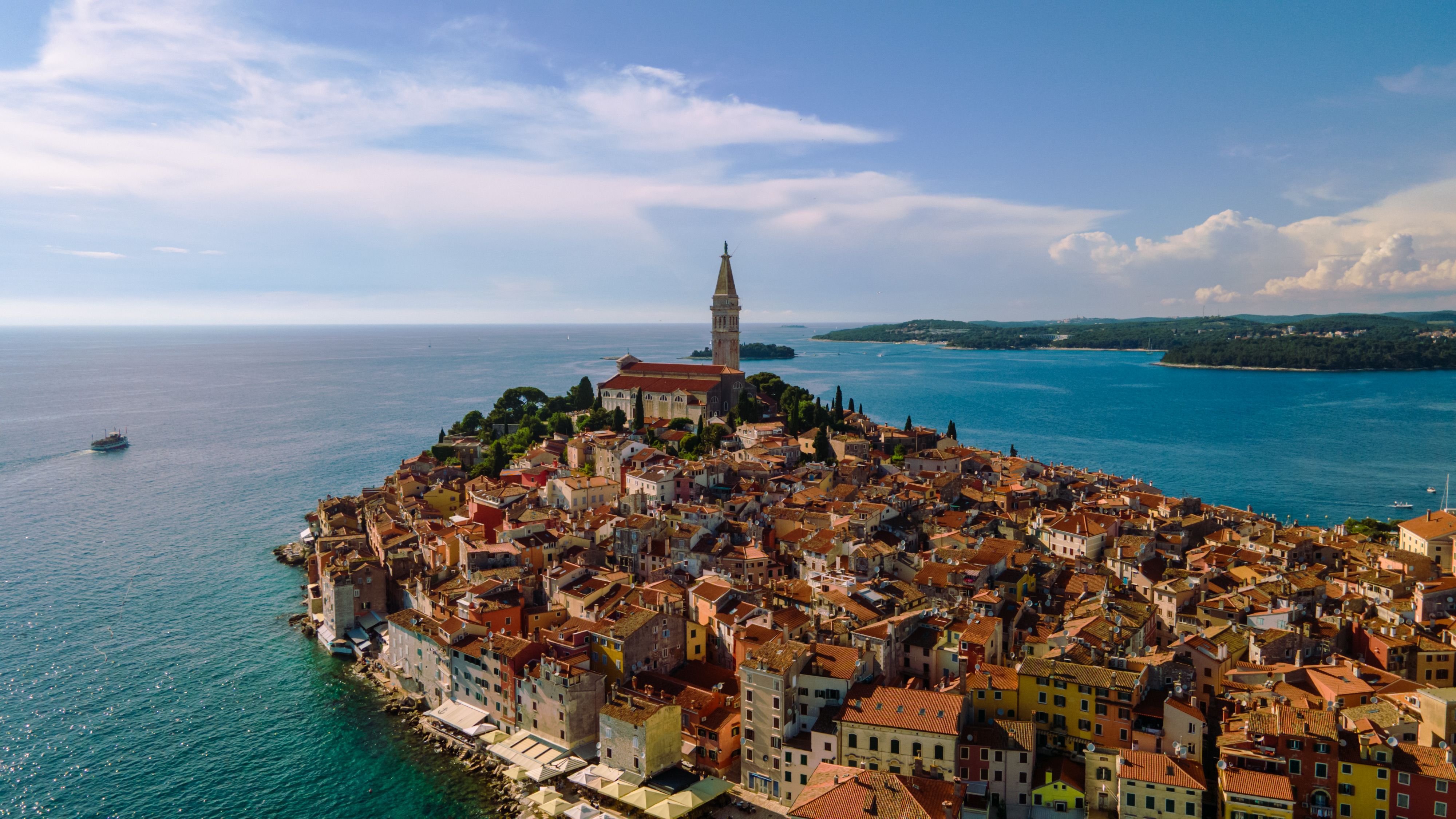
St Euphemia: the top of Rovinj's old town at sunset

The church is free and the bell tower climb has a cheap ticket, 90 minutes with the walk. Climb through the old town in the late afternoon and stay for sunset, which in Rovinj falls over the sea.
The baroque church holds the sarcophagus of St Euphemia, which according to tradition floated into town in the year 800. From the 60 metre bell tower, up a narrow wooden staircase, you see the whole town and the islands. Rovinj is your base for the next four days.
Day 3: the Lim Fjord, Baredine Cave and Poreč
Lim Fjord: the oyster inlet

Free at the viewpoint, 90 minutes with lunch, 15 minutes from Rovinj. The 10 kilometre inlet cuts inland between wooded slopes, and at its head there are oyster and mussel farms.
Stop at the roadside viewpoint, then drive down to the head of the fjord, where restaurants serve oysters opened to order. In summer, boats leave Rovinj harbour for trips along the fjord.
Baredine Cave: 60 metres beneath Istria

14 euros, 45 minutes with a guide, open only from April to October. It is 25 minutes from the Lim Fjord, on the way to Poreč.
The tour descends 60 metres through five chambers of stalactites and stalagmites, at 14 degrees all year. Bring a light jacket. Next door there is an exhibition of old Istrian tractors.
Euphrasian Basilica: the golden mosaics of Poreč

10 euros, plus about 4 euros for the bell tower, 90 minutes with the old town. It is 15 minutes from Baredine and it is Istria's only World Heritage Site.
The 6th century complex keeps gold ground Byzantine mosaics in the apse from the same era as those in Ravenna. Afterwards, walk down the Decumanus, Poreč's main Roman street, to the sea. Head back to Rovinj for dinner.
Day 4: Motovun, the Livade truffles and Grožnjan
Motovun: the walk on the walls above the valley

Free, 90 minutes, about 45 minutes from Rovinj. Leave the car at the paid car park at the foot of the hill and walk up, about 15 minutes.
The walk on the walls goes all the way round the village and looks over the Mirna valley, home to the Motovun forest, Istria's main white truffle area. It is the best known inland village and the busiest; arrive before 10am.
Zigante in Livade: the truffle lunch

The most expensive meal of the trip, 90 minutes, 5 kilometres from Motovun, down in the valley. Book ahead in white truffle season, September to December.
The Zigante family entered the record books in 1999 with a 1.31 kilo white truffle found nearby. If you do not want the full menu, just visit the shop next door, with fresh truffles, olive oils and spreads. In autumn, Livade holds the white truffle fair at weekends.
Grožnjan: the artists' village in the late afternoon

Free, 90 minutes, 20 minutes from Livade. It is the inland village most people love: smaller, quieter and full of studios and galleries run by artists in the stone houses.
In summer there are concerts by the international music school. From the viewpoint behind the church the view reaches the sea. Drive back to Rovinj along the valley road, about 50 minutes.
Day 5: Fažana and Brijuni National Park
Fažana: the harbour for the Brijuni boats

Free, 30 minutes, 35 minutes from Rovinj. The national park boat leaves from here, and the fishing village has the nicest waterfront for a coffee before boarding.
Brijuni: Tito's island, the safari park and Roman ruins

Guided excursion of 50 euros from June to September and 35 euros the rest of the year, with boat, tourist train and guide, about 4 hours. Buy in advance from the park's online shop to secure a slot with an English speaking guide.
Veliki Brijun was the summer residence of Tito, Yugoslavia's president, who hosted heads of state and was given animals as gifts; some of their descendants still live in the island's safari park. The tour passes the ruins of a Roman villa, a Byzantine church and the exhibition of photos of Tito with famous guests. Head back to Rovinj in the late afternoon.
Day 6: Grisia Street and the Golden Cape before leaving
Grisia Street: the old town galleries in the morning

Free, 30 minutes. Early in the morning, before the shops open and the groups arrive, the lane up to the church is empty and the polished stones shine. Galleries and studios fill the doorways on both sides.
Golden Cape: a last swim in the pine forest park

Free, 90 minutes, a 20 minute walk from the old town along the shore. The forest park of pines and cypresses, planted in the 19th century, has flat trails and smooth rocks for swimming.
It is the calmest way to end the trip before the drive to the airport: Pula is 40 minutes away, Trieste 1h30 and Venice about 3 hours.
Do I need a visa to travel to Croatia?
Croatia has been part of the Schengen Area since 2023. Citizens of the EU, the UK, the United States, Canada, Australia and most of Latin America enter visa free for up to 90 days in any 180. The EU plans to start requiring ETIAS, a 20 euro online travel authorisation, for visa exempt visitors from late 2026, with a transition period: check the official EU website before travelling. The currency is the euro.
When is the best time to visit Istria?
May, June, September and October: the sea is good for swimming in June and September, roads are quiet and prices lower. July and August are hot and crowded, and the Cape Kamenjak entry and the Brijuni boat cost more.
For truffles, come from September to December, in white truffle season, with the weekend fairs in Livade. From November to March many coastal hotels and restaurants close and Baredine Cave does not open.
How to get to Istria and how to get around
From April to October Pula airport has flights from many European cities. Year round, the practical gateways are Venice, Trieste and Zagreb, then a rental car: Venice to Rovinj is about 3 hours, Trieste 1h30 and Zagreb 3h15.
A car is essential for the interior: buses link the coastal towns but barely reach Motovun, Livade and Grožnjan. If you rent in Italy, tell the rental company you are driving to Croatia. Istrian roads are good, and the Istrian motorway has tolls.
Where to eat in Istria: truffles, pršut, oysters and what to avoid
Istria is the most Italian region of Croatia, and the food shows it. The dish worth the trip is the local fresh pasta, fuži or pljukanci, covered in truffle shavings: black all year, white from September to December and much pricier. Inland, the reference address is Zigante in Livade, on Day 4.

Also order pršut, wind cured ham served with sheep's cheese as a starter, and maneštra, a thick bean and corn soup, in cold weather. On the Lim Fjord, oysters go straight from the water to the plate.

To drink, Malvazija istarska, a light mineral white, and Teran, a dark, acidic red. Istrian olive oil has repeatedly been named the best growing region by the Italian Flos Olei guide; taste it in the shops of Motovun and Grožnjan before buying.

What to avoid: dishes made with "truffle oil", an artificial flavouring, priced as if they were fresh truffle. Ask whether the truffle is shaved at the table and how many grams go on the plate. On the Rovinj waterfront, places with photo menus and staff calling from the door charge more for the same grilled fish.
How much does a 6 day trip to Istria cost?
Between 750 and 1,300 US dollars per person plus international flights, sharing a double room and splitting the car between two. The budget table breaks it down.
Tickets add up to 100 to 150 dollars: the Arena, the Euphrasian Basilica, Baredine, Brijuni and car entry to Kamenjak. The big costs are accommodation in Rovinj, Istria's most expensive town, and the truffle lunch, if you have it.
Are 6 days enough for Istria?
Yes, for Istria itself: 6 days cover Pula, Rovinj, Poreč, the inland villages and Brijuni without rushing, because distances are short and the two bases split the driving in half.
Left out are Hum, the smallest town in the world according to its residents, Novigrad and Vrsar on the coast, and Opatija on the Kvarner side. With 8 days, add Hum and a beach day; with 10, continue to Ljubljana and Lake Bled in Slovenia, 2 hours away by car. Dubrovnik and Split, in the south of the country, are another trip.
Estimated budget per person
Prices checked on 19 September 2026. Check current prices at Pula Arena, visitor information · Brijuni National Park, Veliki Brijun excursion · Baredine Cave, prices · Cape Kamenjak, vehicle entry fee.
Frequently asked questions
Do I need a visa to visit Croatia?+
Croatia follows Schengen rules. Citizens of the EU, the UK, the United States, Canada, Australia and most of Latin America enter visa free for up to 90 days in 180. The EU plans to require the ETIAS online authorisation, 20 euros, from late 2026; check before you travel.
How much does a 6 day trip to Istria cost?+
Between 750 and 1,300 US dollars per person plus international flights, with a double room, a rental car split between two, food and tickets. Tickets add up to 100 to 150 dollars.
Where to stay in Istria, Pula or Rovinj?+
Rovinj for most of the trip: it sits in the middle of the west coast, under an hour from Poreč, Motovun, Grožnjan and Brijuni. Pula is worth one night for the Arena and Cape Kamenjak, at the southern tip.
When is white truffle season in Istria?+
From September to December. That is when inland restaurants serve fresh white truffle and Livade, at the foot of Motovun, holds the truffle fair at weekends. Black truffle is available all year and costs much less.
Can you visit Istria without a car?+
Only the coast. Buses link Pula, Rovinj and Poreč, but inland villages such as Motovun, Livade and Grožnjan have very few services. Without a car, book a day tour of the interior from Rovinj.
Ready to go?
Save this itinerary to your Galmund and take the schedule, map and budget with you. Edit, share and track it all on the globe.
Save this itinerary to my GalmundBeen there already?
Pin this trip on your globe and keep your photos where they were taken.
Pin it on my globe