
Dublin · Rock of Cashel · Killarney · Cliffs of Moher · Galway · Connemara · Clonmacnoise · 13 min read
Ireland 7 Day Itinerary: Dublin, Killarney and the West Coast
7 days · 4 cities
Duration
7 days
Estimated budget
800 to 1,300 euros per person, no flight
Best time to go
May to September, long daylight
Visa
No visa, up to 90 days, passport only
This 7 day itinerary for Ireland is a one way drive: Dublin, Kerry, Clare, Galway and back. The decision that organises it is renting the car only on day three, because in Dublin it is just a parking bill.
In short: two days in the capital on foot, the drive to Killarney via the Rock of Cashel, the national park, the Cliffs of Moher, Connemara and Clonmacnoise. Entry rules, season and food are at the end.
Day 1: arriving in Dublin, Trinity College and Grafton Street
Trinity College and the Book of Kells: what you actually see now

About 1h30, from 26 euros for the Book of Kells Experience, booked ahead because slots sell out. It is 40 minutes by bus from the airport, and Trinity opens the trip because it sits five minutes from most city centre hotels.
Before you pay, know what changed. The Old Library is under a conservation project and most of the 200,000 books in the Long Room have been taken off the shelves, one by one, into climate controlled storage. The room is still open and still impressive as architecture, but the shelves are empty, and they stay that way until the project ends, planned for 2030. The Book of Kells itself, the 9th century illuminated manuscript, is on display as normal.
If you only want the manuscript and the Long Room, without the digital exhibition in the Red Pavilion, there is a cheaper ticket from 19 euros. On the way out, cross Parliament Square, with the 1853 Campanile in the middle, and use the west gate to come straight out onto Grafton Street.
Grafton Street: the buskers between college and park

Quick stop, 30 minutes, free. This is the pedestrian street linking Trinity to St Stephen Green, and the walk is deliberately short: you can stroll down it hearing two or three street musicians who work the corners all day.
At number 78 is Bewley, a 1927 cafe with Harry Clarke stained glass upstairs, a good spot for the first tea of the trip while the jet lag is still heavy.
St Stephen Green: the park at the end of Grafton Street

About 45 minutes, free entry, gates close at dusk. Nine hectares of lake, bridges and Victorian flower beds, open to the public since 1880 because Arthur Guinness, the grandson, paid for the works and handed the park to the city.
Look for the bullet marks on the arch at the northwest corner. They date from 1916, when rebels dug trenches in the lawn and agreed a ceasefire twice a day so the groundsman could feed the ducks. It is the best place to end the arrival day before dinner.
Day 2: Dublin on foot, from the docks to Kilmainham Gaol
EPIC: ten million departures told across twenty galleries

About 1h30, on the Liffey docks, 15 minutes on foot from Trinity. Start the day here because it is the easternmost point of the route, which from now on only moves west, never doubling back.
There are twenty interactive galleries in the vaulted cellars of the CHQ Building, an 1820 warehouse, covering the roughly 10 million people who left the island, from the Great Famine to missionaries, engineers and musicians. It is the honest counterweight to the green folklore of the souvenir shops, and it explains in an hour why there are far more people of Irish descent outside Ireland than Irish people inside it.
Temple Bar: walk through it, do not drink there

Quick stop, 30 minutes, free. From EPIC follow the Liffey quays west and come in through Merchant Arch. The cobbled lanes, the galleries and the red front of the pub that gave the area its name are worth the walk and the photo.
What is not worth it is the bill. A pint in the pubs on the central block goes well past 10 euros, close to double the normal Dublin price. Save the beer for the Victorian pubs at the end of this article. If it is a Saturday, the food market in Meeting House Square runs in the morning and is far more interesting than the bars.
St Patrick Cathedral: the largest church in Ireland

About an hour, ticket at the door or online, ten minutes uphill from Temple Bar along Patrick Street.
The church has stood since 1220, over the well where St Patrick is said to have baptised converts in the 5th century. What sets it apart from any other cathedral is the tenant: Jonathan Swift, author of Gulliver Travels, was dean here for 32 years and is buried in the nave beside Esther Johnson, under the Latin epitaph he wrote himself.
The park next door is free and sits on the ground of the old well. If money is tight, the Chester Beatty Library inside Dublin Castle, five minutes away, is free and holds one of the finest collections of eastern manuscripts in the world.
Guinness Storehouse: is the 24 euro ticket worth it?

About two hours, from 24 euros online, 25 minutes on foot from the cathedral or ten by bus. Book a dated, timed slot: it is the most visited attraction in the country and the queue at the door is real.
The building is the old fermentation house, hollowed out into a seven storey atrium shaped like a pint glass that would hold the equivalent of 14.3 million pints. The climb ends at the glass walled Gravity Bar, with a 360 degree view over Dublin and the pint that comes with the ticket. The original lease Arthur Guinness signed in 1759, for 9,000 years, sits under a glass floor panel right at the entrance.
If you want to learn to pour your own pint, the Guinness Academy costs 14 euros extra and is the add on most people say was worth it. The Stoutie, which prints your selfie on the head, costs 10 euros and gets you one photo.
Kilmainham Gaol: book it 28 days ahead

About 1h30 in total, including the one hour guided tour, which is the only way in. It is 20 minutes on foot from the Guinness, still heading west, and closes the day at the furthest point from the centre.
Booking is the problem, not the price. Tickets are released 28 days ahead at midnight Irish time and vanish within minutes. If you miss them there is one more chance: the site releases extra tickets and cancellations at 9.15am on the day itself. Buy only from the official site, because look alike pages exist and their tickets are refused at the door.
The prison ran from 1796 to 1924 and held everyone from children jailed for stealing food during the Great Famine to the leaders of the Easter Rising, executed in the Stonebreakers Yard in May 1916. The East Wing, with its cell galleries under an iron and glass roof, dates from 1864 and is where the guide usually tells the hardest part of the story.
Day 3: Dublin to Killarney via the Rock of Cashel and Cahir
Rock of Cashel: the honest swap for Blarney Castle

About 1h30, 8 euros, 1h50 from Dublin on the M7 and M8. Pick the rental car up on the morning of this day and not before: for the first two days it would only be a parking bill.
This is the detour that replaces Blarney Castle, voted by travellers the most disappointing stop in the south of Ireland, where you pay 24 euros and queue up to two hours to kiss a stone. Cashel gives you far more for a third of the price: a 12th century round tower, a roofless Gothic cathedral, a high cross and Cormac Chapel, from 1134, the only building in Ireland that still holds Romanesque frescoes.
Two warnings that change the visit. The chapel can only be seen on a guided tour, and those tickets are sold on site only and in limited numbers, so ask the times the moment you arrive. And the rock is completely exposed to the wind: it closes without notice when the weather turns, which happens often.
Cahir Castle: the cannonball still lodged in the wall

About an hour, 5 euros, 20 minutes from Cashel on the M8 and already on the road to Killarney. It is one of the most complete castles in Ireland for an unheroic reason: it was rarely destroyed, because it tended to surrender first.
It sits on a rocky island in the river Suir, with an outer wall, three courtyards, a keep and defensive passages you can walk end to end. The cannonball embedded in the inner wall is from the 1599 siege, when the Earl of Essex needed three days to take the place.
If your trip falls on the first Wednesday of the month, entry is free, as at most Office of Public Works sites. The same rule covers Ross Castle and Clonmacnoise, both later in this itinerary.
Swiss Cottage: half an hour of detour on the way

Quick stop, 5 euros, a guided tour of about 20 minutes, 2 km from the castle. You can walk there along the riverside path in half an hour, or drive it in five minutes.
It is a cottage orne from around 1810, attributed to John Nash, the architect of the Royal Pavilion in Brighton: a deliberately undulating thatched roof, a veranda of rough tree trunks and no two windows alike, all designed to look like a peasant house that happened by accident. From here it is another two hours to Killarney.
Day 4: Killarney National Park and the start of the Ring of Kerry
Ross Castle: the first stop in the park, 10 minutes from town

About an hour, 5 euros on the guided tour, 3 km from the centre of Killarney. Start here because it is the northernmost point of the day: from the moment you leave, the N71 only runs south, with no stretch repeated.
The tower house is 15th century and held out until 1652, when it became the last stronghold in Munster to fall to Cromwell forces, who dismantled a warship and hauled it overland to besiege the castle from the water. Boats to Innisfallen Island, with its ruined monastery, leave from the jetty beside it, and the jaunting cars, the horse drawn traps, wait in the car park.
Muckross House: the Victorian mansion inside the park

About two hours, 9 euros for the house alone or 18 euros on the joint ticket with the traditional farms. No booking needed, tickets are bought on arrival, and parking is free, as are the park and the gardens.
The 1843 mansion has 65 rooms and was refurbished in a hurry to host Queen Victoria in 1861, at a cost that helped ruin the family that built it. The rhododendron garden around it is what many people come for, and it costs nothing.
The traditional farms next door recreate three 1930s holdings with people working in them, and open daily in May and September and from 10am to 6pm from June to August. In April and October they open weekends only, and from November to February they close.
Torc Waterfall: five minutes from the car park

Quick stop, 30 minutes, free, 3 km south of Muckross on the N71. From the car park to the falls is five minutes on a flat, wide path.
It is about 20 metres of water dropping through moss and oak, and the volume depends on the previous day rain, which in Ireland is rarely a problem. If you want more, climb the steps behind the falls, known as Cardiac Hill, and in 15 minutes you reach a lookout over Lough Leane.
Ladies View: the lookout over the Lakes of Killarney

About 45 minutes with a stop at the cafe, free, 12 km south of Torc on the N71. The road climbs between mountains and the car park sits on the bend itself.
The name comes from 1861: Queen Victoria ladies in waiting stopped here on the way to Kenmare and said it was the best view of the whole journey. From the wall you see the three Lakes of Killarney lined up and the dark glacial valley behind them.
Six kilometres on is Moll Gap, another lookout on the same road, and that is where the full Ring of Kerry would carry on. With a spare day you can close the 179 km loop through Sneem and Waterville. This itinerary turns back to Killarney and heads north the next morning.
Day 5: Killarney to Galway via the Cliffs of Moher and the Burren
Cliffs of Moher: go before 11am or after 4pm

About two hours, a 2h45 drive from Killarney using the Killimer to Tarbert ferry, which runs hourly and cuts almost an hour off the route. Leave early, because here the arrival time changes both the price and the experience.
Entry is by timed slot booked online and costs 8 euros off peak or 12 euros between 11am and 4pm, which is exactly when the coach tours from Dublin and Galway arrive. Parking is included either way. Arrive at 10am or after 4pm and you pay less and walk the trail almost alone, and late in the day the sun hits the wall head on, because it faces west.
The cliffs run for 8 km and reach 214 metres at the highest point, with OBrien Tower from 1835, built as a viewing platform for tourists when that was still a novelty. Stay behind the wall: the edge is loose shale and it gives way without warning.
Doolin: lunch and trad music 15 minutes on

Quick stop, an hour for lunch, 8 km north of the cliffs. It is a village of colourful houses spread across three clusters, with a reputation as the capital of Irish traditional music.
Live sessions run almost every night from May to October, mainly at Gus OConnor and McGann. By day the reason to stop is the seafood soup with soda bread. Ferries to the Aran Islands leave from the pier, and they are left out of this itinerary because they need a full day.
Caherconnell Fort: a live excavation and a sheepdog demo

About 1h30, 25 minutes north of Doolin, already inside the Burren. The ticket covers the fort and the interpretive centre, and the sheepdog demonstration runs several times a day, with fixed times on the board at the entrance.
The fort is a dry stone ring 42 metres across, lived in between the 10th and 17th centuries, and excavated without hurry since 2007: it is the only ring fort in Ireland with continuous archaeological work, and almost everything in the centre came out of the ground right there. The sheepdog demonstration is not a tourist turn, it is the working routine of the farm that surrounds the site.
Poulnabrone Dolmen: 5,600 years old at the roadside

Quick stop, 20 minutes, free, 1 km north of Caherconnell on the R480, with its own car park and a boardwalk to the monument.
It is the best known portal tomb in Ireland, raised around 3600 BC on the bare limestone pavement of the Burren. The 1980s excavation found the remains of more than twenty adults and children buried there over six centuries. From here it is 1h20 to Galway on the coast road.
Day 6: Connemara, from Clifden to Killary Fjord
Sky Road: the 16 km loop that opens the day in Clifden
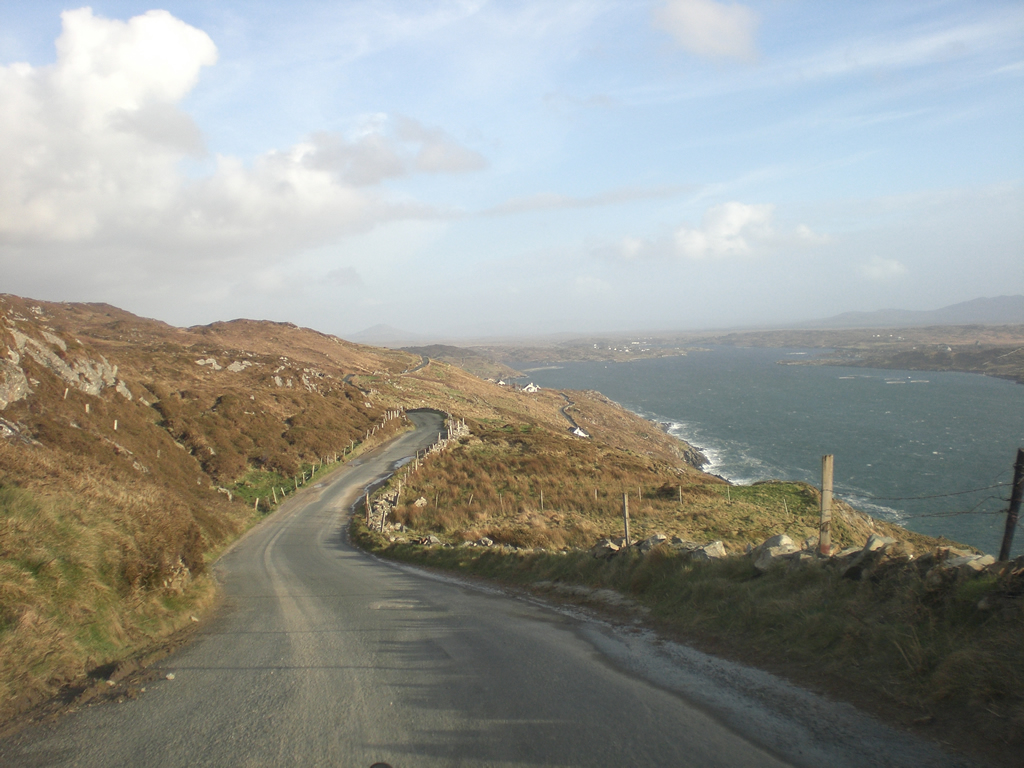
About an hour by car with stops, free, 1h20 west of Galway on the N59. Do the furthest point first, because from here the rest of the day works its way back east.
The loop leaves Clifden, the capital of Connemara, and climbs the peninsula on two parallel roads, an upper and a lower. From the high lookout you see the whole of Clifden Bay, the islands of Inishturk and Turbot and open Atlantic with nothing between you and America. The road is narrow and two way: pull into the marked passing places, never onto the road itself.
Connemara National Park: Diamond Hill in three hours

Three hours for the full loop, free entry and free parking, visitor centre at Letterfrack, 30 minutes east of Clifden.
Diamond Hill is 442 metres, and the circuit that rounds the summit is 7 km, on boardwalk and stone steps for most of the way. From the top you get the Twelve Bens, the broken coastline of Ballynakill and, on a clear day, Inishbofin island. With less time, do the lower loop only, 3 km and an hour, which already gets you out into the bog.
Bring a waterproof jacket even if it is sunny at the bottom: rain here arrives in twenty minutes and clears just as fast.
Kylemore Abbey: the castle reflected in the lake

About two hours, 18 euros, ten minutes from Letterfrack on the N59. Open daily from 10am to 6pm, last admission 5pm.
Mitchell Henry, a doctor from Manchester, built the castle in 1867 as a gift for his wife Margaret, who died of a fever in Egypt nine years later. He raised the mausoleum and the miniature neo Gothic church for her on the far side of the lake, and that church is the most beautiful part of the visit and the least photographed.
The ticket covers the ground floor of the abbey, the church, the mausoleum, the woodland trails and the Victorian walled garden, which is 1.5 km away with a free shuttle. The Benedictine nuns have been here since 1920, after fleeing Ypres in the First World War.
Killary Fjord: the only fjord in Ireland

About 1h30 with the cruise, 20 minutes east of Kylemore. Boats leave from Nancy Point, near Leenane, the sailing lasts around 90 minutes and there are several departures a day in summer: check the times before you leave Kylemore.
Killary cuts 16 km inland and separates counties Galway and Mayo, with Mweelrea, the highest mountain in Connacht, on one side. Lonely Planet picked the fjord as one of the 50 entries in Best in Travel 2027, published in September 2026, and it is the first time it has appeared on a list like that.
The rows of buoys on the water are mussel farms, and mussels are what you eat in Leenane. It is 1h20 back to Galway on the N59, through the Inagh Valley between the Twelve Bens and the Maumturks, which in late afternoon is the finest stretch of the whole drive.
Day 7: Galway, Clonmacnoise and the drive back to Dublin
Quay Street and the Latin Quarter: the morning in Galway

Quick stop, 45 minutes, free. Central Galway can be walked end to end in twenty minutes, and Quay Street is its spine: colourful pub fronts, bunting strung across the street and musicians playing from mid morning.
If there is time, look into the street market beside St Nicholas church, which runs on Saturdays and Sundays and is where Connemara producers sell cheese, oysters and bread.
Spanish Arch: what is left of the medieval wall

Quick stop, 20 minutes, free, 200 metres past the end of Quay Street. Two arches from 1584, all that survives of the wall that protected the quay where wine and salt ships from Spain unloaded.
The grass around it is the city meeting point on any sunny day. Beside it is the Galway City Museum, free to enter, and across the river Corrib you can see the Claddagh, the old fishing village that gave the ring its name.
Clonmacnoise: the right stop on the way back to Dublin

About 1h30, 8 euros, 1h20 east of Galway and another 1h20 on to Dublin airport. It is the detour that turns a dull stretch of motorway into the best stop of the day.
St Ciaran founded the monastery in 544 on a bend of the river Shannon, at the crossing of the river and the gravel road that ran across the bogs of the midlands, and it was that position that made Clonmacnoise the largest monastic city in Ireland. Two round towers, seven churches, the cathedral and hundreds of medieval grave slabs remain, scattered over the grass.
The three high crosses that appear in every old photograph of the place are now inside the visitor centre, protected from the weather, with replicas out in the field. It is worth seeing the originals up close, because the carved panels tell whole biblical scenes. Allow three hours of slack before your flight.
Do you need a visa to visit Ireland?
Most visitors from the Americas do not. Citizens of Brazil, the United States, Canada, Mexico, Argentina, Chile, Colombia and most of the European Union enter Ireland on a valid passport alone, and the length of stay is set by the immigration officer at the airport, up to 90 days.
Two mistakes are common and expensive. Ireland is not in the Schengen Area, so no European visa or authorisation applies here, and an Irish stamp does not count towards the Schengen day limit either. And Ireland does not require the UK ETA, which belongs to a different country: the ETA only matters if your route includes Northern Ireland, Belfast or the Giant Causeway.
Bring printed proof of accommodation, a return ticket and travel insurance. Irish immigration asks for them often.
When is the best time to visit Ireland?
May to September, and within that window May and September are the best months: the days are already long, everything is open and there are far fewer people than in July and August. In June the sun sets after 10pm, which in practice adds two extra hours of sightseeing a day.
Rain here is not seasonal, it is daily and brief. Expect four or five showers a day in any month and bring a hooded waterproof rather than an umbrella, because the Atlantic wind turns any umbrella inside out. Summer temperatures sit between 12 and 20 degrees Celsius and rarely go beyond that.
From November to March the days have about eight hours of light, several inland attractions close or cut their hours, and the roads of Connemara and the Ring of Kerry are almost empty, which suits anyone who does not mind the cold. St Patrick Day, on 17 March, fills Dublin and pushes every price up.
Getting to Ireland and renting a car for this route
Dublin has direct flights from most of Europe and from a record 23 US gateways in summer. From South America the shortest connections go through Lisbon, Madrid, London or Paris, with a one to two hour final hop. Watch the London connection: even without leaving the airport, changing terminals at Heathrow means passing UK immigration, and that makes the UK ETA necessary. Through Lisbon or Madrid the problem does not arise.
The car is rented on day 3, in the city or at the airport, and returned on day 7. In Dublin it would only be a parking bill, because the centre is walkable. Three things surprise first timers: you drive on the left, with the gearstick in your left hand; Irish rental desks require collision cover and rarely accept a foreign credit card policy as proof, so budget for their insurance; and the regional roads of Connemara and the Burren are a car and a half wide with stone walls on both sides, which means low speeds and constant use of the passing places.
Tolls on the M7 and M8 are cheap and paid in cash or by card at the booth. The exception is the M50 ring road in Dublin, which is barrier free and electronic: the rental company bills you later, with an admin fee on top.
Where to eat in Ireland: classic dishes and the best pubs
Irish food stopped being a joke about fifteen years ago, and the reason is the sea. The west coast this route follows has some of the best seafood in Europe at pub food prices.

Irish stew is the national dish: lamb or beef slow cooked with potato, carrot and onion. Almost every pub serves it and almost every pub gets it right, for 16 to 22 euros. Coddle, sausage and bacon simmered in stock, is the Dublin version and divides opinion even among the Irish.

On the coast, order seafood chowder: a creamy soup of salmon, smoked haddock and mussels, served with soda bread and butter. In Doolin, Clifden and Leenane it is the standard lunch and costs between 9 and 14 euros.

Galway lives on the oyster. The native season runs from September to April, which is when the city festival takes place. They are served raw with brown bread and butter, and the match with stout is taken seriously there, not just printed on a leaflet.

In Dublin the pub worth your evening is The Long Hall, on South Great Georges Street: an intact Victorian interior, worked plaster ceiling, old mirrors and a properly poured pint, ten minutes from Temple Bar and about 4 euros cheaper. What to avoid is exactly the central block of Temple Bar, where the same beer passes 10 euros.

For traditional music that is played rather than performed, Gus OConnor in Doolin is the stop this route already passes. Sessions start around 9.30pm from May to October and are played by local musicians who turn up unbilled. Get there before 8pm to get a table and eat there too.
Are 7 days enough to see Ireland?
They are enough for the half this itinerary covers, which is also the half most people come for: Dublin, the southwest of Kerry and the west coast of Clare and Connemara. Seven days with a car give you time to see those three blocks without changing hotel more than three times, and that is the honest limit of the week.
What is left out, and worth adding with more days: the Dingle Peninsula and the Slea Head Drive, a full day out of Killarney; the Aran Islands, with the fort of Dun Aonghasa on the cliff edge, which need a ferry from Doolin or Rossaveal and another day; the full Ring of Kerry, 179 km through Sneem and Waterville; and Glendalough and Powerscourt in the Wicklow Mountains, an hour south of Dublin.
If you want the Giant Causeway and Belfast, remember that is the United Kingdom: you need the UK ETA and at least two more days, and the trip works far better as a second visit than squeezed inside this one.
Estimated budget per person
Prices checked on 23 September 2026. Check current prices at Cliffs of Moher Experience, tarifas de entrada · Heritage Ireland, Rock of Cashel · Heritage Ireland, Cahir Castle e Clonmacnoise · Muckross House, tarifas 2026 · Kylemore Abbey, ingressos · Guinness Storehouse, ingressos · Book of Kells Experience, Trinity College Dublin.
Frequently asked questions
Do you need a visa to visit Ireland?+
Most visitors from the Americas and the European Union do not. Brazilians, Americans, Canadians, Mexicans, Argentinians, Chileans and Colombians enter on a valid passport alone and may stay up to 90 days, with the exact period set by the immigration officer at the airport. Ireland is not in the Schengen Area and does not require the UK ETA, which is a different country: the British ETA only matters if your route includes Northern Ireland. Bring printed accommodation, a return ticket and insurance.
How much does a 7 day trip to Ireland cost?+
Between 800 and 1,300 euros per person excluding the international flight, counting a mid range hotel in a double room, food, the rental car for five days with fuel and tolls, and the tickets on this route. Tickets add up to 90 to 130 euros, the most expensive being the Book of Kells from 26 euros, the Guinness Storehouse from 24 and Kylemore Abbey at 18. A return flight from South America with one connection runs 700 to 1,200 euros.
Is the Book of Kells worth it with the Long Room empty?+
It is worth it if the manuscript is what you came for, because it remains on display as normal. The Old Library is under a conservation project and most of the 200,000 books in the Long Room have been taken off the shelves until the work finishes, planned for 2030: the room is still open and still impressive as architecture, but the shelves are bare, unlike almost every photo in circulation. To spend less, buy the ticket for the Book of Kells and Old Library only, without the digital exhibition, from 19 euros.
Do you need a rental car to travel around Ireland?+
On this route you need one from day three. Dublin is walkable and well served by bus, and a car there is only a parking bill, but Cashel, Killarney, the Burren and Connemara have no rail link between them and rural buses run only a few times a day. Rent on day 3 and return on day 7. You drive on the left, and the regional roads in Connemara are narrow, with stone walls on both sides.
What is the best time of day to visit the Cliffs of Moher?+
Before 11am or after 4pm. Entry is by timed slot booked online and costs 8 euros outside that window against 12 euros between 11am and 4pm, which is exactly when the coach tours from Dublin and Galway arrive. Late in the day there is also the light, because the cliff wall faces west. Parking is included in the ticket either way.
Ready to go?
Save this itinerary to your Galmund and take the schedule, map and budget with you. Edit, share and track it all on the globe.
Save this itinerary to my GalmundBeen there already?
Pin this trip on your globe and keep your photos where they were taken.
Pin it on my globe