
Belgium · Brussels · Bruges · Ghent · Antwerp · 11 min read
Belgium 6-Day Itinerary: Brussels, Bruges, Ghent and Antwerp
6 days · 4 cities
Duration
6 days
Estimated budget
US$ 1,850-2,800 per person, 6 days
Best time to go
Apr-Jun or Sep (spring and autumn)
Visa
No visa needed, just a valid passport.
This 6 day Belgium itinerary covers Brussels, Bruges, Ghent and Antwerp, all less than 1h30 apart by train. No domestic flights: you switch cities after breakfast and use just three hotels.
In short: 2 nights in Brussels, 2 in Bruges, 1 in Ghent, and Antwerp on the last day on the way to the airport. Visa, flights and where to eat are at the end of the article.
Day 1: Brussels, arrival and the Grand-Place
Galeries Royales Saint-Hubert

Walking out of Gare Centrale, where the airport train drops you, the natural route to the Grand-Place runs straight through the Galeries Royales Saint-Hubert, which is why they open the trip rather than come after it. Opened in 1847, they form one of the oldest shopping arcades in Europe, 213 metres of two-storey galleries under a curved glass roof. This is where the first Neuhaus shop opened in 1857, the place the Belgian praline was invented. Twenty minutes is enough to walk through, look at the windows and buy chocolate for a far better price than at the airport. At the far end, Rue des Bouchers is lined with tourist restaurants best avoided, with one worthwhile exception covered in the eating section below.
Grand-Place

You step out of the arcade and, two blocks later, the Grand-Place opens up all at once, which is the right way to see it for the first time. It is an enclosed square, 68 by 110 metres, ringed by the houses of the old Brussels guilds, nearly all rebuilt between 1696 and 1700 after the French bombardment of 1695 destroyed the centre. The facades are covered in gold leaf, and the effect in late afternoon, with the sun striking them from the side, is why the square joined the Unesco list in 1998.
Two buildings pull the eye: the Gothic Town Hall, with its 96-metre tower topped by Saint Michael, and the Maison du Roi opposite, which never housed a king and is now the City Museum. Going inside is optional. The square itself is the point. Allow at least an hour, because it changes completely with the light and the crowd. In August of even-numbered years the Grand-Place hosts the flower carpet, with almost a million begonias covering the ground for four days.
Manneken Pis

Five minutes on foot from the Grand-Place, down Rue de l’Étuve, stands the most photographed boy in Europe. The Manneken Pis is 61 centimetres of bronze, installed in 1619, and far smaller than any photo suggests, which is part of the joke. The city keeps a wardrobe of more than a thousand costumes for him, changed on set dates, and the outfits are displayed in the GardeRobe museum on the corner. Ten to fifteen minutes, a photo, and you move on.
Day 2: Brussels, from the Atomium to the Cinquantenaire
Atomium

The Atomium is what is left of Expo 58, the world fair Brussels hosted in 1958, and it remains the strangest and most photogenic building in the city. Nine steel spheres linked by tubes, 102 metres tall, representing an iron crystal cell magnified 165 billion times. It was meant to last six months and was never torn down.
Get there by metro, line 6 to Heysel, about 25 minutes from the centre. The visit takes 90 minutes to two hours: a lift up to the top sphere, which has the best view over Brussels and the park, then escalators between the middle spheres with exhibitions about the Expo. Tickets run around 16 euros and booking online avoids the queue, which gets long on weekend mornings. Go early, right at opening, and the rest of the day still works.
Mont des Arts

Coming back from the Atomium, the metro drops you five minutes from the Mont des Arts, the landscaped ramp linking the lower town to the Place Royale and the best free viewpoint in Brussels. From the top of the steps you see the rooftops of the historic centre lined up with the Town Hall spire behind them, and to the left the carillon clock from 1965. It is a geometric garden of symmetrical beds, laid out in the 1950s.
Much of the city museum quarter sits around it: the Royal Museums of Fine Arts, holding the largest Bruegel collection in the world, and the Musée Magritte, devoted to the Belgian surrealist, stand a few steps apart on the Place Royale. Allow 90 minutes for the viewpoint and a walk, or a full afternoon if you want to go into one of the museums.
Parc du Cinquantenaire

Ten minutes by metro east of the centre, the Parc du Cinquantenaire closes the day in a half-hour stop. The park opened in 1880 for the 50th anniversary of Belgian independence, and the triple triumphal arch that became its postcard was only finished in 1905. Leaving it for late afternoon has a practical reason: the bronze quadriga on top of the arch faces the setting sun, and that is when it photographs best.
Day 3: Brussels to Bruges
The Markt and the Belfry of Bruges

The train from Brussels to Bruges takes about an hour and leaves every half hour from Gare du Midi or Gare Centrale. Departing around 8.30am gets you there with the whole morning ahead, and Bruges station is a 15-minute walk from the historic centre.
The Markt is the main square, ringed by stepped-gable houses in strong colours, and what dominates it all is the Belfry, the 83-metre tower that appears in every photo of Bruges. You can climb it, and you should: 366 steps up a spiral staircase that gets genuinely tight near the top, with landings on the way to see the mechanism of the 47-bell carillon. Tickets cost about 15 euros, entry is by timed slot and the morning slots sell out first, so book online the day before. From up there the whole city makes sense at once: the intact medieval layout, the red roofs and the canal ringing the centre.
Rozenhoedkaai
Five minutes on foot from the Markt, the Rozenhoedkaai is the quay where salt was unloaded in the Middle Ages and is now the most photographed spot in Bruges. It is the bend in the canal where the brick houses reflect in the water with the Belfry behind them. It is worth coming back in late afternoon, when the light comes in sideways and the tour boats have stopped running, leaving the water flat.
Day 4: Bruges, from the Church of Our Lady to the Minnewater
Church of Our Lady in Bruges

The Church of Our Lady in Bruges has a brick tower 115 metres tall, one of the tallest ever built in that material, and you end up using it to orient yourself across the whole city. It went up between the 13th and 15th centuries, and it is impossible not to notice how the dark brick contrasts with the stone Gothic seen elsewhere in Europe.
The real reason to go in sits in a side chapel: the Madonna of Bruges, carved in marble by Michelangelo around 1504. It is the only sculpture of his to leave Italy during his lifetime, bought by a Bruges cloth merchant and shipped north. The work was stolen twice, by the French in 1794 and by the Nazis in 1944, and recovered both times. A ticket for the museum area costs about 8 euros and the visit takes a comfortable hour.
De Halve Maan brewery

A ten-minute walk from the Church of Our Lady, and on the way to the Minnewater, De Halve Maan is the last family brewery still working inside the historic centre of Bruges. It has been with the same family since 1856, and it is where Brugse Zot, the city beer, is made.
The guided tour runs about 45 minutes, costs around 18 euros and ends with a Brugse Zot included. The route climbs to a rooftop with one of the best views over the Bruges roofline, and takes in the story the brewery most likes to tell: in 2016 it built a three-kilometre pipeline under the medieval streets to pump beer to its bottling plant outside the centre, keeping trucks out of the old town. It was crowdfunded, and backers earned beer for life. Book ahead: the English tours fill first.
Minnewater and the Begijnhof
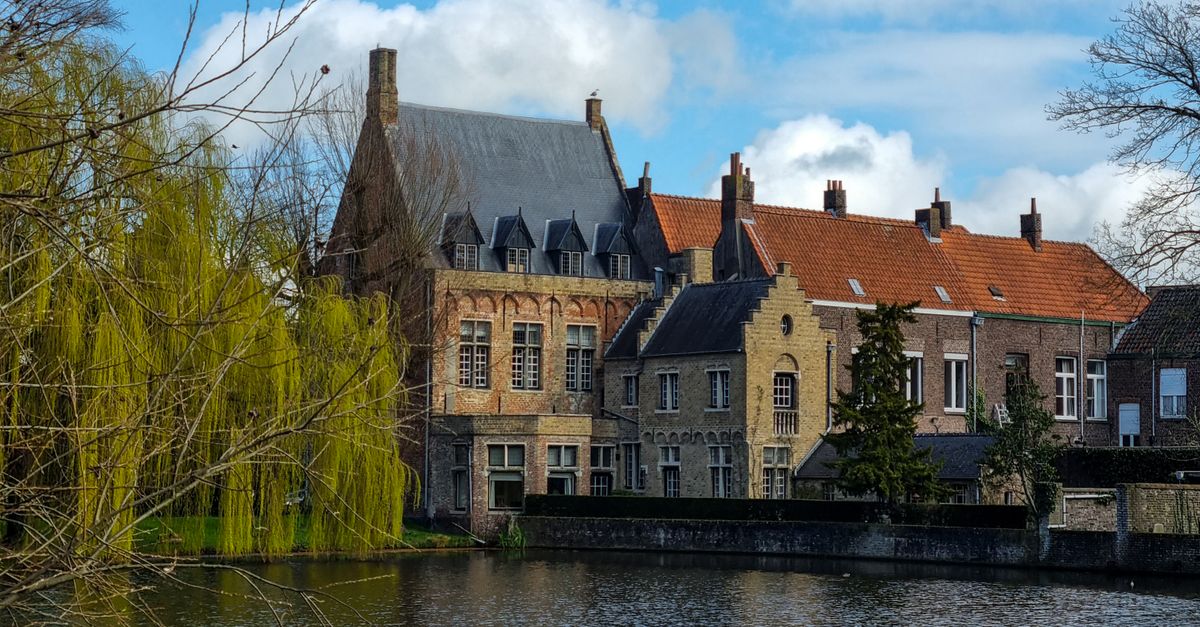
Five minutes further down from the brewery, the Begijnhof of Bruges is an enclosed courtyard of whitewashed houses around a lawn, founded in 1245 to house the beguines, women who lived in religious community without taking nuns vows. Benedictine sisters occupy it today, and the silence inside is a rule taken seriously: you enter without raising your voice. In spring the central lawn fills with daffodils, and that is the image most people carry away from Bruges.
Right next to it, the Minnewater is the lake guides call the Lake of Love, with swans that have lived there by decree since the 15th century. It is the calmest part of the historic centre, and 90 minutes between the courtyard and a loop around the lake rounds off the morning. The site joined the Unesco list in 1998, along with twelve other Flemish beguinages.
Day 5: Bruges to Ghent, the city of the Van Eycks
Saint Bavo Cathedral

Bruges and Ghent are just 25 minutes apart by train, the shortest leg of the whole itinerary. Leave after breakfast and you are there before 10am. Gent-Sint-Pieters station sits south of the centre, so the order that avoids walking in circles is to start at the cathedral, move on to the quays and finish at the castle, always heading the same way.
Saint Bavo Cathedral holds the Ghent Altarpiece, painted by the Van Eyck brothers and completed in 1432. It is one of the most important and most stolen works in art history, with thirteen recorded thefts, and one panel has been missing since 1934. Entry to the cathedral is free, but seeing the altarpiece up close costs about 12 euros and requires a timed slot. That is the part that justifies booking an hour rather than twenty minutes. The restoration completed in 2020 stripped centuries of overpaint and gave the Mystic Lamb back a frontal, almost human expression that made headlines worldwide.
Graslei and Korenlei
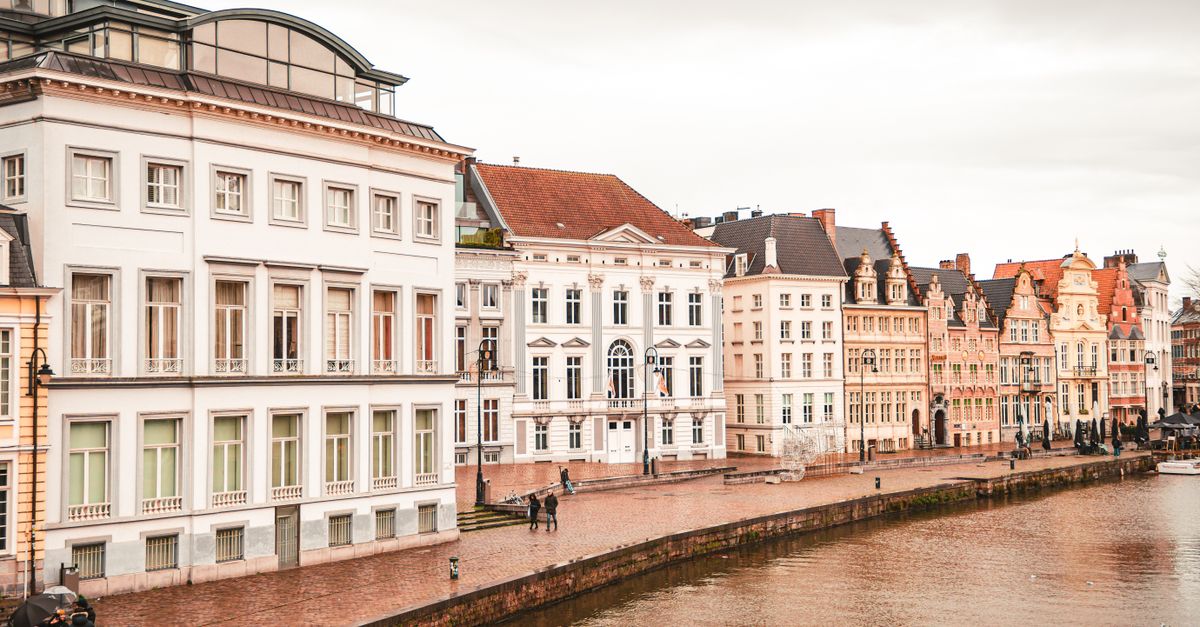
A ten-minute walk north of the cathedral, the Graslei and the Korenlei are the two quays facing each other across the Leie, on the spot where the medieval grain port stood, and together they form the definitive photograph of Ghent. The guild houses lined up there date from the 12th to the 17th centuries, and each facade belonged to a different trade: the free boatmen, the grain measurers, the masons. Sit on the stone steps of the Graslei, which work as the city grandstand, or take the 40-minute boat trip that leaves from the same place for about 10 euros. It is the best way to understand why Ghent was, in the 14th century, one of the largest cities in Europe north of the Alps.
Gravensteen

Five minutes on foot from the Graslei, the Gravensteen is the Castle of the Counts of Flanders, built in 1180 by Philip of Alsace on top of an earlier fortification. It is a real medieval castle, with a moat, curtain wall and keep, wedged into the middle of the modern city, which makes for an unlikely scene of 12th-century stone surrounded by trams and cafés.
The visit takes about 90 minutes and the ticket runs around 13 euros. The included audio guide became famous for being openly comic, narrated by a Belgian comedian, and few people leave without having laughed at something, which is a curious choice for a castle that also holds a collection of torture instruments. Climb to the top of the wall for the view over the Ghent rooftops and the three city towers lined up.
Day 6: Ghent to Antwerp and departure
Grote Markt and the Cathedral of Our Lady

Ghent and Antwerp are about an hour apart by train, and Antwerp is the last stop before the airport: direct trains run from there to Brussels Airport in around 40 minutes, which makes departure day far less tight than it sounds.
The Grote Markt in Antwerp is a triangular square ringed by 16th and 17th-century guild houses, their narrow facades crowned with gilded statues, and in the middle of it the Brabo Fountain, which tells the legend of the giant who charged a toll on the river Scheldt and had his hand cut off. A few steps away stands the Cathedral of Our Lady, the largest Gothic church in the historic Low Countries, with a 123-metre tower that took almost two hundred years to finish. Inside are four Rubens paintings, including the two triptychs of the Descent from the Cross and the Elevation of the Cross, painted for the cathedral itself. Tickets cost about 12 euros and two hours cover the square and the church without rushing.
Antwerpen-Centraal station
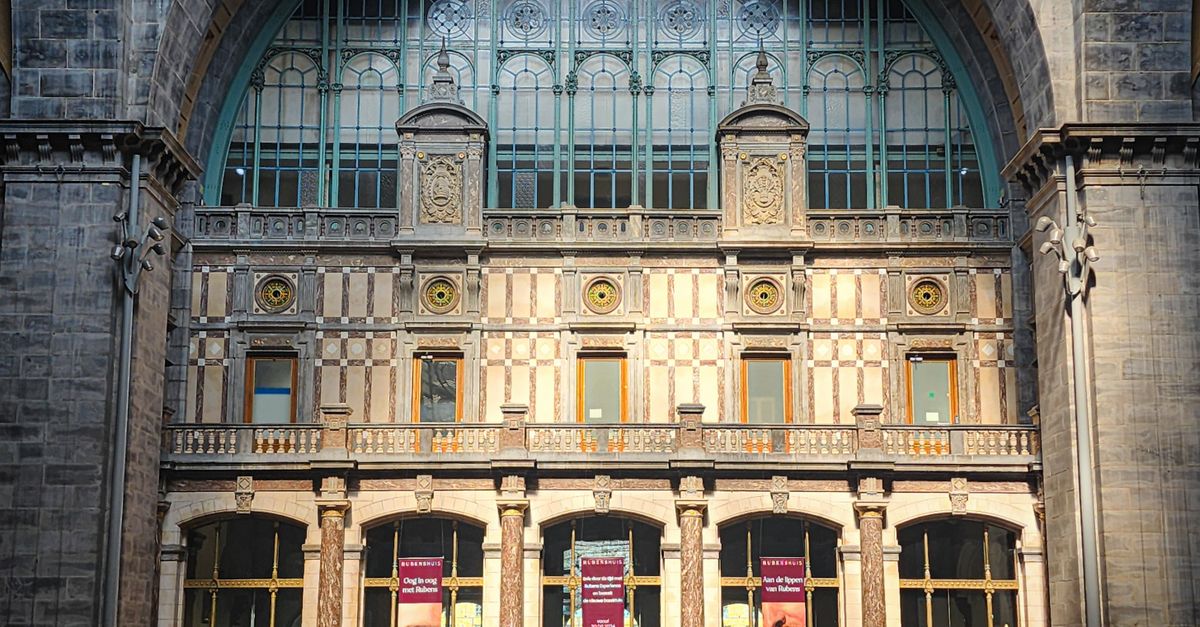
Before catching the train to the airport, set aside twenty minutes for the station itself. Antwerpen-Centraal opened in 1905, designed by Louis Delacenserie, and is known as the railway cathedral: a hall in marble drawn from more than twenty kinds of stone, a 75-metre dome and a glass and iron structure over the platforms. It works on four levels and ranks among the most beautiful stations in the world, which makes it a conveniently placed final postcard, since you are passing through anyway.
Do you need a visa to travel to Belgium?
Most visitors from Brazil and the Americas do not. For tourism you need a valid passport with at least three months of validity beyond the date you plan to leave the Schengen Area. The limit is 90 days in any 180-day period, counted across the whole bloc, not just Belgium.
What changes soon is ETIAS, the European travel authorisation. It is not a visa: it is a 20 euro online registration, valid for three years, that will be required from travellers who currently enter without one. The EU has postponed it more than once, and the current expectation is a transition period from late 2026, when you can still enter without an approved authorisation, becoming a firm requirement during 2027. Check the rule in force close to your travel date, because this calendar has already moved before.
At immigration you may be asked for proof of accommodation, a return ticket and travel insurance. Insurance is not legally required for visa-free entry, but it is asked for often and costs little against the risk.
When is the best time to visit Belgium?
April to June and September are the best windows. Those are the months with long days, temperatures between 12 and 22 degrees and less rain than the rest of the year, plus the daffodils in the Bruges Begijnhof in spring.
July and August bring the warmest weather and the biggest crowds, especially in Bruges, which takes day-trip traffic all year round. Winter is grey and damp, dark from 4.30pm, but December pays off: the Christmas markets in Brussels and Bruges are among the finest in Europe, and the Grand-Place gets a nightly light and sound show.
One specific date worth planning around: in August of even-numbered years the Grand-Place hosts the flower carpet, with almost a million begonias covering the ground for four days.
How to get to Belgium and travel between cities
Since 1 June 2026 LATAM has flown non-stop from São Paulo Guarulhos to Brussels three times a week, on Mondays, Wednesdays and Saturdays, on a Boeing 787-9. It is the only direct link between Brazil and Belgium. Before that the alternative was connecting through Lisbon, Madrid, Paris or Frankfurt and losing half a day.
From Zaventem airport to Gare Centrale is a 17-minute train ride, departing every ten minutes. Between cities everything is solved by rail: Brussels to Bruges takes 1 hour, Bruges to Ghent 25 minutes, Ghent to Antwerp 1 hour, and Antwerp straight to the airport 40 minutes. Tickets cost 10 to 20 euros per leg and, unlike most of Europe, the price does not drop with advance booking, so you can decide on the day and travel without a fixed reservation.
Within the cities you walk. The historic centres of Bruges, Ghent and Antwerp are compact, and in Brussels the metro covers what you cannot walk, with a 7.50 euro day pass.
Language and money. Belgium is trilingual: French in Brussels, Dutch in Bruges, Ghent and Antwerp, and German in a strip to the east. English works anywhere touristic. The currency is the euro and cards are accepted almost everywhere, but carry some cash for public toilets and street friteries.
Where to eat in Belgium: classic dishes and the best restaurants
Belgian food is more interesting than its reputation suggests, and three dishes organise what to try. Moules-frites, mussels cooked in white wine with fries, is the national dish and arrives in portions reaching a kilo. Fries are a Belgian invention, not French, and are eaten from a paper cone at street friteries, with mayonnaise rather than ketchup. And carbonade flamande, beef slow-cooked in dark beer with spiced bread, is the winter dish almost nobody orders and is better than the moules-frites.
In Brussels, Chez Léon on Rue des Bouchers, open since 1893, is the classic address for moules-frites: touristy but honest about what it delivers. Friterie Tabora, steps from the Grand-Place, is one of the most traditional friteries in the city and settles lunch for under 10 euros. For waffles, Maison Dandoy, open since 1829, serves the Brussels one, rectangular and less sweet, and the Liège one, sweeter with caramelised edges: they are different desserts, not versions of the same thing. Avoid the restaurants with laminated menus and a host on the pavement pulling in customers, concentrated on Rue des Bouchers itself.


In Bruges, the food stop worth booking is the De Halve Maan brewery, the last family brewery still working inside the historic centre, five minutes from the Begijnhof. The guided tour costs about 18 euros, includes a Brugse Zot at the end and climbs to a rooftop with a view over the city. The detail that makes the story: in 2016 the brewery built a three-kilometre pipeline under the streets of Bruges to pump beer to its bottling plant, keeping trucks out of the medieval centre.
In Ghent, look for waterzooi, the creamy chicken or fish stew that is the city dish, and cuberdons, cone-shaped purple sweets with a liquid raspberry centre, sold from stalls on the Groentenmarkt. In Antwerp, the local sweet is the handje, a hand-shaped biscuit referring to the Brabo legend, and the city has the highest concentration of artisan chocolate shops in the country.
Are 6 days enough to see Belgium?
They are, comfortably. Belgium covers just over 30,000 square kilometres, smaller than Maryland, and the rail network links everything in under 90 minutes. In six days this itinerary covers the four cities that matter without rushing: two days in Brussels for the Grand-Place, the Atomium and the museums, two in Bruges for the canals, the Belfry and the Begijnhof, one in Ghent and a last one in Antwerp on the way to the airport.
With more time you can stretch to eight days and add Leuven, a university town 20 minutes from Brussels with the most ornate Gothic town hall in the country, or the coast at Ostend. With less, you can cut a night in Bruges and do Ghent as a day trip from Brussels, although sleeping in Bruges after the coach tours leave is one of the best parts of the trip.
Estimated budget per person
Prices checked on 10 September 2026. Check current prices at Atomium · Belfry of Bruges · De Halve Maan.
Frequently asked questions
Do Brazilians need a visa to travel to Belgium?+
No. For tourism of up to 90 days in any 180, a valid passport is enough, with at least three months of validity beyond the planned date of leaving the Schengen Area. ETIAS, the 20 euro electronic authorisation, is expected to enter transition in late 2026 and become a requirement during 2027.
How many days do you need to see Belgium?+
Six days cover Brussels, Bruges, Ghent and Antwerp without rushing, because the cities sit less than 90 minutes apart by train. Four days are enough for Brussels and Bruges, and eight let you add Leuven and the coast at Ostend.
Is there a direct flight from Brazil to Belgium?+
Yes, since 1 June 2026. LATAM flies Guarulhos to Brussels three times a week, on Mondays, Wednesdays and Saturdays, on a Boeing 787-9. It is the only non-stop link between the two countries.
Is it better to sleep in Bruges or do a day trip from Brussels?+
Sleeping in Bruges pays off. The city takes in a lot of day-trip traffic, and after 6pm, once the coaches leave, the historic centre is almost empty. Early morning and evening there are a different experience from visiting only in the middle of the day.
When is the best time to visit Belgium?+
April to June and September, with long days, temperatures between 12 and 22 degrees and less rain. December also pays off for the Christmas markets in Brussels and Bruges, despite the cold and nightfall at 4.30pm.
How much does a 6-day trip to Belgium cost?+
A realistic estimate runs from US$ 1,850 to US$ 2,800 per person, including airfare, five nights in a 3 or 4-star hotel, food, trains between cities and the main attraction tickets.
Ready to go?
Save this itinerary to your Galmund and take the schedule, map and budget with you. Edit, share and track it all on the globe.
Save this itinerary to my GalmundBeen there already?
Pin this trip on your globe and keep your photos where they were taken.
Pin it on my globe